



The LDW (lane departure warning) is a driver-assistance system that monitors the vehicle’s position within the lane and alerts the driver when it detects an unintentional drift out of the current lane.
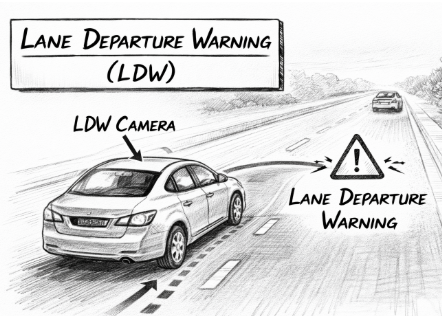
Its core purpose is prevention of lateral departures caused by distraction or drowsiness: it does not “keep” the car centered, but rather warns early when the trajectory is about to cross a lane marking.
The most common sensor is a forward-facing camera (typically mounted behind the windshield near the rear-view mirror) that detects lane markings. In some designs, camera output is fused with vehicle dynamics data to improve robustness.
The software reconstructs lane geometry and computes metrics such as lateral offset, heading angle relative to the lane, and an estimate of time-to-line crossing. If the predicted path crosses a marking without a clear indication of intent, the system triggers an alert.
Distinguishing “unintentional” from “intentional” lane changes is usually based on cues like turn-signal usage, steering rate, and overall dynamics. With the indicator active, warnings are commonly suppressed or the sensitivity is reduced.
Alerts can be audible, visual in the instrument cluster, and/or haptic (steering wheel or seat vibration). Haptic feedback is often effective because it captures attention without requiring the driver to look away from the road.
LDW performs best with clear markings and standard lane layouts; it can degrade in heavy rain, snow, glare, worn paint, construction zones, or temporary/overlapping lines. Tight curves and unusually narrow lanes may also increase false alerts or reduce accuracy.
It’s important to distinguish LDW from LKA (lane keeping assist): LDW warns, while LKA can also apply steering assistance to nudge the vehicle back toward the center. Many modern vehicles combine both functions and share sensors, but with different goals and intervention levels.
From a safety standpoint, LDW brings the most value on highways and rural roads where lane departures can be severe; however, driver supervision remains essential because the system cannot always interpret context (atypical markings, evasive maneuvers, or complex road scenes).
In summary, LDW is a low-intrusiveness active-safety feature that increases driver awareness of unintended lateral drift, helping reduce lane-departure risk within its operating limits.

