



Parking sensors:pros, cons, problems
Parking sensors are low-speed assistance systems that help the driver estimate the distance to obstacles during maneuvers such as parallel parking, reversing, entering a garage, or approaching barriers.
The most common technology is ultrasonic: small transducers integrated into the front and/or rear bumpers emit high-frequency sound pulses and measure the echo return time to calculate the distance to an obstacle. In some architectures, short-range radar sensors or camera-based solutions are also used, but ultrasonics remain the standard due to cost and simplicity.
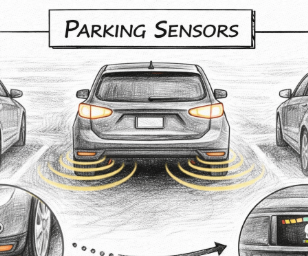
The control unit processes the signals and applies filtering to reduce false detections (heavy rain, dirt, irregular surfaces). The result is presented through audible alerts (beeps that increase in frequency as distance decreases) and often visual cues on the display, with a zone representation and distance bars.
Sensors are organized into “zones” and operate according to driving direction: they typically activate in reverse and, at the front, below a certain speed or when the vehicle detects a maneuver. Some systems also include side detection when exiting a parking space or low-speed cross-traffic functions, if integrated with other sensors.
Performance depends on obstacle characteristics: thin objects (narrow poles), highly absorbent or angled surfaces, and very low obstacles can be harder to detect. Snow, mud, or ice on the transducers can also significantly reduce signal quality and cause false alerts or missed detections.
Calibration includes distance thresholds and sensor “priority” logic to prevent a farther obstacle in one zone from masking a closer one in another zone. In more advanced systems, integration with a camera and on-screen graphics enables a more intuitive reading of remaining space, but correct interpretation by the driver remains essential.
In practical terms, parking sensors improve comfort and reduce low-speed bumps, but they do not guarantee detection in every scenario: moving pedestrians, very low objects, or complex surfaces still require attention and direct visual checks.
In terms of reliability and maintenance, the most frequent issues involve damaged transducers, bumper wiring, oxidized connectors, and impacts that misalign the sensors. The vehicle often reports the fault and disables the assistance or limits it to degraded modes.
In summary, parking sensors are a proximity ADAS (Advanced Driver Assistance Systems) based primarily on ultrasonics, effective at providing distance cues during maneuvers. They perform best with clean sensors, obstacles that are acoustically “visible,” and combined use with mirrors and a camera—while always maintaining driver supervision.

