



BLIS (Blind Spot Information System): pros, cons, problems
The BLIS (blind spot information system) is an ADAS feature that monitors the lateral and rear-lateral areas not directly visible in the mirrors, with the goal of reducing collision risk during lane changes and overtaking.
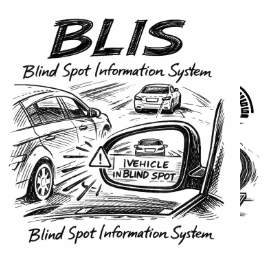
The operating concept is blind-spot surveillance: an area that varies with vehicle geometry, mirror adjustment, and driver seating position. BLIS does not eliminate the need for visual checks, but it provides additional information when another vehicle is in a critical region.
The most common technology is short-/mid-range radar mounted in the rear bumper (one per side), oriented to cover the adjacent lane and part of the rear zone. In some implementations—especially on vehicles with extensive camera suites—the function can also be supported by camera and sensor fusion, but radar remains dominant due to robustness in darkness and light rain.
The system estimates the presence and often the dynamics of an object (relative speed and trajectory) and applies “relevance” criteria to avoid unnecessary alerts, for example by ignoring stationary objects out of context or very distant vehicles. Some BLIS implementations use thresholds that depend on vehicle speed and the speed difference to the target.
The typical interface includes a warning indicator on the mirror or A-pillar that signals a vehicle in the blind spot. If the driver activates the turn signal toward the occupied side, the system may trigger an enhanced audible or haptic warning, because the maneuver is interpreted as an imminent lane change.
Many manufacturers integrate BLIS with rear cross-traffic alert: when reversing out of a parking space, the side sensors can detect vehicles approaching crosswise and warn the driver. The same sensor set can also support lane-change assistance functions with corrective steering intervention (in that case it moves into LCA/LKA territory, depending on the brand’s naming).
Operational limits depend on installation and scenario: tight curves, guardrails, motorcycles with a smaller radar signature, very fast-approaching vehicles, and bumper contamination (dirt/snow) can reduce reliability. Dense traffic can also produce near-continuous indications, requiring a well-calibrated HMI to avoid increasing cognitive load.
From a safety perspective, the main benefit is reducing unsafe lane-change crashes, especially on highways and during overtakes. However, BLIS does not replace good practice: mirror checks, shoulder checks, proper spacing, and correct use of turn indicators.
From a maintenance standpoint, rear-bumper impacts, replacements, or repainting may require radar recalibration. A fault is often indicated on the instrument cluster and can lead to function disablement or degraded modes.
In summary, BLIS is a radar-dominated lateral surveillance technology that provides targeted warnings to increase driver awareness during lane changes. It performs best when sensors and bumper surfaces are clean, calibration is correct, and it is used together with direct visual checks.

