



ESP (Electronic Stability Control):pros, cons, problems
The ESP (Electronic Stability Control) is an active-safety system that helps keep the vehicle on the intended path when it starts to lose stability, using selective intervention on brakes and engine torque to correct skids and lateral drift.
The key concept is the comparison between the trajectory “requested” by the driver and the vehicle’s “actual” trajectory. The request is estimated mainly from steering angle and speed, while the real trajectory is measured through sensors such as yaw rate, lateral acceleration, and wheel speeds.
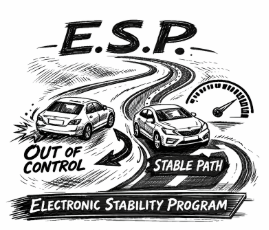
The ESP control unit computes a reference model (how much the vehicle “should” yaw at a given steering angle and speed) and compares it with the observed behavior. If the deviation exceeds calibrated thresholds, the system identifies a condition of understeer or oversteer.
In understeer (the car runs wide), ESP can selectively brake an inner rear wheel and/or manage torque to increase yaw moment and help the vehicle tighten its line. In oversteer (the rear end starts to step out), it typically brakes the outer front wheel to generate a corrective moment that stabilizes the vehicle.
The intervention is not simply “on/off”: it is modulated in intensity and duration and works in close integration with ABS and TCS, sharing sensors and the same hydraulic modulator. In practice, ESP leverages ABS’s ability to modulate brake pressure at each wheel, but with the goal of lateral stability rather than only preventing lock-up.
In modern vehicles, ESP often includes additional functions such as trailer stability control, cornering brake control, roll mitigation, and strategies tailored to low-grip surfaces. Drive modes may shift thresholds and aggressiveness, but there is almost always a baseline layer of protection that cannot be fully disabled.
The benefits are especially relevant during sudden maneuvers, emergency avoidance, and variable-grip conditions (split-μ), where even experienced drivers can exceed the limit. By reducing uncontrolled lateral energy, ESP lowers the likelihood of spin-outs and run-off-road events.
However, there are physical limits: if available grip is too low or speed is too high, no electronic control can “create” traction. In addition, worn tires, incorrect alignment/suspension setup, or abnormal loading reduce the system’s effective operating window.
From an operational standpoint, when ESP intervenes the driver may feel pulsing braking on an individual wheel, power reduction, or a flashing indicator lamp. In those situations, the correct approach is to keep inputs smooth, avoid excessive countersteer, and allow the system to stabilize the dynamics rather than disabling it in critical conditions.
In summary, ESP is one of the most effective systems for preventing loss of control: it integrates dynamic sensing and brake/engine actuation to bring the vehicle back toward a trajectory consistent with the driver’s intent, within the limits imposed by physics and available grip.

