

Olio di limone
Media gradimento : 7
| Valutazione | N. Esperti | Valutazione | N. Esperti |
|---|---|---|---|
| 1 | 6 | ||
| 2 | 7 | ||
| 3 | 8 | ||
| 4 | 9 | ||
| 5 | 10 |
10 pt da FCS777
| Iscriviti per poter valutare questo oggetto, le sue recensioni e per contribuire a Tiiips.Valuta | Dove si trova? |
| "Olio di limone studi" su Olio di limone Consenso relazione 10 di FCS777 (5544 pt) | 25-set-2022 11:20 |
| Leggi il Tiiip completo | (Invia il tuo commento) |
Compendio degli studi più significativi con riferimento a proprietà, assunzione, effetti.
Dugo P, Ragonese C, Russo M, Sciarrone D, Santi L, Cotroneo A, Mondello L. Sicilian lemon oil: Composition of volatile and oxygen heterocyclic fractions and enantiomeric distribution of volatile components. J Sep Sci. 2010 Nov;33(21):3374-85. doi: 10.1002/jssc.201000578.
Abstract. A total of 92 samples of Sicilian lemon oils (Citrus limon (L.) Burm. f.) produced from September 2008 to June 2009, industrially cold-pressed by different extraction techniques (Brown Oil Extractor and Food Machinery Corporation), were analyzed by GC-flame ionization detector (FID) and GC/MS-LRI to investigate the volatile fraction; by RP-HPLC/PDA to determine the non-volatile components and by enantio-GC-FID to determine the enantiomeric ratios of 12 volatile components. This study provides a detailed investigation on the composition of Sicilian lemon essential oils industrially produced during a productive season, with the aim to recognize quality parameters for the characterization of this product. The results obtained are discussed to evaluate seasonal variation, influence of the extraction techniques, and are compared with those obtained for samples produced during different seasons.
Mehl F, Marti G, Boccard J, Debrus B, Merle P, Delort E, Baroux L, Raymo V, Velazco MI, Sommer H, Wolfender JL, Rudaz S. Differentiation of lemon essential oil based on volatile and non-volatile fractions with various analytical techniques: a metabolomic approach. Food Chem. 2014 Jan 15;143:325-35. doi: 10.1016/j.foodchem.2013.07.125.
Abstract. Due to the importance of citrus lemon oil for the industry, fast and reliable analytical methods that allow the authentication and/or classification of such oil, using the origin of production or extraction process, are necessary. To evaluate the potential of volatile and non-volatile fractions for classification purposes, volatile compounds of cold-pressed lemon oils were analyzed, using GC-FID/MS and FT-MIR, while the non-volatile residues were studied, using FT-MIR, (1)H-NMR and UHPLC-TOF-MS. 64 Lemon oil samples from Argentina, Spain and Italy were considered. ...Copyright © 2013 Elsevier Ltd.
Valgimigli L, Gabbanini S, Berlini E, Lucchi E, Beltramini C, Bertarelli YL. Lemon (Citrus limon, Burm.f.) essential oil enhances the trans-epidermal release of lipid-(A, E) and water-(B6, C) soluble vitamins from topical emulsions in reconstructed human epidermis. Int J Cosmet Sci. 2012 Aug;34(4):347-56. doi: 10.1111/j.1468-2494.2012.00725.x.

Abstract. Topical bioavailability of lipid- and water-soluble vitamins is a critical issue for protecting or anti-ageing formulations. Using 17-day-old SkinEthic(®) reconstructed human epidermis, we investigated (at 34°C) the role of lemon EO in enhancing the penetration of α-tocopherol (E) and retinyl acetate (A), pyridoxine (B(6)) and ascorbic acid (C), released from O/W or W/O emulsions. ...© 2012 The Authors. ICS © 2012 Society of Cosmetic Scientists and the Société Française de Cosmétologie.
EFSA Panel on Additives and Products or Substances used in Animal Feed (FEEDAP), Bampidis V, Azimonti G, Bastos ML, Christensen H, Kouba M, Fašmon Durjava M, López-Alonso M, López Puente S, Marcon F, Mayo B, Pechová A, Petkova M, Ramos F, Sanz Y, Villa RE, Woutersen R, Brantom P, Chesson A, Westendorf J, Galobart J, Manini P, Pizzo F, Dusemund B. Safety and efficacy of feed additives consisting of expressed lemon oil and its fractions from Citrus limon (L.) Osbeck and of lime oil from Citrus aurantiifolia (Christm.) Swingle for use in all animal species (FEFANA asbl). EFSA J. 2021 Apr 30;19(4):e06548. doi: 10.2903/j.efsa.2021.6548.
Abstract. Following a request from the European Commission, the EFSA Panel on Additives and Products or Substances used in Animal Feed (FEEDAP) was asked to deliver a scientific opinion on the safety and efficacy of expressed lemon oil and distilled lemon oil from Citrus limon (L.) Osbeck and lime oil from Citrus aurantiifolia (Christm.) Swingle, when used as sensory additives in feed for all animal species. The use of the expressed lemon oil and its residual fraction and the use of lime oil in feed is not expected to increase the exposure to furocoumarins and methoxycoumarins and perillaldehyde of those target species that are already fed citrus by-products a relevant extent (< 10%). For companion animals and ornamental fish not normally exposed to citrus by-products, no conclusion can be drawn. For the other species and for the distilled fraction of expressed lemon oil, the FEEDAP Panel concludes that the additives under assessment are safe at the maximum proposed or at reduced use levels in complete feed. The Panel considers that the use in water for drinking is safe provided that the total daily intake of the additive does not exceed the daily amount that is considered safe when consumed via feed. No concerns for consumer safety were identified following the use of the additives at the maximum proposed use level in feed. The additives under assessment should be considered as irritants to skin and eyes and the respiratory tract and as skin sensitisers. Since expressed lemon oil and its fractions contain furocoumarins, they may cause phototoxicity. The use of the additives under the proposed conditions of use in animal feed is not expected to pose a risk for the environment. Since C. limon and C. aurantiifolia and their preparations are recognised to flavour food and its function in feed would be essentially the same as that in food, no further demonstration of efficacy is considered necessary. © 2021 European Food Safety Authority.
Giatropoulos A, Papachristos DP, Kimbaris A, Koliopoulos G, Polissiou MG, Emmanouel N, Michaelakis A. Evaluation of bioefficacy of three Citrus essential oils against the dengue vector Aedes albopictus (Diptera: Culicidae) in correlation to their components enantiomeric distribution. Parasitol Res. 2012 Dec;111(6):2253-63. doi: 10.1007/s00436-012-3074-8.

Abstract. Laboratory experiments were conducted to study the bioefficacy against Ae. albopictus of three Citrus essential oils, derived from peels of Citrus sinensis, Citrus limon, and Citrus paradise and of their components. Chiral gas chromatography analysis revealed the dominant occurrence of R-(+)-limonene and (-)-β-pinene in all three essential oils while in the case of lemon oil γ-terpinene, neral, and geranial detected also among other components. The tested Citrus essential oils were toxic against mosquito larvae with LC(50) values ranging from 25.03 to 37.03 mg l(-1). Among citrus essential oils components tested, γ-terpinene was the most toxic (LC(50) = 20.21 mg l(-1)) followed by both enantiomeric forms of limonene (LC(50) = 35.99 and 34.89 mg l(-1), for R-(+)-limonene and S-(-)-limonene, respectively). The delayed toxic effects after exposure of larvae to sublethal (LC(50)) doses were also investigated for citrus essential oils and their major component R-(+)-limonene, indicating a significant reduction of pupal survival. In repellent bioassays, lemon essential oil, S-(-)-limonene, citral (mixture of neral\geranial) and (+)-β-pinene were the most effective compared with other citrus essential oils and components against adult mosquitoes. Repellent bioassays also revealed that limonenes and β-pinenes showed an isomer dependence repellent activity. Finally, according to enantiomeric distribution of limonene and α- and β-pinene, the repellency of lemon essential oil is possibly attributed to the presence of citral.
Rao J, McClements DJ. Impact of lemon oil composition on formation and stability of model food and beverage emulsions. Food Chem. 2012 Sep 15;134(2):749-57. doi: 10.1016/j.foodchem.2012.02.174.
Abstract. Lemon oil is a complex organic compound isolated from citrus peel, which is commonly used as a flavouring agent in beverages, foods, cosmetics, and household products. We have studied the influence of lemon oil fold (1×, 3×, 5× and 10×) on the formation and properties of oil-in-water emulsions. Initially, the composition, molecular characteristics, and physicochemical properties of the four lemon oils were established....Copyright © 2012 Elsevier Ltd.
| Iscriviti per poter valutare questo oggetto, le sue recensioni e per contribuire a Tiiips.ValutaChiudi | (0 commenti) |
| "Descrizione" su Olio di limone Consenso relazione 10 di FCS777 (5544 pt) | 25-set-2022 11:26 |
| Leggi il Tiiip completo | (Invia il tuo commento) |
Il limone ( Citrus limon), nasce dall'albero perenne sempreverde appartenente alla famiglia delle Rutaceae, ha avuto probabilmente le sue origini nell'Asia del sud-est ed è stato importato nelle regioni del Mediterraneo intorno al 300 aC.
Con tutta probabilità venne introdotto, tramite gli Ebrei che ne curavano la coltivazione, in Calabria, ad Amalfi e sul Lago di Garda.

Specie più diffuse :
Due cultivar locali di Citrus medica L. sono coltivate in Costiera Amalfitana: C. medica cv. 'Liscia', conosciuto con il nome volgare di 'cedro', e C. medica cv. 'rugosa', noto come 'ponsino'. Questi due cultivar hanno contribuito alla biodiversità agricola di questa zona, così come altre specie di agrumi . Tuttavia, la loro diffusione è in diminuzione, a causa delle difficoltà tecniche per la loro coltivazione (1).
La composizione chimica del limone comprende soprattutto acido citrico e Limonene. L'acido citrico nel succo di limone è utile nella gestione medica dell'urolitiasi da calcio.
Il succo di limone contiene flavonoidi, componenti estremamente utili alla difesa immunitaria del corpo umano e a contrastare quindi le malattie degenerative come il cancro. In particolare Rutina, Quercetin, Neoeriocitrin (2).

Contiene anche una grande quantità di vitamina C , uno degli antiossidanti più importanti che si trovano in natura ed elemento di contrasto ai radicali liberi che sono la causa dell'invecchiamento e di molte malattie legate al processo di ossidazione delle cellule. Tuttavia, il frutto che contiene la maggior quantità di vitamina C è il kiwi.
Una spremuta di limoni, si sa è un rimedio contro il raffreddore e le malattie influenzali e da raffreddamento.
Funge anche da protettore contro l'artrite reumatoide.
Sono preferibili i limoni a buccia sottile in quanto hanno più succo.
Al limone sono stare riconosciute da studi scientifici attività antimicrobica sia in forma di nanoemulsioni in olio essenziale che in forma di puro succo di olio essenziale (3).
Tra i vari componenti fenolici presenti nella buccia del limone, l'Eriocitrin, per le sue proprietà di antinvecchiamento è stato oggetto di studi specifici in ratti (4).

L'estratto di limone ha anche dimostrato un'attività antimicrobica contro alcuni batteri quali Pseudomonas aeruginosa e Klebsiella pneumoniae (5).
L'olio essenziale del limone è utilizzato in alimentazione, cosmetica e farmaceutica per le sue attività antimicrobiche ed antiossidanti. La fase acquosa di questo olio viene estratta con diversi processi chimici, ad esempio con diclorometano, essiccata con solfato di sodio anidro ed il solvente è successivamente eliminato con distillazione a bassa pressione. In genere viene utilizzata la spremitura a freddo. Nella Farmacopea europea 10.0 (PhEur, 2020) è definito come l'olio essenziale ottenuto con un'idonea procedura meccanica senza riscaldamento dalla buccia fresca di Citrus limon (L.).
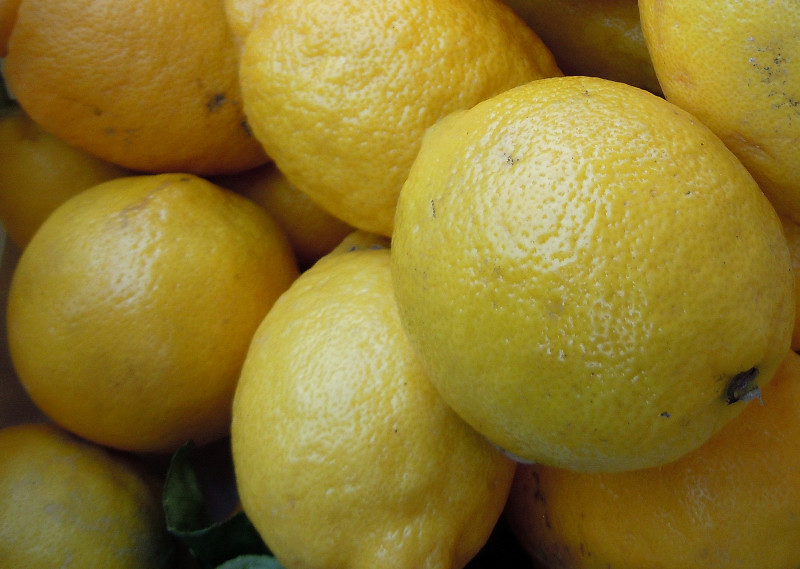
Si presenta in forma di liquido giallo trasparente.

A cosa serve e dove si usa
Alimentazione
L'olio di limone è aggiunto in prodotti alimentari sia come fragranza che come conservante.
Cosmetica
E' una materia prima cosmetica che mantiene la pelle umida e fornisce una certa levigatezza ed elasticità alla pelle per le sue caratteristiche antiossidanti. Utilizzato nei massaggi per perdita di peso, nei bagni rilassanti, aumenta la lucentezza dei capelli e provvede allo loro lubrificazione.
Farmaceutica
Viene inserito in formule farmaceutiche come agente antibatterico.
Bibliografia______________________________________________________________
(1) Aliberti L, Caputo L, De Feo V, De Martino L, Nazzaro F, Souza LF. Chemical Composition and in Vitro Antimicrobial, Cytotoxic, and Central Nervous System Activities of the Essential Oils of Citrus medica L. cv. 'Liscia' and C. medica cv. 'Rugosa' Cultivated in Southern Italy. Molecules. 2016 Sep 18;21(9):1244. doi: 10.3390/molecules21091244.
(2) Ledesma-Escobar CA, Priego-Capote F, Luque de Castro MD. Comparative Study of the Effect of Sample Pretreatment and Extraction on the Determination of Flavonoids from Lemon (Citrus limon). PLoS One. 2016 Jan 25;11(1):e0148056. doi: 10.1371/journal.pone.0148056.
(3) Yazgan H, Ozogul Y, Kuley E. Antimicrobial influence of nanoemulsified lemon essential oil and pure lemon essential oil on food-borne pathogens and fish spoilage bacteria. Int J Food Microbiol. 2019 Oct 2;306:108266. doi: 10.1016/j.ijfoodmicro.2019.108266.
(4) Shimizu C, Wakita Y, Inoue T, Hiramitsu M, Okada M, Mitani Y, Segawa S, Tsuchiya Y, Nabeshima T. Effects of lifelong intake of lemon polyphenols on aging and intestinal microbiome in the senescence-accelerated mouse prone 1 (SAMP1). Sci Rep. 2019 Mar 6;9(1):3671. doi: 10.1038/s41598-019-40253-x.
(5) Liya SJ, Siddique R. Determination of Antimicrobial Activity of Some Commercial Fruit (Apple, Papaya, Lemon and Strawberry) Against Bacteria Causing Urinary Tract Infection. Eur J Microbiol Immunol (Bp). 2018 Aug 16;8(3):95-99. doi: 10.1556/1886.2018.00014.
| Iscriviti per poter valutare questo oggetto, le sue recensioni e per contribuire a Tiiips.ValutaChiudi | (0 commenti) |
Leggi altri Tiiips su questo oggetto in Inglese (2)
Tipologia:   Natural Principali sostanze contenute:   Ultimo aggiornamento:   2022-10-13 21:37:14 | Rischio chimico:   |

