

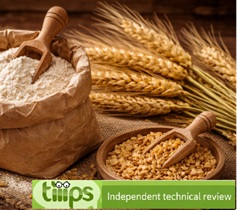
Khorasan KAMUT flour
Rating : 8.8
| Evaluation | N. Experts | Evaluation | N. Experts |
|---|---|---|---|
| 1 | 6 | ||
| 2 | 7 | ||
| 3 | 8 | ||
| 4 | 9 | ||
| 5 | 10 |
Pros:
Antidiabetic (1) Antioxidant (1)Cons:
Contains gluten (1)10 pts from Fillp
| Sign up to vote this object, vote his reviews and to contribute to Tiiips.Evaluate | Where is this found? |
| "Khorasan KAMUT® studies" about Khorasan KAMUT flour Review Consensus 8 by Fillp (3336 pt) | 2019-Jul-27 17:38 |
| Read the full Tiiip | (Send your comment) |
Flavoring Production in Kamut®, Quinoa and Wheat Doughs Fermented by Lactobacillus paracasei, Lactobacillus plantarum, and Lactobacillus brevis: A SPME-GC/MS Study.
Di Renzo T, Reale A, Boscaino F, Messia MC.
Front Microbiol. 2018 Mar 9;9:429. doi: 10.3389/fmicb.2018.00429.
Metabolomic approach to study the impact of flour type and fermentation process on volatile profile of bakery products.
Saa DLT, Nissen L, Gianotti A.
Food Res Int. 2019 May;119:510-516. doi: 10.1016/j.foodres.2019.01.024.
Short-Term Hemodynamic Effects of Modern Wheat Products Substitution in Diet with Ancient Wheat Products: A Cross-Over, Randomized Clinical Trial.
Cicero AFG, Fogacci F, Veronesi M, Grandi E, Dinelli G, Hrelia S, Borghi C.
Nutrients. 2018 Nov 4;10(11). pii: E1666. doi: 10.3390/nu10111666.
Health benefits of ancient grains. Comparison among bread made with ancient, heritage and modern grain flours in human cultured cells.
Valli V, Taccari A, Di Nunzio M, Danesi F, Bordoni A.
Food Res Int. 2018 May;107:206-215. doi: 10.1016/j.foodres.2018.02.032.
Do ancient types of wheat have health benefits compared with modern bread wheat?
Shewry PR.
J Cereal Sci. 2018 Jan;79:469-476. doi: 10.1016/j.jcs.2017.11.010. Review.
Prebiotic effect of soluble fibres from modern and old durum-type wheat varieties on Lactobacillus and Bifidobacterium strains.
Marotti I, Bregola V, Aloisio I, Di Gioia D, Bosi S, Di Silvestro R, Quinn R, Dinelli G.
J Sci Food Agric. 2012 Aug 15;92(10):2133-40. doi: 10.1002/jsfa.5597
Immunogenicity characterization of two ancient wheat α-gliadin peptides related to coeliac disease.
Gregorini A, Colomba M, Ellis HJ, Ciclitira PJ.
Nutrients. 2009 Feb;1(2):276-90. doi: 10.3390/nu1020276.
| Sign up to vote this object, vote his reviews and to contribute to Tiiips.EvaluateClose | (0 comments) |
| "Descrizione" about Khorasan KAMUT flour Review Consensus 10 by Fillp (3336 pt) | 2026-Feb-10 19:42 |
| Read the full Tiiip | (Send your comment) |
Khorasan wheat flour KAMUT®
Khorasan wheat flour KAMUT® is obtained by milling a specific cultivar of Triticum turgidum subsp. turanicum (Khorasan wheat). In practice, “KAMUT®” is not the generic name of the cereal, but a registered trademark associated with defined production and supply-chain criteria. KAMUT International.
From a sensorial standpoint, the flour often shows nutty and slightly sweet notes, with good performance in doughs aiming for structure and “ancient grain” aromaticity (depending on the extraction rate).

Definition
The raw material is Khorasan wheat; the KAMUT® wording identifies a commercial and specification system (not a different species). The brand’s commercial history began in the United States in the mid-20th century, with cultivation scaling in the Great Plains (Montana area) and later expansion in “ancient grain” and specialty bakery channels.
In food formulations, the flour behaves in some technological aspects like a “durum/tetraploid” wheat flour, but with variability depending on milling grade, protein content, and gluten quality.
Main uses
Food.
Used as an alternative to, or blended with, common soft/durum wheat flours for bread, pizza, focaccia, cookies, crackers, and baked goods. It is also used in fresh pasta doughs and in whole-grain recipes when an integral version is available.
Industrial use.
Industrial food applications (bakery, snacks, premixes, specialty flours) where a distinctive sensorial profile and an “ancient grain” positioning are desired.
Nutrition and health
Khorasan wheat flour KAMUT® is often positioned for a profile that includes a good protein fraction and an interesting content of minerals and B Vitamine (especially thiamin and niacin), with contributions also from magnesium, phosphorus, zinc, and selenium, depending on grade and processing.
From the perspective of clinical studies, some “substitution” diets based on Khorasan wheat products (compared with modern wheat) have been associated, in specific experimental contexts, with favorable changes in certain cardio-metabolic markers. These results should be interpreted cautiously: portion size, the overall dietary pattern, the level of refining, and—most importantly—the real comparability of the tested products (recipes, fiber, processes) matter.
Safety (allergens) and contraindications
Allergen. Contains gluten (wheat): not suitable for celiac disease and gluten-free diets.
Contraindications (brief). In case of diagnosed celiac disease or non-celiac gluten sensitivity, avoid. In case of wheat allergy, avoid.
Storage and shelf-life
Store in a cool, dry place, away from light and heat sources. Close tightly to limit moisture uptake and contamination. Shelf-life depends on refining level (whole-grain tends to be more sensitive due to the lipid fraction of the germ) and on barrier packaging.
Labelling
“KAMUT®” is a trademark: on label it should be used in compliance with the owner’s rules and with the correct ingredient denomination (Khorasan wheat flour). For nutrition claims (e.g., “source of fiber”, “source of protein”), applicable thresholds and conditions depend on the market of sale.
Troubleshooting
Dough not very extensible or difficult to handle. Adjust hydration and rest times; consider blends with other flours to modulate strength and workability.
Dense crumb or limited rise. Check fermentation, flour strength, percentage of this flour in the recipe, and refining level; optimize mixing and bulk proof.
Perceived rancidity (oxidized notes). More likely in whole-grain flours or poorly stored flour; improve packaging, stock rotation, and storage conditions.
Identification data and specifications
| Characteristic | Value |
|---|---|
| Denomination | Khorasan wheat flour KAMUT® |
| Botanical species | Triticum turgidum subsp. turanicum |
| Nature | milled flour (not an additive) |
| Flour vs semolina | flour is finer; semolina is coarser/more granular |
| Commercial-origin note | brand associated with the owner’s cultivation/supply-chain specifications |
Physico-chemical and nutritional properties (indicative)
| Characteristic | Indicative value | Note |
|---|---|---|
| Energy | ~335–345 kcal/100 g | varies by grade and supplier |
| Protein | ~14–15 g/100 g | depends on batch and extraction |
| Carbohydrates | ~67–71 g/100 g | include starch and a fiber fraction |
| Lipids | ~1–4 g/100 g | low fraction; includes PUFA (polyunsaturated fatty acids; note: generally favorable within dietary balance) and MUFA |
| Fiber | variable | higher in whole-grain versions |
| Color and aroma | golden-yellow, nutty notes | depends on extraction and freshness |
Conclusion
Khorasan wheat flour KAMUT® is a tetraploid wheat flour with a commercial identity linked to a trademark, appreciated for its sensorial profile and “ancient grain” positioning. In baking and bakery it can deliver interesting results, but it requires attention to hydration, timings, and blends to optimize workability and volume. From a safety standpoint, it remains a wheat flour: contains gluten.
Mini-glossary
PUFA. Polyunsaturated fatty acids. Note: generally associated with favorable lipid profiles, but absolute amounts (here low) and overall dietary balance matter.
MUFA. Monounsaturated fatty acids. Note: often considered favorable within a balanced diet.
Extraction rate. Degree of separation of grain fractions during milling. Note: more whole-grain = more fiber and micronutrients, but higher oxidative sensitivity.
Gluten. Wheat protein complex responsible for dough structure. Note: contraindicated in celiac disease.
Studies
In particular, it may be suitable to counteract certain risks of the cardiovascular system (1).
This study highlights several aspects that support its benefits (2).
The action of antioxidant peptides inhibits lipid peroxidation (3) has also been established.
This interesting study provides evidence that a substitution diet with KAMUT® khorasan wheat products can reduce some markers associated to the development of type-2 diabetes compared to a diet of modern wheat (4).
References______________________________________________
(1) Sofi F, Whittaker A, Cesari F, Gori AM, Fiorillo C, Becatti M, Marotti I, Dinelli G, Casini A, Abbate R, Gensini GF, Benedettelli S. Characterization of Khorasan wheat (Kamut) and impact of a replacement diet on cardiovascular risk factors: cross-over dietary intervention study. Eur J Clin Nutr. 2013 Feb;67(2):190-5. doi: 10.1038/ejcn.2012.206.
Abstract. Background/objectives: Khorasan wheat (Kamut) is an ancient grain with widely acclaimed beneficial effects on human health. The objective was to characterise Kamut and to examine the effect of a replacement diet with their products on cardiovascular risk parameters. Subjects/methods: We conducted a randomized, single-blinded cross-over trial with two intervention phases on 22 healthy subjects (14 females; 8 males). The participants were assigned to consume products (bread, pasta and crackers) made either from Kamut or control semi-whole-grain wheat for 8 weeks in a random order. An 8-week washout period was implemented between the interventions. Laboratory analyses were performed both at the beginning and at the end of each intervention phase. Results: At a general linear model for repeated measurements adjusted for several confounders, consumption of Kamut products showed a significant reduction of metabolic risk factors such as total cholesterol (mean reduction: -8.46 mg/dl; -4%), low-density lipoprotein cholesterol (-9.82 mg/dl; -7.8%) and blood glucose. Similarly, redox status was significantly improved only after the Kamut intervention phase, as measured by a reduction in both thiobarbituric acid reactive substances (-0.17 nmol/ml; -21.5%;) and carbonyl levels (-0.16 nmol/ml; -17.6%). The replacement diet with Kamut products also resulted in a significant increase of serum potassium and magnesium. Circulating levels of key pro-inflammatory cytokines (interleukin (IL)-6, IL-12, tumour necrosis factor-α and vascular endothelial growth factor) were significantly reduced after the consumption of Kamut products. Conclusions: The present results suggest that a replacement diet with Kamut products could be effective in reducing metabolic risk factors, markers of both oxidative stress and inflammatory status.
(2) Bordoni A, Danesi F, Di Nunzio M, Taccari A, Valli V. Ancient wheat and health: a legend or the reality? A review on KAMUT khorasan wheat. Int J Food Sci Nutr. 2017 May;68(3):278-286. doi: 10.1080/09637486.2016.1247434.
Abstract. After WWII, the industrialized agriculture selected modern varieties of Triticum turgidum spp. durum and spp. aestivum (durum wheat and common wheat) based on higher yields and technological characteristics. Nowadays, the use of whole ancient grains and pseudo cereals is considered nutritionally important. How ancient grains have positive effects is not entirely known, the fragmentation of the scientific knowledge being also related to the fact that ancient grains are not a homogeneous category. The KAMUT® trademark indicates a specific and ancient variety of grain (Triticum turgidum ssp. turanicum, commonly khorasan wheat), and guarantees certain attributes making studies sufficiently comparable. In this work, studies on KAMUT® khorasan wheat have been systematically reviewed, evidencing different aspects supporting its benefits. Although it is not possible to establish whether all ancient grains share these positive characteristics, in total or in part, this review provides further evidences supporting the consumption of ancient grains.
(3) Babini E, Tagliazucchi D, Martini S, Dei Più L, Gianotti A. LC-ESI-QTOF-MS identification of novel antioxidant peptides obtained by enzymatic and microbial hydrolysis of vegetable proteins. Food Chem. 2017 Aug 1;228:186-196. doi: 10.1016/j.foodchem.2017.01.143.
(4) Trozzi C, Raffaelli F, Vignini A, Nanetti L, Gesuita R, Mazzanti L. Evaluation of antioxidative and diabetes-preventive properties of an ancient grain, KAMUT® khorasan wheat, in healthy volunteers. Eur J Nutr. 2019 Feb;58(1):151-161. doi: 10.1007/s00394-017-1579-8.
Abstract. Purpose: Recently, there was an increasing interest on the use of ancient grains because of their better health-related composition. The aim of this study was to evaluate in healthy human subjects the antioxidative and diabetes-preventive properties of ancient KAMUT® khorasan wheat compared to modern wheat. Methods: The study was a randomized, non-blind, parallel arm study where the biochemical parameters of volunteers with a diet based on organic whole grain KAMUT® khorasan products, as the only source of cereal products were compared to a similar replacement diet based on organic whole grain modern durum wheat products. A total of 30 healthy volunteers were recruited and the intervention period lasted 16 weeks. Blood analyses were performed before and after the diet intervention. The effect of KAMUT® khorasan products on biochemical parameters was analyzed by multiple quantile regression adjusted for age, sex, physical activity and BMI compared to data at baseline. Results: Subjects receiving KAMUT® khorasan products showed a significantly greater decrease of fat mass (b = 3.7%; CI 1.6-5.5; p = 0.042), insulin (b = 2.4 µU/ml; CI 0.2-4.2; p = 0.036) and a significant increase of DHA (b = - 0.52%; CI - 1.1 to - 0.12; p = 0.021). Conclusions: Our study provides evidence that a substitution diet with KAMUT® khorasan wheat products can reduce some markers associated to the development of type-2 diabetes compared to a diet of modern wheat.
| Sign up to vote this object, vote his reviews and to contribute to Tiiips.EvaluateClose | (0 comments) |
Read other Tiiips about this object in __Italiano (2)
Content:   Last update:   2025-09-08 18:05:30 | Kcal/100g:   337 Family:   Threat factors:   |

