

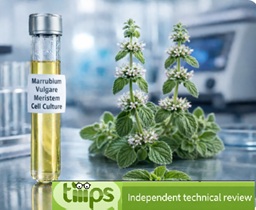
Marrubium vulgare meristem cell culture: properties, uses, pros, cons, safety
Marrubium vulgare meristem cell culture is a cosmetic raw material obtained from meristematic cells (the plant’s “formative” tissue) of Marrubium vulgare L. (family Lamiaceae, historical synonym Labiatae) grown in vitro under sterile, controlled conditions. In formulation it is mainly used with an skin protecting function, typically positioned as a “cell culture / biotech botanical” ingredient intended to support the skin against external aggressors (urban exposome, environmental oxidative stress), depending on the supplier’s dossier.

For more information: White horehound
Definition
The term “meristem cell culture” indicates a suspension (or an equivalent preparation) containing meristematic cells cultivated in the laboratory. Compared with a field-harvested botanical extract, meristem culture aims to improve repeatability and control of the raw material (reduced seasonal variability), although the final composition still depends significantly on culture medium, operating conditions, and any standardization approach.
Production process and key constituents
How it is produced (in brief)
A typical industrial process includes: starting sterile cultures from meristem tissue, growth in bioreactors or culture systems, harvesting the biomass/suspension, optional processing to make constituents available (for example extraction/filtration or homogenization, depending on the commercial grade), followed by standardization and stabilization in the carrier (often aqueous and/or glycerin-based), with microbiological control and traceability.
Key constituents (representative, by category)
Phenylpropanoids/phenylethanoids
Verbascoside (acteoside)
Forsythoside B
Campneoside
Sugars and “repair sugars” fraction
Organic acids
Phytosterols
Technical note. The presence and levels of these constituents depend on supplier technology and on the commercial form (cell suspension vs extracted/filtered fraction). From a formulation standpoint, the most critical variable is marker standardization (for example phenylpropanoids) and batch-to-batch consistency.
Main uses
Cosmetics
Typical use in leave-on products (serums, creams, light emulsions, eye area products) positioned for protection and barrier/sensorial support, often within “anti-urban stress,” “anti-age,” or “skin defense” concepts, depending on the available technical documentation.
INCI functions
Skin protectant. It creates a protective barrier on the skin to defend it from harmful substances, irritants, allergens, pathogens that can cause various inflammatory conditions. These products can also improve the natural skin barrier and in most cases more than one is needed to achieve an effective result.
Industrial use
Raw material for skincare formulations positioned as “biotech botanical,” often integrated with humectants, film formers, and barrier-support systems.
Identification data and specifications
| Characteristic | Value | Note |
|---|
| INCI name | Marrubium vulgare meristem cell culture | Cosmetic denomination |
| Botanical origin | Marrubium vulgare L. | Meristem (formative tissue) |
| Botanical family | Lamiaceae | Syn. Labiatae |
| Preparation type | cell culture | Suspension/culture-derived material |
| Main function | skin protecting | Ingredient-function framing |
| CAS / EC numbers | not always reported for this entry | Database- and supplier-dependent |
| Variability note | high | Culture medium, process, standardization |
Chemical-physical properties (indicative)
| Characteristic | Indicative value | Note |
|---|
| Physical state | liquid (suspension) or dispersion | Depends on the commercial grade |
| Color | clear to yellow-amber | Varies with phenolic markers |
| Odor | mild herbal/neutral | Depends on carrier and purification |
| Solubility | typically compatible with aqueous phase | Often supplied in water/glycerin |
| pH (solutions) | slightly acidic–neutral (variable) | Depends on standardization |
| Stability | good if protected from light/oxygen | Phenolics can be oxidation-sensitive |
| Critical points | microbiology and variability | Preservative/QC control is central |
Functional role and mechanism of action
The functional rationale is linked to:
a phenylpropanoid fraction (e.g., verbascoside, forsythoside B) with a potential antioxidant contribution consistent with “skin defense” positioning;
a sugar fraction that may support superficial comfort/hydration perception and mild film-forming behavior (matrix-dependent);
minor fractions (organic acids/phytosterols) that may contribute to the overall conditioning and sensorial profile.
Perceived effects depend on dose, vehicle, and grade quality (markers, carrier, purity, preservation).
Formulation compatibility
Generally compatible with O/W emulsions, gels, and aqueous serums. Development points to verify: color stability over time, preservative compatibility (possible interactions with polyphenolic fractions), behavior with pH-/electrolyte-sensitive polymers, and batch-to-batch sensorial repeatability.
Pros and cons
Pros
Higher potential control and repeatability versus seasonal botanical raw materials (supplier-dependent).
Suitable for “skin defense/urban care” concepts with an skin protecting function.
Generally easy integration into aqueous bases and emulsions.
Cons
Analytical identification and specifications are often supplier-dependent (carrier, markers, methods), so complete documentation is needed (COA/TDS).
Possible color/odor variability if standardization is not robust.
Microbiological management is more critical than for anhydrous raw materials.
Safety, regulatory, and environmental aspects
Allergen.
Not typically a single “classic” fragrance allergen; as with many botanical/biotech materials, irritation or sensitization remains possible in predisposed individuals. Assessment should be performed on the finished product and on the batch specification.
Contraindications (brief).
Use caution on highly reactive skin and in leave-on products at high use levels; prefer well-standardized grades and verify stability/preservation to reduce microbiological risks.
Formulation troubleshooting
Color drift over time.
Action: barrier packaging, reduced headspace, evaluation of compatible antioxidants/chelators, control of light exposure.
Microbiological instability in high-aqueous formulas.
Action: optimize the preservative system, verify incoming batch microbial load, control process and plant hygiene.
Interactions with gelling agents/polymers.
Action: control final pH, run polymer compatibility testing, manage order of addition and shear.
Conclusion
Marrubium vulgare meristem cell culture is a “cell culture” ingredient used with an skin protecting function, with a rationale linked to phenylpropanoid markers and a more controllable supply chain compared with traditional extracts. For effective and repeatable use, the critical points are standardization, supplier documentation, preservative compatibility, and management of color/microbiology in the finished formula.