

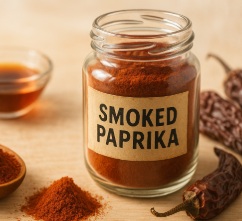
Smoked paprika
Description
Spice produced by milling dried fruits of Capsicum annuum that have been smoke-dried over hardwoods (e.g., oak), delivering warm color (amber → red) and smoky (phenolic, woody, lightly caramelized) notes.
Types: sweet, semi-hot, hot (generally moderate pungency; low–mid SHU range).
Color units: specified in ASTA (typical ~80–160 ASTA, depending on variety and process).

Caloric value (per 100 g)
Dry powder: ~280–320 kcal; total carbohydrates ~50–60 g (of which fiber ~30–35 g), protein ~12–15 g, fat ~10–15 g.
Typical use (0.5–5 g): modest energy; nutritional interest chiefly from carotenoids and aroma compounds.
Key constituents
Carotenoids: capsanthin, capsorubin, zeaxanthin, β-carotene (drive color).
Capsaicinoids: generally low in sweet grades (limited heat).
Smoke phenols: guaiacol, syringol and derivatives (signature smoky imprint).
Polyphenols and tocopherols; dietary fiber (celluloses/hemicelluloses), trace minerals.
Lipids: modest share, trending toward PUFA/MUFA with minimal SFA (see Fat profile).
Production process
Raw material: selected cultivars, destemming/de-seeding (partial placenta removal), washing and pre-drying.
Smoke-drying: exposure to hardwood smoke at low temperature for days with controlled humidity and aw to achieve aroma, safety, and stability while limiting PAH.
Milling at low temperature, sieving, and blending to standardize ASTA, particle size, and pungency.
Controls: moisture (≈8–12%), ASTA, mycotoxins (e.g., aflatoxins), metals/pesticides, PAH, microbiology (low aw), and foreign matter absence.
Sensory and technological properties
Efficient natural colorant at low dose; warm, bright hues.
Smoky aroma is stable yet sensitive to light, oxygen, and prolonged heat → prefer barrier packs and late addition.
Dispersibility: excellent in fatty matrices; in aqueous systems improve with pre-dispersion in oil or suitable emulsifiers.
Pairing: synergy with acids (vinegar, citrus), umami (soy, miso), and fats (olive oil, butter/ghee).
Culinary uses
Traditional cuisines: Iberian (pimentón; e.g., chorizo, pulpo, fabada), Hungarian (goulash variants), Balkan, Middle Eastern.
BBQ/rubs for meats/vegetables, patatas bravas, legumes (stews, hummus), eggs and roasted potatoes, smoky mayo/sauces, spreadable cheeses, snacks.
In plant-forward cookery, a flavorful stand-in for direct smoking or bacon-like notes.
Nutrition and health
Provides carotenoids with potential antioxidant activity; serving sizes are small.
Sodium intrinsically low; recipe dependent.
Tolerability: moderate heat; adjust dose for GERD or spice sensitivity.
Fat profile
Quality and specifications (typical topics)
ASTA, moisture, particle size, ash, pungency/SHU (if declared).
PAH within limits (clean smoking, controlled combustion).
Mycotoxins compliant; pesticides/metals within limits; microbiology: pathogen-free.
Uniformity of color/aroma and absence of foreign matter.
Storage and shelf life
Store dark, dry, cool (≈5–20 °C) in tight barrier containers; avoid light, air, and heat.
Typical shelf life 12–24 months (depending on ASTA, antioxidant protection, and packaging); reclose promptly after use.
Allergens and safety
Naturally gluten-free; not among major allergens. Possible cross-contact in facilities (verify supplier).
Manage PAH risk via controlled smoke-drying and suitable raw materials; apply GMP/HACCP with CCP on combustion, smoke filtration, and cleanup.
INCI functions in cosmetics
Possible names: Capsicum Annuum Fruit Powder, Capsicum Annuum Extract, Paprika Powder/Paprika Oleoresin (for extract forms).
Roles: natural colorant (orange-red tones), mild secondary antioxidant, light skin-conditioning. Evaluate skin staining and stability; use at low levels with compatibility testing.
Troubleshooting
Fading during cooking: reduce time/temperature, dose late, limit light/air exposure.
Harsh smoky/bitter notes: over-dosage or overheating → lower dose; briefly toast in a cool pan, then warm gently.
Lumping in dry mixes: optimize particle size/moisture, sieve, pre-disperse in oil.
Uneven color: improve blending, choose grade with appropriate ASTA, verify dispersibility.
Sustainability and supply chain
Smoke-drying managed to minimize emissions and PAH; prefer efficient kilns with heat recovery.
Agricultural traceability, control of mycotoxins/residues; recyclable packaging and effluent management toward BOD/COD targets.
Operate under GMP/HACCP with defined CCP (e.g., smoking parameters, filtration, PAH screening).
Conclusion
Smoked paprika combines warm color with layered smokiness at tiny doses, elevating classic and modern dishes. Thoughtful grade selection (sweet/hot; ASTA), good matrix dispersion, and control of light/oxygen/temperature ensure stability, uniformity, and sensory consistency, while maintaining process safety and sustainability.
Mini-glossary
ASTA — American Spice Trade Association color units: standard measure of coloring strength.
SHU — Scoville heat units: index of perceived pungency (higher = hotter).
PAH — Polycyclic aromatic hydrocarbons: combustion-derived compounds; keep as low as possible via controlled smoking.
aw — Water activity: available water for microbes; low in spices.
PUFA — Polyunsaturated fatty acids: may support cardiometabolic health; more prone to oxidation.
MUFA — Monounsaturated fatty acids: often neutral/beneficial for lipid profile.
SFA — Saturated fatty acids: advisable to moderate in the overall diet.
GMP/HACCP — Good Manufacturing Practice / Hazard Analysis and Critical Control Points: preventive hygiene systems with validated CCPs.
CCP — Critical control point: process step requiring strict control (e.g., smoking parameters, foreign-body removal).
BOD/COD — Biochemical/Chemical Oxygen Demand: indicators of effluent impact in wastewater treatment.