

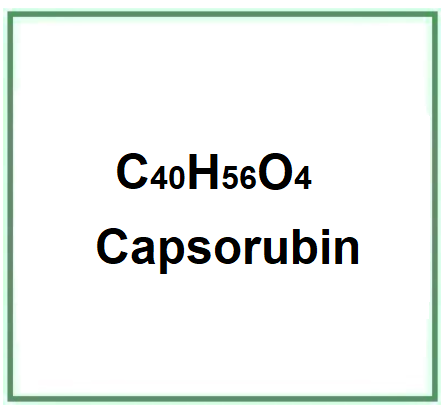
Capsorubin is a carotenoid, specifically a red pigment extracted from peppers (Capsicum genus). It is used as a food coloring and may be listed as E160c on ingredient labels in Europe. Capsorubin is fat-soluble and water-insoluble and is used to provide red/orange coloring in various food and cosmetic products.
The name describes the structure of the molecule.
- Capso- derive from "Capsicum," the genus of peppers from which capsorubin is extracted.
- -rubin. is a common suffix for compounds that are pigments, often derived from plants.
Step-by-step Summary of Industrial Production Process.
- Extraction of Capsorubin. The pigment is extracted from red peppers using organic solvents or supercritical fluid extraction.
- Purification. The extract undergoes processes like precipitation and column chromatography to isolate capsorubin.
- Concentration. The pigment is then concentrated to achieve the desired hue.
- Formulation. Capsorubin is formulated into a usable form, such as powders, liquids, or pastes, for utilization in the food and cosmetics industries.
- Quality Control. The final product undergoes testing to ensure color intensity, purity, and stability.
What it is used for and where
Cosmetics
It is a restricted ingredient as IV/147 a Relevant Item in the Annexes of the European Cosmetics Regulation 1223/2009.
Colorant. This ingredient has the primary function of colouring the solution in which it is inserted in a temporary, semi-permanent or permanent manner, either alone or in the presence of the complementary components added for colouring.
- Molecular Formula C40H56O4
- Molecular Weight 600.9 g/mol
- CAS 470-38-2
- UNII 805VAB3L0H
- EC Number 207-425-2
Safety
Capsorubin is generally recognized as safe, though some individuals may have sensitivities or allergies to pepper-derived ingredients.
Environmental Impact.
Considerations include the environmental impact of pepper farming, extraction processes, and waste management in production.