



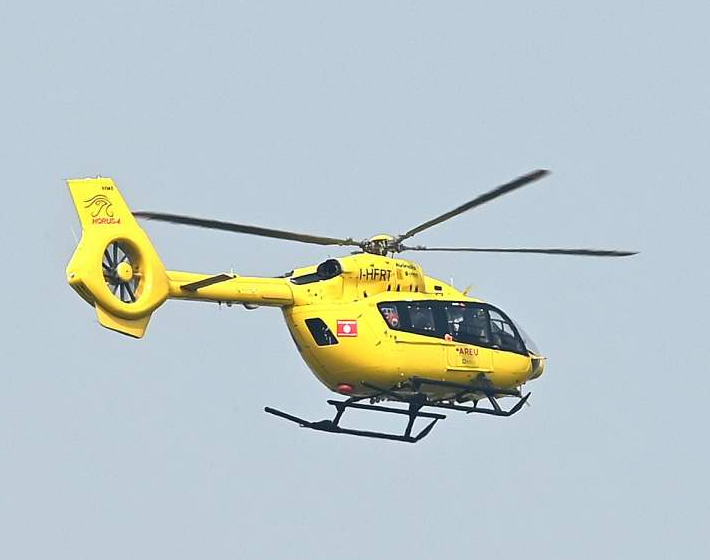
An overview of the Airbus Helicopters H145, a multi-role, twin-engine helicopter in the four-tonne class. The information below is general; for specific data, exact performance, and operating procedures, consult the manufacturer’s official documentation and authoritative technical publications.
Introduction And Historical Context
The H145 is the evolution of the EC145 (itself derived from the joint MBB/Kawasaki BK117 family). It adopted Airbus’ current naming in 2015 and has been progressively upgraded through the H145 “D2” (Fenestron tail rotor and Helionix avionics) and the “D3” five-blade variant. First flight as EC145: 12 June 1999. Entry into service: 2002. A notable demonstration of “hot & high” capability occurred in 2019 when a five-blade H145 landed on Aconcagua (6,962 m), the Andes’ highest peak.
Design And Structure
Fuselage
Designed around a large, unobstructed cabin with a flat floor, wide sliding doors on both sides, and rear clamshell doors that enable straight-in loading. Energy-absorbing seats and crashworthy design features support survivability. The airframe accepts a wide array of mission kits with minimal reconfiguration time.
Main Rotor
On the D3, a five-blade, bearingless composite rotor reduces part count and vibration while increasing useful load by approximately 150 kg versus the previous generation, simplifying maintenance and improving comfort.
Tail Rotor
A shrouded Fenestron anti-torque system (10 blades) enhances ground safety, improves yaw authority, and lowers the external noise signature—valuable for HEMS and policing over urban areas.
Landing Gear
Skid-type landing gear is standard, with ground-handling wheels and mission-specific options (e.g., emergency floats) available.
Powerplant And Systems
Propulsion
Two Safran Arriel 2E turboshafts with dual-channel FADEC provide robust AEO power and strong OEI margins suited to SAR/HEMS and confined-area operations.
Indicative Performance (standard configuration, ISA*)
• Recommended cruise speed: ~241 km/h (130 kt).
• Max range with standard tanks: ~650 km (351 nm).
• Max endurance with standard tanks: ~3 h 35 min.
• Hover ceiling OGE/IGE: ~8,955 ft / ~12,490 ft.
• Max altitude for takeoff/landing: 20,000 ft.
*ISA: 15 °C at sea level, 1013.25 hPa.
Fuel System
Standard usable fuel is roughly 723 kg, with auxiliary tanks and mission-specific fuel options available.
Electrical System And Avionics
The Helionix “glass” suite integrates an advanced alerting philosophy and a dual-duplex, four-axis autopilot capable of fully-coupled approaches to a hover. IFR/NVG configurations are available; options include synthetic vision and HTAWS. A wireless Airborne Communications Server (wACS) enables secure data offload to support connected services and predictive maintenance workflows.
Capacity And Configurations
Passenger Transport
Typically 1–2 pilots plus up to 10 passengers (high-density layout), with VIP/corporate interiors available (enhanced trim, soundproofing, climate control).
HEMS/SAR
A spacious cabin accommodates one or two stretchers with up to three medical attendants. Loading is via side doors or the rear clamshells. External hoists are commonly fitted (typical lift capability in the ~270 kg class), with Human External Cargo (HEC) provisions available.
Firefighting And Utility
Compatible with underslung buckets and belly tanks; compact footprint and excellent “hot & high” performance support mountain and urban-adjacent missions.
External Load (Cargo Hook)
Single-point cargo hook capability up to ~1,600 kg; dual-hook (HEC class D) configurations commonly rated around ~800 kg.
Principal Variants And Designations
EC145 (BK117 C-2)
Baseline civil/government variant that established the platform’s roomy cabin and flat-floor concept.
EC145e (C-2e)
A simplified, utility-focused derivative produced for select markets; often delivered VFR-centric, with IFR/autopilot retrofits available via STC.
H145 / EC145 T2 (D2)
Introduces the Fenestron tail rotor, Arriel 2E engines with FADEC, and the Helionix avionics suite with a four-axis autopilot.
H145 D3 (Five-Blade)
New bearingless five-blade main rotor adds ~150 kg useful load, reduces vibration, and further streamlines maintenance.
H145M (EC645 T2)
Militarized variant supporting the modular HForce weapon/sensor architecture, ballistic protection, EO/IR payloads, and a broad set of utility roles.
UH-72 Lakota / UH-72B
U.S. Army utility derivative based on the EC145/H145 lineage, with later models adopting H145 upgrades (including the five-blade rotor and Fenestron).
Operational Employment
Military And Paramilitary
Light utility, special operations support, troop transport, ISR, and MEDEVAC; H145M integrates HForce for scalable armament and targeting.
Civil And Governmental
Extensive use in HEMS/air ambulance, SAR, law enforcement, civil protection, firefighting, powerline/pipeline patrol, and VIP/corporate transport—helped by the low noise footprint and excellent confined-area handling.
Offshore And Energy
Crew change for oil, gas, and offshore wind. The compact D-value and strong OEI margins enable operations from small helidecks; Class 1 performance is achievable as configured.
Maintenance And Support
The platform’s maintenance program is backed by comprehensive technical publications and global support. The D3’s simplified rotor system reduces maintenance burden and downtime versus earlier iterations. Connectivity (e.g., wACS) and associated analytics improve health monitoring and enable condition-based or predictive maintenance approaches, enhancing availability and cost control.
Conclusions
Within the “light twin” segment, the H145 stands out for its versatile, truly usable cabin; excellent access via side and rear doors; mature Helionix avionics and four-axis autopilot; and strong performance in hot-and-high or confined-area scenarios. The D2/D3 upgrades (Fenestron and the five-blade main rotor) further reduce noise and vibration while increasing payload and simplifying support. As with any rotorcraft, strict adherence to applicable maintenance procedures, technical updates, and regulatory requirements—combined with thorough crew training and operational standardization—is essential to maximize mission effectiveness and safety.

