

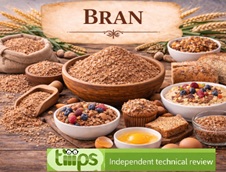
Bran: properties, uses, pros, cons, safety
Definition
Bran is the outer fraction of the wheat kernel (typically Triticum aestivum, family Poaceae) separated during milling. It mainly includes the pericarp, aleurone layers and parts of the seed coat, and is characterised by a high content of dietary fibre and a relatively high mineral fraction (ash). In food applications it is used as a functional ingredient to increase fibre content and to modify texture and dough rheology. Wheat bran contains gluten due to adherence/contamination with endosperm fractions and because it derives from a gluten-containing cereal; it is not suitable for gluten-free diets.

Production process
Bran is obtained as a co-product of wheat milling: cleaning and tempering of grain, breaking and sifting (plansifting) with fraction separation. Bran can be further stabilised (thermal treatments) to reduce microbiological load and inactivate enzymes, or micronised to obtain different particle sizes. Industrial critical points include foreign bodies, microbiological load, pests, moisture and particle-size consistency.
Key constituents
The matrix contains mainly dietary fibre (predominantly insoluble, with a soluble fraction), structural polysaccharides of the cell wall, variable protein content, and minerals (relatively high ash). Phenolic compounds bound to the cell wall (variable) and trace lipids are present. Bran may also contain phytates (natural constituents that can influence mineral availability in the overall meal, depending on diet context and processing).
Identification data and specifications
| Parameter | Value | Note |
|---|---|---|
| Ingredient name | Bran (wheat bran) | Can be fine, coarse, micronised |
| Botanical name | Triticum aestivum | Family: Poaceae |
| Plant part | Outer kernel fractions | Pericarp/aleurone/seed coats |
| Nature | Plant fibre in flakes/powder | Functional component for fibre and texture |
| Key parameters | Total fibre, moisture, particle size, ash, microbiological load, foreign bodies | Quality and application drivers |
| Allergen | Yes: gluten (wheat) | Not suitable for coeliac disease |
| Caloric value | Typically ~200–300 kcal/100 g | Depends on residual starch and moisture |
Physico-chemical properties (indicative)
| Property | Indicative value | Note |
|---|---|---|
| Physical state | Flakes/particles/powder | Depends on micronisation |
| Colour | Beige → brown | Varies by origin and sifting |
| Odour | Cereal | Rancid notes suggest storage issues |
| Water solubility | Mostly insoluble | Forms suspensions; fibres bind water |
| Water-binding capacity | High | Increases with fineness and fibre level |
| Stability | Good if kept dry | Key issues: moisture/odour uptake |
| Typical criticalities | Dough stiffening, “rough” mouthfeel, variability | Driven by particle size and dosage |
Main uses
Food
Used to increase fibre in bread, biscuits/cookies, crackers, breakfast cereals, bars and “whole grain” products. In leavened doughs, bran absorbs water and can interfere with gluten development, reducing loaf volume and openness: compensation often includes higher hydration, autolyse, longer fermentation, or blending with stronger flours. In dry products it can increase friability and deliver a more “rustic” texture.
Industrial use
Used in fibre premixes, functional enrichment and standardised bakery products. Industrial drivers: particle-size consistency, fibre content and hydration behaviour.
Nutrition and health
Bran is a high-fibre ingredient and can help increase dietary fibre intake when incorporated into balanced recipes. The effect depends on dose, individual tolerance and the overall meal context (hydration, other fibres, protein and fat).
Pros
It effectively increases fibre content, supporting fibre-positioned products and—when tolerated—satiety and bowel regularity. It can enhance “whole/fibre” positioning of baked goods without completely changing the underlying technological system.
Cons
It contains gluten (wheat) and is contraindicated for coeliac disease. At high doses it may cause bloating or discomfort in sensitive individuals. Technologically, it can reduce loaf volume and softness and create a rougher mouthfeel, especially with coarse particle sizes.
Serving note
Serving size depends on the finished product and inclusion level. In practice, increased fibre should be balanced with adequate hydration and individual tolerance.
Safety (allergens, contraindications)
Allergen: gluten (wheat). Contraindicated for coeliac disease and gluten-free diets. From a quality standpoint, physical contaminants (foreign bodies) and moisture/pest control in storage are relevant. In fibre-sensitive individuals, rapid fibre increases may be poorly tolerated; gradual increases within the overall diet are often preferable.
Storage and shelf-life
Store in a cool, dry place, tightly closed, away from moisture and strong odours. Bran is relatively stable but can absorb odours and moisture; stock rotation and barrier packaging improve sensory and functional consistency.
Labelling
Declare “wheat bran” (if wheat-derived) and manage the allergen wheat/gluten according to applicable rules. Any “source of fibre” or “high in fibre” claims require compliance with quantitative thresholds and the final product formulation.
Functional role and rationale for use
Its main role is nutritional-functional (fibre enrichment) and technological (water binding, increased “body” and rustic texture). Bran binds water, increases dough viscosity and can disrupt gluten network continuity: hydration and mixing/fermentation management are essential to preserve volume and softness.
Formulation compatibility
In leavened products, increased water and rest times are often needed; finer micronised bran reduces the “cutting” effect on gluten compared with coarse bran. In biscuits and crackers, bran increases friability and may require adjustments to fats and water. In extruded cereals, particle size and moisture determine expansion performance and crispness.
Safety, regulatory and quality
GMP/HACCP management is relevant for contaminants, traceability and pest control. Clear specifications for fibre, ash, moisture and particle size reduce variability and process issues.
Conclusion
Wheat bran (Triticum aestivum) is a high-fibre ingredient used to enrich baked goods and cereals. It offers nutritional and positioning advantages but requires process management (hydration, processing) to avoid reduced volume and overly rough texture. The main limitation is gluten, making it unsuitable for coeliac disease.
Mini-glossary
Bran: outer kernel fraction rich in fibre and minerals.
Ash: indicator of mineral fraction; tends to be high in outer fractions.
Dietary fibre: non-digestible component affecting satiety and bowel function depending on context.
Phytates: natural compounds that can bind minerals and influence bioavailability in the overall meal.
Gluten: wheat protein complex; critical allergen for coeliac disease.
GMP/HACCP: good manufacturing practices (GMP) and the hazard analysis and critical control points (HACCP) system for food safety.

