

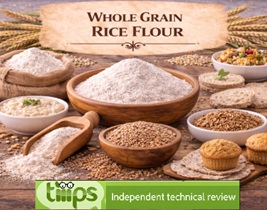
Whole grain rice flour
Rating : 7
| Evaluation | N. Experts | Evaluation | N. Experts |
|---|---|---|---|
| 1 | 6 | ||
| 2 | 7 | ||
| 3 | 8 | ||
| 4 | 9 | ||
| 5 | 10 |
0 pts from Al222
| Sign up to vote this object, vote his reviews and to contribute to Tiiips.Evaluate | Where is this found? |
| "Descrizione" about Whole grain rice flour by Al222 (24812 pt) | 2026-Feb-23 07:53 |
| Read the full Tiiip | (Send your comment) |
Whole grain rice flour: properties, uses, pros, cons, safety
Definition
Whole grain rice flour is obtained by milling the caryopsis of Oryza sativa (family Poaceae) while retaining the outer layers (rice bran) and the germ. Compared with refined (white) rice flour, it generally contains more fibre, a higher mineral (ash) fraction, and a more pronounced “cereal” sensory profile. It is naturally gluten-free, but “gluten-free” suitability depends on the supply chain and control of cross-contamination. The presence of the germ increases susceptibility to oxidation, making storage and shelf-life more critical than for refined flours.

Production process
The process includes cleaning and sorting the rice, possible thermal stabilisation (to reduce enzyme activity and rancidity risk), then milling (roller or stone) and sieving to reach the target particle size. For fine flours, limiting the typical “gritty” mouthfeel of some grinds is important. Key controls include moisture, microbiological load, foreign bodies, particle size, and oxidation indicators (rancid odour; peroxide-related checks where lipid fractions are relevant).
Key constituents
The matrix contains starch, rice proteins, fibre (mainly in the outer fractions), germ-associated lipids, and variable micronutrients. In addition, whole-grain fractions (bran + germ) contain rice-specific bioactive compounds.
Starch: main source of energy (carbohydrates). Potential downside: in some matrices (especially very fine flour and high-temperature cooking), starch can be rapidly available, with potentially higher glycaemic impact unless the meal is balanced with fibre/protein/fats.
Fibre (insoluble + a smaller soluble fraction): supports satiety and bowel regularity; technologically it increases water absorption and “body”. Potential downside: rapid increases may cause bloating in sensitive individuals; real effect depends on dose and portion size.
Germ lipids: contribute to a more complete profile than white rice flour. Potential downside: they increase sensitivity to oxidation/rancidity (sensory defects and quality loss).
Rice proteins: contribute protein, but do not form a gluten network; benefit: useful in gluten-free diets; downside: limited structure in leavened products, requiring blends and binders.
Vitamin E (tocopherols and tocotrienols; variable): mainly associated with germ/bran lipid fractions; benefit: antioxidant role within the matrix and support for lipid stability; downside: sensitive to oxygen and heat, therefore it can decrease with harsh processing and long storage.
Phytic acid (phytates): concentrated in outer layers; benefit: often discussed as a bioactive with potential antioxidant/chelating behaviour; downside: it can reduce mineral bioavailability (e.g., iron, zinc) within the meal context, especially when the overall diet is already marginal in these micronutrients.
Gamma-oryzanol: rice-characteristic fraction (typically associated with rice bran oil); benefit: bioactive compound with antioxidant behaviour in lipid phases; downside: its effective amount in flour depends on how much bran/germ remains and on processing, and it is sensitive to oxidation and processing conditions.
Phenolics (phenolic compounds; trace): linked to outer layers; benefit: potential antioxidant contribution; downside: batch variability and partial loss with severe processing.
Minerals and B-group vitamins (variable): generally higher than in refined flour; benefit: improved micronutrient profile; downside: practical impact depends on inclusion level in the recipe and consumed portion.
Identification data and specifications
| Characteristic | Value | Note |
|---|---|---|
| Ingredient name | Whole grain rice flour | From milled whole grain rice |
| Botanical name | Oryza sativa | Family: Poaceae |
| Plant part | Caryopsis (endosperm + bran + germ) | Germ presence increases oxidative sensitivity |
| Nature | Starch–protein–fibre flour | Darker than refined rice flour |
| Key parameters | Moisture, particle size, fibre, ash, microbiological load, storage stability | Performance and consistency drivers |
| Allergen | No (intrinsic) | Beware gluten cross-contamination in the supply chain |
| Caloric value | Typically ~340–380 kcal/100 g | Depends on moisture and variety |
Physico-chemical properties (indicative)
| Characteristic | Indicative value | Note |
|---|---|---|
| Physical state | Powder | Fine → medium |
| Colour | Ivory → beige/light brown | Depends on variety and milling |
| Odour | Cereal | Rancid notes indicate oxidation |
| Water solubility | Insoluble | Forms dispersions; starch gelatinises upon heating |
| Water absorption | Medium–high | Increases with fibre and finer particle size |
| Stability | Good if kept dry | Critical: moisture and rancidity (germ lipids) |
| Typical criticalities | Gritty mouthfeel (if coarse), lumping, rheology variability | Driven by particle size and batch |
Main uses
Food
Used in gluten-free recipes (bread, cakes, biscuits/cookies, pancakes, batters) and as a thickener in creams and sauces. In gluten-free baking it is often used in blends with starches (tapioca, corn, potato) and binders (fibres, hydrocolloids) to improve structure and softness. In biscuits and shortcrust-style products, whole grain rice flour provides a more “cereal” profile and a more rustic texture than refined rice flour.
Industrial use
Gluten-free premixes, bakery bases, extruded products and snacks: key industrial drivers are consistent particle size, predictable water absorption, and oxidation control throughout shelf-life.
Nutrition and health
Compared with refined rice flour, the whole-grain version tends to provide more fibre and micronutrients and can support greater satiety within balanced products. However, it remains a starch-based ingredient: the overall profile depends on the recipe (added sugars/fats) and portion size.
Pros
It is naturally gluten-free (with controlled supply chain) and provides more fibre than refined rice flour, supporting a more “whole-grain” profile and often better satiety when used in well-designed recipes.
Cons
It can go rancid more easily due to the germ and requires tighter storage management. In gluten-free leavened products it often requires more complex formulation (blends and binders) to avoid fragile or dry textures.
Serving note
Serving size depends on the finished product. For impact assessment, consider inclusion level in the recipe, added sugars/fats, and pairing with proteins/fibre within the meal.
Safety (allergens, contraindications)
Not a typical intrinsic allergen. For “gluten-free” claims, a controlled supply chain and, where appropriate, analytical verification are essential. The main practical criticality is quality-related: moisture and oxidation can degrade aroma and acceptability. In fibre-sensitive individuals, rapid increases in whole-grain products may cause bloating.
Storage and shelf-life
Store in a cool, dry place, tightly closed, protected from light and heat. The germ increases rancidity susceptibility: stock rotation, lower temperatures and oxygen/moisture barrier packaging improve shelf-life.
Labelling
Declare “whole grain rice flour”. “Gluten-free” wording is appropriate only if supported by supply-chain controls and consistent verification. Any “whole grain” and “source of fibre” claims must be consistent with the finished product and applicable thresholds.
Functional role and rationale for use
Provides a starch base and adds “body” and water absorption through fibre. In gluten-free systems it is primarily a base and “whole-grain identity” ingredient rather than a structuring agent: leavened structure must be built with blends and binders. Particle size is a key driver to reduce gritty mouthfeel and improve sensory performance.
Formulation compatibility
In gluten-free bakery it performs well in blends with starches and hydrocolloids. Hydration must be tuned because fibre binds water and can make dough/batter denser. In creams and sauces it must be dispersed properly to avoid lumps; prolonged heating can increase viscosity and alter texture. Oxidation control becomes especially relevant for long-shelf-life products.
Safety, regulatory and quality
GMP/HACCP management supports control of contamination, traceability, microbiology and batch consistency. Clear specifications for moisture, particle size and oxidative stability reduce variability and complaints (rancid odour, poor performance).
Conclusion
Whole rice flour (Oryza sativa) is a gluten-free flour oriented to a more “whole-grain” profile (more fibre and micronutrients than refined rice flour) and is useful in blends for gluten-free baking. Key drivers are particle size, hydration management, and control of oxidation/rancidity during storage. The real nutritional value depends on the finished product and portion size.
Studies
Rice flour is one of the most suitable flours for cooking gluten-free products as it has hypoallergenic properties and low sodium content (1).
It has applications in medicine (2).
This study analyzed the effects of endogenous proteins and lipids on the digestibility of starch in rice flour, with particular emphasis on the creation of the physical-chemical mechanisms involved (3).
Note on scientific evidence
From a practical standpoint, these findings should be interpreted cautiously: translation to finished foods and to humans depends on dose, bioavailability, food matrix, and study quality, and does not automatically imply a clinical effect under real-life consumption conditions.
References__________________________________________________________
(1) Beretta S, Fabiano V, Petruzzi M, Budelli A, Zuccotti GV. Fermented rice flour in pediatric atopic dermatitis. Dermatitis. 2015 Mar-Apr;26(2):104-6. doi: 10.1097/DER.0000000000000103.
(2) Bee Ling Tan, Mohd Esa Norhaizan Scientific Evidence of Rice By-Products for Cancer Prevention: Chemopreventive Properties of Waste Products from Rice Milling on Carcinogenesis In Vitro and In Vivo Biomed Res Int. 2017; 2017: 9017902. Published online 2017 Jan 22. doi: 10.1155/2017/9017902
Abstract. Cancer is a significant global health concern affecting men and women worldwide. Although current chemopreventive drugs could inhibit the growth of cancer cells, they exert many adverse side effects. Dietary factor plays a crucial role in the management of cancers and has drawn the attention of researchers to be used as an option to combat this disease. Both in vitro and in vivo studies showed that rice and its by-products display encouraging results in the prevention of this disease. The mechanism of anticancer effect is suggested partly through potentiation of bioactive compounds like vitamin E, phytic acid, γ-aminobutyric acid (GABA), γ-oryzanol, and phenolics. Nevertheless, the bioactivity of rice and its by-products is still incompletely understood. In this review, we present the findings from a preclinical study both in in vitro and in animal experiments on the promising role of rice by-products with focus on cancer prevention.
(3) Ye J, Hu X, Luo S, McClements DJ, Liang L, Liu C. Effect of endogenous proteins and lipids on starch digestibility in rice flour. Food Res Int. 2018 Apr;106:404-409. doi: 10.1016/j.foodres.2018.01.008. Epub 2018 Jan 8
| Sign up to vote this object, vote his reviews and to contribute to Tiiips.EvaluateClose | (0 comments) |
Read other Tiiips about this object in __Italiano (1)
Content:   Last update:   2026-02-23 07:45:58 | Kcal/100g:   360 Family:   Threat factors:   |

