

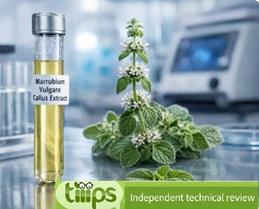
Marrubium vulgare callus extract: properties, uses, pros, cons, safety
Marrubium vulgare callus extract is an extract obtained from the callus (undifferentiated tissue) of Marrubium vulgare L. (family Lamiaceae; historical synonym Labiatae) grown in vitro under controlled conditions. In cosmetics it is mainly used as a skin conditioning ingredient, with a use profile aimed at supporting surface hydration, comfort, and skin sensoriality, with performance depending on the grade and the supplier’s standardization.

For more information: White horehound
Definition
“Callus extract” means an extract obtained from plant biomass produced via cell/tissue culture (callus) followed by extraction with suitable solvents (typically water, glycols, or hydroalcoholic mixtures). Compared with a whole-plant extract, callus culture can enable more controllable production and reduced seasonality dependence; however, the metabolic profile may differ depending on culture medium, growth regulators, elicitors, and operating conditions.
Production process and key constituents
How it is produced (in brief)
Typical industrial production includes: starting sterile cultures from selected plant material, inducing and growing callus on nutrient media, optional modulation with regulators/elicitors to steer the metabolic profile, harvesting biomass, extraction with a cosmetically suitable solvent, filtration and standardization (solids, markers, chromatographic fingerprint), then stabilization/preservation depending on the carrier.
Key constituents (representative, by category)
Phenylpropanoids/phenylethanoids
Verbascoside (acteoside)
Forsythoside B
Chlorogenic acid
Flavonoids
Iridoid glycosides
Phytosterols
Polysaccharides
Technical note. In Marrubium vulgare cell culture systems, phenylpropanoids (especially verbascoside) are frequently reported and, depending on conditions, flavonoids and iridoids may also be present; the final composition depends substantially on the supplier’s technology and marker standardization.
Main uses
Cosmetics
Typical use in leave-on products (serums, creams, light emulsions, gels) and, more rarely, in gentle rinse-off products where skin conditioning support and a “biotech-botanical” (cell culture) positioning are desired.
INCI functions
Skin conditioning agent. It is the mainstay of topical skin treatment as it has the function of restoring, increasing or improving skin tolerance to external factors, including melanocyte tolerance. The most important function of the conditioning agent is to prevent skin dehydration, but the subject is rather complex and involves emollients and humectants that can be added in the formulation.
Industrial use
Raw material for skincare positioned around “cell culture / biotech botanical,” often combined with humectants and emollients, depending on the available performance dossier.
Identification data and specifications
| Characteristic | Value | Note |
|---|
| INCI name | Marrubium vulgare callus extract | Cosmetic denomination |
| Botanical origin | Marrubium vulgare L. | Callus (in vitro culture) |
| Botanical family | Lamiaceae | Syn. Labiatae |
| CAS number | 84696-20-8 (generic) | Often shared with other M. vulgare extracts |
| EC number (EINECS) | 283-638-4 | EU identifier |
| Preparation type | callus-derived extract | Carrier/solvent depends on grade |
| Main function | skin conditioning | Ingredient-function framing |
| Variability note | high | Culture, extraction, standardization dependent |
Chemical-physical properties (indicative)
| Characteristic | Indicative value | Note |
|---|
| Physical state | liquid or powder | Depends on carrier and drying technology |
| Color | yellow-brown / amber | Variable with phenolic fraction |
| Odor | mild herbal or neutral | Depends on purification and carrier |
| Solubility | often good in water/glycols | Depends on extraction solvent |
| pH (solutions) | typically slightly acidic–neutral | Depends on batch and standardization |
| Stability | good if protected from light/oxygen | Phenolics are oxidation-sensitive |
| Critical points | preservative compatibility and color | To be verified in the finished formula |
Functional role and mechanism of action
The action is mainly supportive and linked to a combination of: phenylpropanoid fraction (e.g., verbascoside) with a potential antioxidant contribution consistent with perceived “comfort,” polysaccharides with a possible film-forming/conditioning effect, and minor fractions (flavonoids/phytosterols) that may improve the feel of skin that is softer and “more balanced.” The actual effect depends on dose, vehicle, and grade quality/marker standardization.
Formulation compatibility
Generally compatible with O/W emulsions, aqueous gels, and serums. Key development points: color stability over time, compatibility with the preservative system (possible interactions with polyphenolic fractions), behavior in the presence of electrolytes/pH-sensitive polymers, and batch-to-batch sensorial repeatability.
Pros and cons
Pros
In vitro supply chain with potentially greater control versus seasonal extracts (supplier-dependent).
Good support ingredient for skin conditioning and comfort concepts.
Relatively easy integration into many aqueous bases and emulsions.
Cons
CAS/EC are often “generic” and not always discriminative: technical documentation (COA/TDS) is needed to identify the grade.
Marker and color variability if not well standardized.
Performance is tied to the supplier dossier quality and the actual marker content.
Safety, regulatory, and environmental aspects
Allergen.
Not typically a classic single fragrance allergen; as with many botanical extracts, irritation/sensitization remains possible in predisposed individuals. Assessment should be performed on the finished product and batch specification.
Contraindications (brief).
Use caution on highly reactive skin, especially at high leave-on dosages; prefer well-standardized grades and verify microbiological stability/preservation.
Formulation troubleshooting
Batch-to-batch color shifts or color change over time.
Action: request color/marker ranges from the supplier, use barrier packaging, evaluate compatible antioxidants/chelators.
Microbiological instability in high-aqueous formulas.
Action: recalibrate preservation, verify incoming batch microbial load, optimize process and plant hygiene.
Interactions with gelling agents/polymers.
Action: control final pH, test compatibility with the chosen polymer, evaluate order of addition.
Conclusion
Marrubium vulgare callus extract is a “cell culture” ingredient used in cosmetics for skin conditioning. Practical value depends on grade repeatability (marker standardization such as verbascoside and overall phenolic profile) and on correct formulation management of color, preservation, and compatibility with the matrix.