

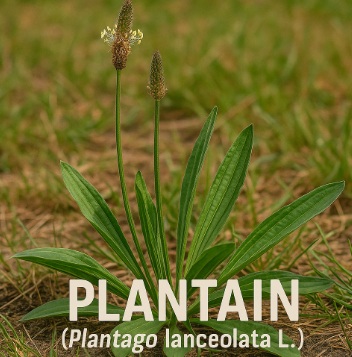
Plantain
Rating : 6
| Evaluation | N. Experts | Evaluation | N. Experts |
|---|---|---|---|
| 1 | 6 | ||
| 2 | 7 | ||
| 3 | 8 | ||
| 4 | 9 | ||
| 5 | 10 |
0 pts from Al222
| Sign up to vote this object, vote his reviews and to contribute to Tiiips.Evaluate | Where is this found? |
| "Descrizione" about Plantain by Al222 (23254 pt) | 2025-Nov-07 19:41 |
| Read the full Tiiip | (Send your comment) |
Plantain (Plantago spp.)
(leaves and aerial parts of Plantago major L. and Plantago lanceolata L.; family Plantaginaceae)
Description
• Perennial herb; the leaves (whole, cut, or powdered) are used as a botanical ingredient in infusions, syrups, extracts, and functional foods.
• Sensory profile is herbaceous–astringent with a slight bitter note; commercial forms include dried drug, aqueous/hydroalcoholic extracts, tinctures, and pressed juices.

Indicative nutrition values (dried leaf, per 100 g; typical use is at low dosage)
• Energy: ~230–310 kcal
• Carbohydrate: ~35–55 g (sugars <5 g)
• Dietary fiber: ~30–45 g (soluble pectins/mucilages; insoluble hemicelluloses/cellulose)
• Protein: ~12–20 g
• Fat: ~3–6 g — SFA (saturated fatty acids; advisable to keep low overall) <1.5 g; MUFA and PUFA minor
• Minerals: contains potassium, calcium, magnesium; sodium low
• Note: As infusion or extract, the caloric and nutrient contribution to the finished beverage is modest.
Key constituents
• Mucilages (heteropolysaccharides: arabinose, xylose, rhamnose, galacturonic acid) conferring emollient behavior.
• Iridoids (aucubin, catalpol) with soothing/astringent activity.
• Polyphenols/flavonoids (luteolin- and apigenin-glycosides) and phenylethanoid glycosides (verbascoside/acteoside) with antioxidant properties.
• Phenolic acids (caffeic, chlorogenic), condensed tannins, traces of volatile compounds; minerals (K, Ca, Mg), silica.
• Note: Seeds of Plantago ovata (psyllium) are a distinct ingredient rich in mucilage used primarily as fiber.
Production process
• Harvest leaves/aerial parts at early flowering → low-temperature drying with forced air → defoliation/cutting → sieving.
• For extracts: maceration/percolation in water or hydroalcohol → filtration, low-temperature concentration → standardization to markers (e.g., aucubin, total polyphenols).
• Packed under controlled conditions with full traceability per GMP/HACCP.
Physical properties
• Appearance: green to green-brown cut herb or olive-green powder; liquid extracts amber-brown.
• Solubility: drug insoluble; mucilages swell in water and form viscous solutions.
• Moisture typically ≤10%; ash within botanical range; mild herbaceous odor.
Sensory and technological properties
• Astringency and slight bitterness suit teas and soothing syrups; mucilage adds body/viscosity.
• Acts as a natural stabilizer at low dose in fruit syrups and gels.
• In bakery/bars it can contribute fiber and subtle green notes if dosed carefully.
Food applications
• Functional infusions/teas, soothing syrups and lozenges, herbal beverage blends.
• Extracts for soft drinks, food supplements, flavored honeys.
• Jams/sauces: minor texture aid via mucilage fraction.
Nutrition & health
Plantain contains mucilage fibers that can soothe oropharyngeal mucosa and gently modulate intestinal transit; tannins and iridoids support a local astringent/soothing effect, while polyphenols contribute antioxidant activity. It is generally well tolerated at traditional infusion/extract intakes.
Cautions: potential hypersensitivity in individuals allergic to Plantago pollens; rare cross-reactions with psyllium (P. ovata). Avoid use with known intestinal obstruction, and separate intake from medications with a narrow therapeutic index by 1–2 hours (mucilage may interfere with absorption). In pregnancy/lactation, keep to dietary amounts and seek professional advice. Dietary fat and sfa contributions are negligible; interest centers on fiber and phytochemicals.
Quality and specifications (typical topics)
• Botanical identity (P. major/P. lanceolata), absence of foreign matter/weeds, moisture ≤10%, total/insoluble ash within spec.
• Markers: aucubin/total iridoids, total polyphenols, mucilage (gravimetric).
• Contaminants: pesticides ≤ MRL, heavy metals (Pb, Cd, Hg, As) within limits, mycotoxins absent; low counts/pathogens absent/25 g.
• Residual solvents (for extracts) compliant; foreign bodies absent.
Storage and shelf-life
• Store dark, dry, below 25 °C in moisture/oxygen-barrier packs; avoid odor pickup.
• Typical shelf-life: 24–36 months (dried drug) when well packed; extracts per spec (often 12–24 months).
Safety and regulatory
• Botanical ingredient permitted in foods/beverages per traditional use; for supplements comply with national/EU lists and any constituent limits.
• Manufacture and packing under GMP/HACCP; export may require extended pesticide and metal panels.
Labeling
• Name: “plantain” / “Plantago major/lanceolata leaves”; indicate part used, origin, and form (cut/powder/extract) with directions for use.
• For supplements: declare marker levels (e.g., aucubin, polyphenols) and use warnings.
Troubleshooting
• Color/aroma loss → light/oxygen exposure → use opaque/barrier packs and reduced headspace.
• Excess turbidity in beverage → high dose/long maceration → reduce dose/time; consider cold clarification.
• Sediment in syrups → inadequate filtration → improve filtering or clarification.
• Batch flavor variability → botanical/harvest differences → implement marker-based standardization.
Sustainability and supply chain
• Wild/managed material with low inputs; favor sustainable harvest, rotations, and integrated pest management.
• Plant operations: water/heat recovery, wastewater to BOD/COD targets, recyclable packaging and optimized logistics.
• Supplier qualification with geographic traceability and periodic residue checks.
INCI functions (cosmetics)
• Plantago Major Leaf Extract / Plantago Lanceolata Leaf Extract: soothing, astringent, antioxidant, skin-conditioning; used in toners, serums, and creams per cosmetic regulations and tolerability profiles.
Conclusion
Plantain is a versatile botanical delivering mucilages, iridoids, and polyphenols for soothing/astringent applications in teas, syrups, and extracts. Strong results rely on robust botanical ID, marker standardization, protection from light/moisture, and formulation that balances astringency and turbidity.
Mini-glossary
• SFA: Saturated fatty acids — Keep overall intake low for a favorable LDL profile; plantain contributes negligible amounts.
• MUFA: Monounsaturated fatty acids — Generally favorable when replacing saturates.
• PUFA: Polyunsaturated fatty acids — Beneficial when balanced and protected from oxidation.
• GMP/HACCP: Good manufacturing practice / hazard analysis and critical control points — Preventive hygiene and process-control systems.
• MRL: Maximum residue limits — Legal limits for pesticide residues.
• BOD/COD: Biochemical/chemical oxygen demand — Wastewater impact metrics guiding treatment and discharge.
• Markers: Characteristic compounds used to standardize an extract (e.g., aucubin, total polyphenols).
References__________________________________________________________________________
Reza MM, Redoy MRA, Rahman MA, Ety S, Alim MA, Cheng L, Al-Mamun M. Response of plantain (Plantago lanceolata L.) supplementation on nutritional, endo-parasitic, and endocrine status in lambs. Trop Anim Health Prod. 2021 Jan 7;53(1):82. doi: 10.1007/s11250-020-02514-0.
Abstract. The aim of the present study was to assess the effects of plantain herb (Plantago lanceolata L.) supplementation on growth, plasma metabolites, liver enzymatic activity, hormonal status, gastrointestinal parasites, and carcass characteristics of lambs. A total of 24 lambs, aged 6 months weighing 8.0 ± 0.5 kg were randomly allocated to one of two dietary treatments: (1) CL diet-roadside grass and concentrate mixture; (2) PL diet-CL diet + 5% fresh plantain supplementation on a DM basis. The PL diet group exhibited 23% higher (P = 0.01) average daily gain and 15% improved (P = 0.03) feed conversion efficiency. Circulating cholesterol concentrations were suppressed by 9% (P = 0.03), and liver enzyme activity was improved by 5-25% (P < 0.05) in the lamb fed PL diet, compared with CL diet only. The inclusion of plantain in the diet was highly effective at suppressing the parasites, Paramphistomum spp. (P = 0.003) and coccidial parasites (P = 0.04), but not stomach worms. Moreover, plantain supplementation increased growth hormone and insulin concentrations in plasma level, whereas decreased carcass fat by 32.7%. Therefore, supplementation of the lambs' diet with plantain showed some beneficial effects on productivity and parasitic infection, while it led to a leaner carcass.
Laanet PR, Bragina O, Jõul P, Vaher M. Plantago major and Plantago lanceolata Exhibit Antioxidant and Borrelia burgdorferi Inhibiting Activities. Int J Mol Sci. 2024 Jun 28;25(13):7112. doi: 10.3390/ijms25137112.
Abstract. Lyme disease, caused by Borrelia burgdorferi sensu lato infection, is the most widespread vector-borne illness in the Northern Hemisphere. Unfortunately, using targeted antibiotic therapy is often an ineffective cure. The antibiotic resistance and recurring symptoms of Lyme disease are associated with the formation of biofilm-like aggregates of B. burgdorferi. Plant extracts could provide an effective alternative solution as many of them exhibit antibacterial or biofilm inhibiting activities. This study demonstrates the therapeutic potential of Plantago major and Plantago lanceolata as B. burgdorferi inhibitors. Hydroalcoholic extracts from three different samples of each plant were first characterised based on their total concentrations of polyphenolics, flavonoids, iridoids, and antioxidant capacity. Both plants contained substantial amounts of named phytochemicals and showed considerable antioxidant properties. The major non-volatile constituents were then quantified using HPLC-DAD-MS analyses, and volatile constituents were quantified using HS-SPME-GC-MS. The most prevalent non-volatiles were found to be plantamajoside and acteoside, and the most prevalent volatiles were β-caryophyllene, D-limonene, and α-caryophyllene. The B. burgdorferi inhibiting activity of the extracts was tested on stationary-phase B. burgdorferi culture and its biofilm fraction. All extracts showed antibacterial activity, with the most effective lowering the residual bacterial viability down to 15%. Moreover, the extracts prepared from the leaves of each plant additionally demonstrated biofilm inhibiting properties, reducing its formation by 30%.
Miszalski Z, Kaszycki P, Śliwa-Cebula M, Kaczmarczyk A, Gieniec M, Supel P, Kornaś A. Plasticity of Plantago lanceolata L. in Adaptation to Extreme Environmental Conditions. Int J Mol Sci. 2023 Sep 2;24(17):13605. doi: 10.3390/ijms241713605.
Abstract. This study aimed at characterizing some adaptive changes in Plantago lanceolata L. exposed to harsh conditions of a desert-like environment generating physiological stress of limited water availability and exposure to strong light. It was clearly shown that the plants were capable of adapting their root system and vascular tissues to enable efficient vegetative performance. Soil analyses, as well as nitrogen isotope discrimination data show that P. lanceolata leaves in a desert-like environment had better access to nitrogen (nitrite/nitrate) and were able to fix it efficiently, as compared to the plants growing in the surrounding forest. The arbuscular mycorrhiza was also shown to be well-developed, and this was accompanied by higher bacterial frequency in the root zone, which might further stimulate plant growth. A closer look at the nitrogen content and leaf veins with a higher number of vessels and a greater vessel diameter made it possible to define the changes developed by the plants populating sandy habitats as compared with the vegetation sites located in the nearby forest. A determination of the photosynthesis parameters indicates that the photochemical apparatus in P. lanceolata inhabiting the desert areas adapted slightly to the desert-like environment and the time of day, with some changes of the reaction center (RC) size (photosystem II, PSII), while the plants' photochemical activity was at a similar level. No differences between the two groups of plants were observed in the dissipation of light energy. The exposure of plants to harsh conditions of a desert-like environment increased the water use efficiency (WUE) value in parallel with possible stimulation of the β-carboxylation pathway.
Drava G, Cornara L, Giordani P, Minganti V. Trace elements in Plantago lanceolata L., a plant used for herbal and food preparations: new data and literature review. Environ Sci Pollut Res Int. 2019 Jan;26(3):2305-2313. doi: 10.1007/s11356-018-3740-1.
Abstract. Plantago lanceolata L. is a common grassland and roadside plant, widely used in many countries in food and herbal preparations. In this study, samples of this wild plant were collected from rural, suburban/urban, and industrial environments; the concentrations of As, Cd, Co, Cu, Fe, Mn, Ni, P, Pb, V, and Zn were measured in the edible parts of the plant (leaves), in the roots, and in the soils in order to calculate the bioaccumulation and translocation factors. The data obtained were compared with literature data available. Except for samples collected near mines and smelting plants, where Cd, Pb, and Zn concentrations were up to 15 times higher, in all other cases, no differences were observed with respect to samples from rural areas, except for Pb concentration, which was 3 times higher in urban areas. In the samples collected in our study area, the metal content does not pose particular health risks; however, even within a quite restricted region like the investigated area, high metal concentrations, possibly due to the presence of particular substrates, were observed in some samples collected from areas considered "clean" and suitable for wild food plant gathering.
| Sign up to vote this object, vote his reviews and to contribute to Tiiips.EvaluateClose | (0 comments) |
Read other Tiiips about this object in __Italiano (1)
Component type:   Natural Main substances:   Last update:   2025-11-07 19:24:28 | Chemical Risk:   |

