

Smoked chili powderDescriptionGround spice obtained from smoke-dried chili peppers (e.g., chipotle, smoked ancho, smoked guajillo, or smoked paprika–type chiles), milled to a fine powder and som ...
Smoked chili powder
Description
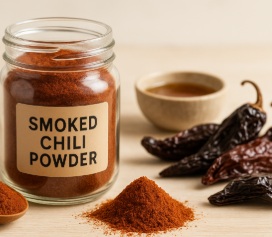
Ground spice obtained from smoke-dried chili peppers (e.g., chipotle, smoked ancho, smoked guajillo, or smoked paprika–type chiles), milled to a fine powder and sometimes blended with salt, garlic, onion, or anti-caking agents.
Primary functions: flavouring, colouring (natural carotenoids), and aroma delivery with a characteristic smoky profile (woody/phenolic).

Caloric value (per 100 g; typical spice powder)
~280–360 kcal; carbohydrates 50–60 g (including fiber 25–35 g), protein 10–15 g, fat 8–12 g, sodium low unless salted.
Use level in foods: commonly 0.2–1.0% of formula (higher in rubs).
Key constituents
Capsaicinoids: capsaicin and dihydrocapsaicin (heat; SHU varies by cultivar/process).
Carotenoids: capsanthin, capsorubin, β-carotene, zeaxanthin (colour; oxidation-sensitive).
Volatile smoke phenolics: guaiacol, syringol, cresols, carbonyls (smoky, sweet, bacon-like notes).
Polyphenols/tannins; minerals (notably potassium). Trace seeds contribute lipids.
Production process
Raw material: sound, mature chiles → washing, de-stemming/de-seeding to target heat and colour.
Smoking/drying: hot-smoking over approved hardwoods (e.g., oak/beech) or application of condensed natural smoke; controlled time/temperature for moisture and PAH compliance.
Milling & grading: hammer/pin milling, sifting to particle size; optional standardisation (colour/SHU) and anti-caking; barrier packaging.
Quality controls: moisture/aw, ASTA colour, SHU/pungency, volatile profile, particle size, microbiology (e.g., Salmonella absent/25 g), mycotoxins (aflatoxins, ochratoxin A), pesticide residues, and PAHs within limits.
Sensory and technological properties
Aroma/flavour: smoky, roasted, mild sweetness; heat from low to high depending on pepper and seeds.
Colouring power: warm red–rust tones; fades with light, heat, oxygen.
Process behaviour: stable in dry systems; colour and top notes attenuate with long wet cooks—add part late in process for freshness.
Food applications
Dry rubs for BBQ/grilling, taco/fajita seasonings, smoky marinades, sausages/plant analogues, snacks (coatings), soups/stews/chili, sauces (BBQ, chipotle, adobo), spreads and dips.
Pairings: tomato, garlic, cumin, coriander, cocoa, molasses, maple, vinegars, and fermented umami (miso/soy—mind allergens).
Nutrition and health
Low dose usage → minimal caloric impact per serving; contributes fiber and phytonutrients.
Capsaicinoids can promote perceived warmth and satiety; may irritate mucosae in sensitive individuals.
Sodium only if blended with salt; choose unsalted for low-sodium recipes.
Fat profile
Low total fat; residual lipids primarily PUFA — polyunsaturated fatty acids (e.g., linoleic n-6; beneficial when balanced, more oxidation-prone) and MUFA — monounsaturated fatty acids (e.g., oleic n-9; often neutral/beneficial), with minimal SFA — saturated fatty acids. TFA — trans fatty acids negligible; MCT — medium-chain triglycerides not significant.
Quality and specifications (typical topics)
Identity/variety, particle size, moisture ≤ 10–12%, aw ≤ ~0.6, ASTA colour (spec-defined), SHU range, ash, extraneous matter.
Safety: Salmonella/E. coli absent, mycotoxins within limits, PAHs controlled (smoked lines), heavy metals within limits.
Stability tests: peroxide value/hexanal (lipid oxidation), colour retention (accelerated), caking index.
Storage and shelf life
Store cool, dark, dry, and airtight; avoid light/heat/oxygen.
Shelf life: typically 12–24 months unopened; use soon after opening; consider oxygen-scavenging or nitrogen flush for premium lines.
Allergens and safety
No major allergens intrinsic; may be blended with allergens (e.g., mustard, sesame, wheat/soy carriers) → check label.
Irritant dust: use PPE, control dust during handling.
For smoked goods, verify PAH compliance; prefer clean condensed smoke to minimise contaminants.
INCI functions in cosmetics (when applicable)
INCI: Capsicum Frutescens Fruit Powder/Extract, Capsicum Annuum Extract, Capsicum Oleoresin.
Roles: warming, rubefacient, antioxidant, masking (use with safety/claim substantiation).
Troubleshooting
Harsh/ashy smoke notes: over-smoking or poor combustion → reduce smoke time/temp, switch to condensed natural smoke, improve airflow.
Dull/browned colour: oxidation/overheating → lower mill temp, add antioxidant (e.g., rosemary extract), improve packaging.
Caking: moisture uptake → increase anti-caking, reduce aw, use barrier packs with desiccant.
Hot spots in blends: seed carryover or poor mixing → standardise SHU, sieve, extend blend time.
Micro failures: implement steam/EO treatment or validated kill-step; maintain GMP/HACCP.
Sustainability and supply chain
Source from traceable farms; encourage solar drying/energy-efficient smokehouses with emission control.
Manage effluents/air toward BOD/COD targets and low-PAH outputs; use recyclable packaging; maintain pesticide/mycotoxin control in upstream drying.
Labelling
Declare pepper variety where relevant (e.g., “chipotle chili powder”, “smoked ancho powder”), and any added ingredients (salt, garlic, anti-caking).
Optional heat indicators (mild/medium/hot or SHU range).
Claims (“no added salt”, “colour from natural sources”, “vegan”) only when compliant.
Conclusion
Smoked chili powder delivers a ready-to-use smoky heat and warm red colour, enabling BBQ-style depth without separate smoking steps. Tight control of variety/SHU, smoke process, moisture/aw, oxidation, and packaging ensures consistent flavour, safe microbiology, and colour stability across culinary and industrial uses.
Mini-glossary
SHU — Scoville heat units: Scale of pungency based on capsaicinoids.
PAH — Polycyclic aromatic hydrocarbons: Smoke-related contaminants; kept low via clean smoke and process control.
ASTA colour: Industry index of red colour strength for paprika/chili products.
PUFA — Polyunsaturated fatty acids: Often beneficial when balanced; more oxidation-prone.
MUFA — Monounsaturated fatty acids: Typically neutral/beneficial and relatively stable.
SFA — Saturated fatty acids: Keep moderated overall; low share in chili powder.
TFA — Trans fatty acids: Negligible in non-hydrogenated spices.
MCT — Medium-chain triglycerides: Not significant in chili powder.
GMP/HACCP — Good manufacturing practice / hazard analysis and critical control points: Preventive systems with validated CCPs.
BOD/COD — Biochemical/chemical oxygen demand: Indicators of wastewater impact from processing.