

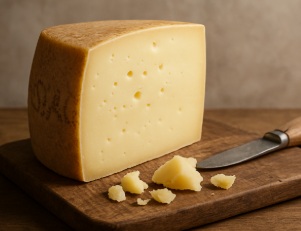
Asiago cheese
Rating : 7
| Evaluation | N. Experts | Evaluation | N. Experts |
|---|---|---|---|
| 1 | 6 | ||
| 2 | 7 | ||
| 3 | 8 | ||
| 4 | 9 | ||
| 5 | 10 |
0 pts from Al222
| Sign up to vote this object, vote his reviews and to contribute to Tiiips.Evaluate | Where is this found? |
| "Descrizione" about Asiago cheese by Al222 (23259 pt) | 2025-Nov-01 21:30 |
| Read the full Tiiip | (Send your comment) |
Asiago cheese (cow’s milk; semi-cooked paste, short–long ripening)
Description
Semi-cooked cow’s-milk cheese made with lactic starter cultures (Italian label: Fermenti Lattici), protected as PDO with two main styles: Asiago Pressato (fresh/mild; short ripening) and Asiago d’Allevo (Mezzano/Vecchio/Stravecchio; progressively longer ripening).
Origin: alpine and foothill areas of Veneto and Trentino (Italy) under a strict PDO specification.
Pressato: elastic, supple paste, fine scattered eyes, milky–buttery, lightly sweet flavor.
d’Allevo: firmer, drier, gradually granular with age; tiny/irregular eyes; nutty–savory with a gentle piquant finish in longer maturations.

Caloric value (per 100 g)
Asiago Pressato: ~330–380 kcal; fat ~26–30 g, protein ~23–25 g, carbohydrate ~0–2 g (very low lactose), salt ~1.6–2.2 g, moisture ~40–44%.
Asiago d’Allevo: ~370–420 kcal; fat ~28–33 g, protein ~25–28 g, carbohydrate ~0–1 g, salt ~1.8–2.5 g, moisture ~34–40%.
Key constituents
Proteins: casein network with calcium–phosphate bridges; trace whey proteins.
Milk fat (triacylglycerols) with fat-soluble vitamins A, D, E, K.
Minerals: high calcium and phosphorus; sodium from brining.
Aroma compounds from proteolysis and lipolysis (more marked in d’Allevo).
Typical markers: pH ~5.1–5.4, % moisture, % salt, fat in dry matter ≥~48–50%, controlled aw.
Production process
Standardized milk (raw or pasteurized per PDO) → addition of starter cultures (Fermenti Lattici) → rennet (mainly calf) → coagulation and fine curd cut.
Semi-cooking of the curd and whey drainage → molding and pressing (more pronounced for Pressato).
Brining → permitted rind treatments (oils/waxes) → ripening:
Pressato: about 20–40 days.
d’Allevo: Mezzano ~4–10 months, Vecchio ~10–15 months, Stravecchio >15 months.
Managed under GMP/HACCP with CCP on pH trajectory, brine time/salt uptake, hygiene, and pack integrity.
Sensory and technological properties
Texture: elastic and melting (Pressato) → drier/ lightly granular as ripening extends (d’Allevo).
Meltability: good melt and moderate stretch; aged d’Allevo melts cleanly but is less stretchy.
Flavor: milky-creamy, buttery and nutty; increasing umami/savoriness and slight piquancy with age.
Food uses
Table cheese/slicing, sandwiches/burgers, gratins/oven dishes, risotti/gnocchi/pasta (finishing), pizza blends, polenta dishes, antipasti (aged d’Allevo with honey/mostarda).
For soups/sauces, add off-boil to minimize graininess.
Nutrition and health
High in protein and calcium; energy-dense with meaningful sodium and saturated fat → practice portion control.
Low lactose (<~0.5 g/100 g, variable) but not always zero.
Smoked variants (where present): manage exposure to keep PAH within limits.
Lipid profile
Typical cow-milk cheese pattern: ~60–70% SFA (saturated fatty acids; high intakes may raise LDL), ~25–33% MUFA (monounsaturated fatty acids, mainly oleic; generally favorable/neutral for blood lipids), ~2–5% PUFA (polyunsaturated fatty acids, linoleic/ALA; beneficial when balanced).
Small natural ruminant TFA (e.g., CLA) and minor MCT (medium-chain triglycerides) occur in milk fat.
Quality and specifications (typical topics)
pH 5.1–5.4, style-appropriate moisture/salt, fat in dry matter ≥~48–50%.
Structure: compact paste with tiny/mechanical openness; absence of bitterness and defect odors.
Microbiology: low counts; Listeria/Salmonella absent/25 g; control of yeasts/molds.
Packaging: barrier films, suitable wax/paraffin; sound seals; full PDO traceability.
Storage and shelf-life
0–4 °C. Unopened: 1–3 months (Pressato) up to 6–12+ months (d’Allevo, depending on pack).
After opening: 7–14 days well wrapped and dry; limit oxygen/humidity to prevent mold and weeping.
Freezing possible for portions/grated (expect slight texture changes).
Allergens and safety
Contains milk (major allergen).
If made from raw milk: comply with required ripening and stringent hygiene; for ready-to-eat products, environmental monitoring for Listeria is essential.
INCI functions in cosmetics
Asiago is not a standard INCI ingredient. Related materials: Lactis (Milk) Protein, Milk Fat/Lactis Lipida, Sodium Caseinate (emollient/skin-conditioning roles in specific formulations).
Troubleshooting
Oiling-off when heated: excessive temperature or cheese too dry → lower heat/time; blend with moister cheeses; optimize salt/calcium balance.
Grainy sauces: too low pH or boiling → add off-boil, use suitable starches/emulsifiers.
Bitterness during aging: excessive proteolysis/lipolysis → review rennet type/dose, ripening time/temperature, and salt.
Surface molds: inadequate barrier/gas exchange → improve packaging and permitted rind treatments.
Sustainability and supply chain
Dairy has notable GHG and water footprints; mitigate via feed/energy efficiency, manure methane capture, recyclable packaging, and optimized cold chain.
Plants: treat effluents to BOD/COD targets; full traceability under GMP/HACCP.
Conclusion
Asiago offers culinary versatility, reliable melt, and rich aromatics. Tight control of pH/salt/moisture, ripening, and heating conditions ensures products that are safe, stable, and sensorially consistent—from fresh Pressato to the more complex Stravecchio.
Mini-glossary
SFA — Saturated fatty acids: High intakes can raise LDL; favor partial replacement with unsaturated fats.
MUFA — Monounsaturated fatty acids (e.g., oleic): Generally favorable/neutral for blood lipids.
PUFA — Polyunsaturated fatty acids (e.g., linoleic/ALA): Beneficial when balanced; more oxidation-prone.
TFA — Trans fatty acids: Small natural amounts in dairy (CLA); industrial TFA should be avoided.
MCT — Medium-chain triglycerides (C6–C12): Minor fraction of milk fat.
GMP/HACCP — Good Manufacturing Practice / Hazard Analysis and Critical Control Points: Hygiene and preventive-safety systems with defined CCP.
CCP — Critical control point: Processing step where a control prevents/reduces a hazard (e.g., pH, brining, sealing).
BOD/COD — Biochemical/Chemical oxygen demand: Wastewater impact indicators for dairies.
aw — Water activity: “Free” water availability; lower aw improves stability.
References__________________________________________________________________________
Lora I, Zidi A, Magrin L, Prevedello P, Cozzi G. An insight into the dairy chain of a Protected Designation of Origin cheese: The case study of Asiago cheese. J Dairy Sci. 2020 Oct;103(10):9116-9123. doi: 10.3168/jds.2019-17484.
Abstract. The Protected Designation of Origin (PDO) label of the European Union safeguards and guarantees top-quality traditional agri-food products that must be manufactured in a specific region according to traditional production methods. Production specifications of PDO cheeses are often focused on the cheese-making process and lack information on the dairy farming system that is upstream of the chain. This case study aimed to analyze and cluster the dairy farms that supply milk to the chain of Asiago, an internationally known PDO cheese of northeastern Italy. A large survey involving all of the cheese factories of the Asiago PDO chain was made in 2017. Each cheese factory submitted a questionnaire to its supplying dairy farmers concerning (1) farm facilities and herd management and (2) feeding program of lactating cows. Results from 517 farms were processed; there were 67 ± 27% (mean ± standard deviation) respondents per cheese factory. Four clusters of dairy farms were identified by hierarchical clustering analysis. Cluster 1 (8% of the surveyed farms) and cluster 2 (22%) are small in size and low in yield, representing the traditional milk production system; farms are mainly located on mountains or hills and have autochthonous dual-purpose breeds mostly housed in tiestall barns. By rearing cattle of endangered breeds and feeding cows primarily with forages produced on-farm together with the use of pasture, these clusters, and especially cluster 1, have shown to provide essential ecosystem services for landscape and biodiversity preservation in the alpine areas. Clusters 3 and 4 (34 and 36% of the surveyed farms, respectively) gather medium-scale farms mainly located in the lowland that operate according to modern management and housing systems and rear high-producing dairy cows. These cows are mainly fed total mixed rations based on corn silage, but the dietary forage:concentrate ratio is kept relatively high, as farmers are more interested in producing high-quality milk for cheese-making than pushing for yield. Regardless of the cluster allocation, a considerable cow longevity, which is a recognized "iceberg indicator" of cattle well-being, was highlighted. This study showed that different farming systems may lay behind a single PDO cheese. The knowledge of their characteristics is important to reinforce the PDO production specifications as well as to distinguish and protect niche products that come from specific groups of farms that provide essential ecosystem services. The Authors. Published by Elsevier Inc. and Fass Inc. on behalf of the American Dairy Science Association®.
Segato S, Galaverna G, Contiero B, Berzaghi P, Caligiani A, Marseglia A, Cozzi G. Identification of Lipid Biomarkers To Discriminate between the Different Production Systems for Asiago PDO Cheese. J Agric Food Chem. 2017 Nov 15;65(45):9887-9892. doi: 10.1021/acs.jafc.7b03629.
Abstract. The lipid fraction of Asiago Protected Designation of Origin (PDO) cheese was analyzed to identify specific biomarkers of its main production systems through a canonical discriminant analysis. The three main production systems of the cheese were considered. Two were located in the upland (UL): pasture-based (P-UL) vs hay-based total mixed rations (H-UL). The third was located in the lowland (LL) and processed milk from cows fed maize silage-based rations (maize silage lowland: MS-LL). The discriminant analysis selected nine fatty acids and vitamin A as lipid biomarkers useful to separate the three production systems. High contents of conjugated linoleic acids, anteiso-C15:0, and vitamin A were discriminant factors for P-UL cheese. The separation between H-UL and MS-LL cheese was less marked with the former having the higher content of conjugated linoleic acids and some polyunsaturated n-6 fatty acids and with the latter being identified by cyclopropane fatty acid and C9:0.
Segato S, Caligiani A, Contiero B, Galaverna G, Bisutti V, Cozzi G. 1H NMR Metabolic Profile to Discriminate Pasture Based Alpine Asiago PDO Cheeses. Animals (Basel). 2019 Sep 25;9(10):722. doi: 10.3390/ani9100722.
Abstract. The study was carried out in an alpine area of North-Eastern Italy to assess the reliability of proton nuclear magnetic resonance 1H NMR to fingerprint and discriminate Asiago PDO cheeses processed in the same dairy plant from upland pasture-based milk or from upland hay-based milk. Six experimental types of Asiago cheese were made from raw milk considering 2 cows' feeding systems (pasture- vs. hay-based milk) and 3 ripening times (2 months, Pressato vs. 4 months, Allevo_4 vs. 6 months, Allevo_6). Samples (n = 55) were submitted to chemical analysis and to 1H NMR coupled with multivariate canonical discriminant analysis. Choline, 2,3-butanediol, lysine, tyrosine, and some signals of sugar-like compounds were suggested as the main water-soluble metabolites useful to discriminate cheese according to cows' feeding system. A wider pool of polar biomarkers explained the variation due to ripening time. The validation procedure based on a predictive set suggested that 1H NMR based metabolomics was an effective fingerprinting tool to identify pasture-based cheese samples with the shortest ripening period (Pressato). The classification to the actual feeding system of more aged cheese samples was less accurate likely due to their chemical and biochemical changes induced by a prolonged maturation process.
Segato, Severino, et al. "Effect of period of milk production and ripening on quality traits of Asiago cheese." Italian Journal of Animal Science 6.sup1 (2007): 469-471.
Abstract. After 6 and 12 months of ripening, samples of Asiago d’Allevo were analyzed for quality traits. Cheeses were produced during 3 periods using milk from cows fed a total mixed ration (TMR, May) or grazing on alpine pasture (AG) in early (July) and late (Sept.) summer. Data were submitted to ANOVA considering ripening, milk production period and farm as main effects, and whole cheese weight as covariate. During ripening, pH of AG-cheese was significantly lower than that of TMR-cheese; crude fat and protein significantly increased. According to period, July-samples showed the significantly lowest value of dry matter (DM), maybe due to a lower crude fat con-tent; however, variability in skimming method could have altered proximate composition. No texture differences were found, although increasing weight of whole cheese significantly reduced max shear force as result of a lower DM content. Lightness (L*) and yellowness (b*) significantly decreased during ripening. AG feeding system caused a lower L* and higher b* than TMR one, probably as a consequence of a different amount of milk pigments. Cheese varied also within AG season: Sept.-samples showed the lowest L* value and the highest b*.
Lignitto, Laura, et al. "Angiotensin-converting enzyme inhibitory activity of water-soluble extracts of Asiago d'allevo cheese." International dairy journal 20.1 (2010): 11-17.
Abstract. The angiotensin-converting enzyme (ACE) inhibitory activity of water-soluble extracts (WSE) from Asiago cheeses was assayed in two cheese production systems and with different ripening times. The WSE were ultrafiltered through 10 kDa and 3 kDa cut-off membranes to evaluate the ACE inhibitory activity of long and short peptides, respectively. The cheese production systems had no significant effect on the ACE inhibitory activity, whereas 6-month-old cheeses had higher inhibitory potency than the more ripened ones. Moreover, the fraction containing peptides smaller than 3 kDa made a more considerable contribution to ACE inhibitory activity than the fraction smaller than 10 kDa, suggesting an inhibitory effect due to short peptides. The peptidic fraction was characterized using RP-HPLC coupled to mass spectrometric detection. Simulated gastrointestinal digestion was carried out to evaluate the effects of digestive enzymes on the generation of bioactive peptides, but this did not significantly affect the inhibitory activity.
| Sign up to vote this object, vote his reviews and to contribute to Tiiips.EvaluateClose | (0 comments) |
Read other Tiiips about this object in __Italiano (1)
Component type:   Natural Main substances:   Last update:   2025-11-13 19:10:24 | Chemical Risk:   |

