

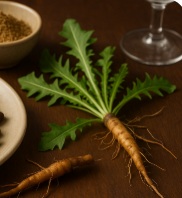
Dandelion root
Rating : 7
| Evaluation | N. Experts | Evaluation | N. Experts |
|---|---|---|---|
| 1 | 6 | ||
| 2 | 7 | ||
| 3 | 8 | ||
| 4 | 9 | ||
| 5 | 10 |
0 pts from Al222
| Sign up to vote this object, vote his reviews and to contribute to Tiiips.Evaluate | Where is this found? |
| "Descrizione" about Dandelion root by Al222 (23254 pt) | 2025-Oct-23 12:49 |
| Read the full Tiiip | (Send your comment) |
Dandelion root
Taraxacum officinale—dandelion or blowball—is a perennial herb in the Asteraceae family. Ubiquitous across Europe and other temperate regions, it colonizes lawns, meadows, roadsides, and disturbed soils. It’s easily recognized by its basal rosette of toothed leaves, bright yellow flower heads, and spherical seed heads (“clocks”) with wind-borne parachute seeds.
Kingdom: Plantae
Clade: Angiosperms – Eudicots
Order: Asterales
Family: Asteraceae
Genus: Taraxacum
Species: T. officinale

Habit: Taprooted perennial; the taproot can exceed 30–40 cm in depth.
Leaves: Basal rosette; lobed/serrated (hence “lion’s tooth”); exude white latex.
Flowers: Single capitulum on a hollow scape (10–40 cm), composed entirely of yellow ligulate florets; very long flowering season (spring to autumn).
Fruits: Achenes with a long beak topped by a plumose pappus for wind dispersal.
Ecology: Tolerant of compacted soils and pH from slightly acidic to slightly alkaline; indicates nitrate-rich soils.
Leaves: Vitamins A, C, K, folate; minerals (K, Ca, Mg); polyphenols (chlorogenic & caffeic acids), flavonoids (luteolin, apigenin).
Root: Inulin (prebiotic), triterpenes (taraxasterol, β-amyrin), sesquiterpene lactones (taraxacolides), phytosterols.
Latex: Terpenes and natural rubbers (notably in T. kok-saghyz; a rubber source).
Flowers/seeds: Carotenoids (lutein), xanthophylls; trace coumarins.
Activities: Diuretic, choleretic/cholagogue, mild bitter-tonic, prebiotic (inulin), antioxidant.
Soil: Loam to sandy loam, well drained; tolerates heavier soils if aerated.
Exposure: Full sun to partial shade (shade yields tender but less aromatic leaves).
Sowing/planting: Broadcast in spring or autumn; 20–25 cm spacing. For blanched leaves, exclude light (forcing).
Watering: Moderate; drought-tolerant due to deep taproot, but steady moisture boosts leaf yield.
Care: Hand weeding, organic mulches; rotate away from other Asteraceae to limit soil pathogens.
Harvest: Young leaves in spring/autumn; flower buds before opening; roots in autumn (peak inulin).
Herbal/traditional: Supportive in hyposecretory dyspepsia, seasonal “depurative” use, liver–biliary support, gentle diuretic (high in potassium).
Nutrition: Wild green with high micronutrient density; bitters stimulate gastric and pancreatic secretions.
Metabolic/gut: Root inulin acts as a prebiotic (favours Bifidobacterium); potential benefits for regularity and lipid metabolism.
Antioxidant: Polyphenols and carotenoids contribute to radical-scavenging capacity.
Culinary:
Raw leaves in rustic salads (classic with hard-boiled eggs, bacon, citrus); blanched or sautéed like spinach; in risottos and frittatas.
Flower buds pickled as “dandelion capers.”
Flowers for syrups, “honeys,” country wines; petals as garnish.
Roasted, ground roots as “dandelion coffee.”
Herbal forms: Leaf/root teas and decoctions; fluid extracts, tincture; often paired with Silybum marianum, Cynara scolymus, Urtica dioica.
Cosmetic: Antioxidant/soothing extracts in toners and creams for dull or blemish-prone skin.
Other: Early nectar source for pollinators; light phytoremediation of nitrate-rich soils; early spring forage.
Sustainability: Wild, pioneer species; harvest away from polluted areas (roadsides/industrial sites) to avoid heavy metals/contaminants.
Allergy/safety: Possible reactions in those allergic to Asteraceae (latex/pollen). Choleretic action—avoid with obstructive gallstones unless advised by a clinician.
Interactions: Diuretic effect may enhance drug elimination; caution with diuretics/antihypertensives. High vitamin K in leaves—monitor with anticoagulant therapy.
Pregnancy/lactation: Culinary use is fine; seek professional guidance for medicinal dosing.
Tea (leaf/root): 2–4 g per 200–250 ml, 1–3×/day.
Dry extract (root, standardized): 200–500 mg, 1–2×/day (per product titration).
Tincture: 30–50 drops, 1–3×/day.
(General ranges—individualize with a qualified practitioner.)
Look-alikes: Young rosettes resemble Hypochaeris and Sonchus. Dandelion has a single head per hollow scape and abundant white latex.
Bitterness management: Brief soak in cold water or quick blanch; shaded growth produces milder leaves.

Abstract. Taraxacum officinale has been widely used as a folkloric medicine for the treatment of diverse diseases. The dried plant was extracted with 70% ethanol to generate its ethanol extract (TEE). For some experiments, ethyl acetate (EA), n-butanol (BuOH) and aqueous (Aq) fractions were prepared in succession from TEE. TEE showed a scavenging activity in the 1,1-diphenyl-2-picrylhydrazyl (DPPH) assay, a diminishing effect on intracellular reactive oxygen species (ROS) level, and an anti-angiogenic activity in the chicken chorioallantoic (CAM) assay. In the carrageenan-induced air pouch model, TEE inhibited production of exudate, and significantly diminished nitric oxide (NO) and leukocyte levels in the exudate. It also possessed an inhibitory effect on acetic acid-induced vascular permeability and caused a dose-dependent inhibition on acetic acid-induced abdominal writhing in mice. Suppressive effects of TEE on the production of NO and expression of inducible nitric oxide synthase (iNOS) and cyclooxygenase-2 (COX-2) in lipopolysaccharide (LPS)-stimulated macrophages were also assessed. Among the fractions, the n-butanol fraction (BuOH) was identified to be most effective in the CAM assay. Collectively, Taraxacum officinale contains anti-angiogenic, anti-inflammatory and anti-nociceptive activities through its inhibition of NO production and COX-2 expression and/or its antioxidative activity.
Fan M, Zhang X, Song H, Zhang Y. Dandelion (Taraxacum Genus): A Review of Chemical Constituents and Pharmacological Effects. Molecules. 2023 Jun 27;28(13):5022. doi: 10.3390/molecules28135022.
Abstract. Dandelion (Taraxacum genus) is a perennial herb belonging to the Asteraceae family. As a well-known and extensively studied genus, dandelion comprises numerous species. Some species have been widely used in both complementary and alternative medicine to clear heat, detoxify, activate blood circulation, dispel stasis, and discharge urine. Multiple pharmacological studies have highlighted its therapeutic potential, including anti-bacterial, anti-oxidant, anti-cancer, and anti-rheumatic activities. Furthermore, bioactive compounds associated with these effects include sesquiterpenoids, phenolic compounds, essential oils, saccharides, flavonoids, sphingolipids, triterpenoids, sterols, coumarins, etc. Based on recent studies about the Taraxacum genus, the present review critically evaluates the current state of dandelion utilization and summarizes the significant roles of dandelion and its constituents in different diseases. We also focus on the reported phytology, chemical composition, pharmacology, and toxicity of dandelion, along with the main possible action mechanisms behind their therapeutic activities. Meanwhile, the challenges and future directions of the Taraxacum genus are also prospected in this review, thus highlighting its pharmaceutical research and practical clinical applications.
Wirngo FE, Lambert MN, Jeppesen PB. The Physiological Effects of Dandelion (Taraxacum Officinale) in Type 2 Diabetes. Rev Diabet Stud. 2016 Summer-Fall;13(2-3):113-131. doi: 10.1900/RDS.2016.13.113.
Abstract. The tremendous rise in the economic burden of type 2 diabetes (T2D) has prompted a search for alternative and less expensive medicines. Dandelion offers a compelling profile of bioactive components with potential anti-diabetic properties. The Taraxacum genus from the Asteraceae family is found in the temperate zone of the Northern hemisphere. It is available in several areas around the world. In many countries, it is used as food and in some countries as therapeutics for the control and treatment of T2D. The anti-diabetic properties of dandelion are attributed to bioactive chemical components; these include chicoric acid, taraxasterol (TS), chlorogenic acid, and sesquiterpene lactones. Studies have outlined the useful pharmacological profile of dandelion for the treatment of an array of diseases, although little attention has been paid to the effects of its bioactive components on T2D to date. This review recapitulates previous work on dandelion and its potential for the treatment and prevention of T2D, highlighting its anti-diabetic properties, the structures of its chemical components, and their potential mechanisms of action in T2D. Although initial research appears promising, data on the cellular impact of dandelion are limited, necessitating further work on clonal β-cell lines (INS-1E), α-cell lines, and human skeletal cell lines for better identification of the active components that could be of use in the control and treatment of T2D. In fact, extensive in-vitro, in-vivo, and clinical research is required to investigate further the pharmacological, physiological, and biochemical mechanisms underlying the effects of dandelion-derived compounds on T2D.
Laquale S, Avato P, Argentieri MP, Candido V, Perniola M, D'Addabbo T. Nematicidal potential of Taraxacum officinale. Environ Sci Pollut Res Int. 2018 Oct;25(30):30056-30065. doi: 10.1007/s11356-018-2903-4.
Abstract. This study was aimed to investigate the activity of the Asteraceae species Taraxacum officinale against the root-knot nematode Meloidogyne incognita. Leaf and root extracts of T. officinale were tested in vitro at a range of 62.5-1000 and 250-1000 μg mL-1 concentrations on nematode juveniles and eggs, respectively, whereas treatments with 10-40 g kg-1 soil rates of dry leaf and root T. officinale biomass were applied to soil infested by M. incognita in greenhouse experiments on potted tomato. Peak 36 and 50% juvenile mortality and 14.8 and 23.8% egg hatchability reduction were recorded at the maximum concentration of leaf and root extracts, respectively. Soil treatments with T. officinale leaf and root material strongly suppressed nematode multiplication and gall formation on tomato roots and significantly increased plant growth. Chicoric acid and 3-O- and 3,5-di-O-caffeoylquinic acid were found to be the main components of leaf and root extract, respectively, and proved, as the total hydroalcoholic extracts from T. officinale leaf and root material, for an antioxidant activity. Data from this study indicate the suitability of plant materials from T. officinale for a potential formulation of nematicidal products to include in sustainable nematode management strategies.
Lis B, Jedrejek D, Rywaniak J, Soluch A, Stochmal A, Olas B. Flavonoid Preparations from Taraxacum officinale L. Fruits-A Phytochemical, Antioxidant and Hemostasis Studies. Molecules. 2020 Nov 18;25(22):5402. doi: 10.3390/molecules25225402.
Abstract. Dandelion (Taraxacum officinale L.) roots, leaves, and flowers have a long history of use in traditional medicine. Compared to the above organs, dandelion fruits are the least known and used. Hence, the present paper was aimed at the phytochemical analysis of T. officinale fruit extract and estimating its antiradical, antiplatelet, and antioxidant properties related to hemostasis. Methanolic extract of fruits (E1), enriched with polyphenols (188 mg gallic acid equivalents (GAE)/g), was successfully separated into cinnamic acids (E2; 448 mg GAE/g) and flavonoids (E3; 377 mg GAE/g) extracts. Flavonoid extract was further divided into four fractions characterized by individual content: A (luteolin fraction; 880 mg GAE/g), B (philonotisflavone fraction; 516 mg GAE/g), C (flavonolignans fraction; 384 mg GAE/g), and D (flavone aglycones fraction; 632 mg GAE/g). High DPPH radical scavenging activity was evaluated for fractions A and B (A > B > Trolox), medium for extracts (Trolox > E3 > E2 > E1), and low for fractions C and D. No simple correlation between polyphenol content and antiradical activity was observed, indicating a significant influence of qualitative factor, including higher anti-oxidative effect of flavonoids with B-ring catechol system compared to hydroxycinnamic acids. No cytotoxic effect on platelets was observed for any dandelion preparation tested. In experiments on plasma and platelets, using several different parameters (lipid peroxidation, protein carbonylation, oxidation of thiols, and platelet adhesion), the highest antioxidant and antiplatelet potential was demonstrated by three fruit preparations-hydroxycinnamic acids extract (E2), flavonoid extract (E3), and luteolin fraction (A). The results of this paper provide new information on dandelion metabolites, as well as their biological potential and possible use concerning cardiovascular diseases.
Kamal FZ, Lefter R, Mihai CT, Farah H, Ciobica A, Ali A, Radu I, Mavroudis I, Ech-Chahad A. Chemical Composition, Antioxidant and Antiproliferative Activities of Taraxacum officinale Essential Oil. Molecules. 2022 Oct 1;27(19):6477. doi: 10.3390/molecules27196477.
Abstract. Taraxacum officinale (TO) has been historically used for medicinal purposes due to its biological activity against specific disorders. To investigate the antioxidant and the antiproliferativepotential of TO essential oil in vitro and in vivo, the chemical composition of the essential oil was analyzed by GC-MS. The in vivo antioxidant capacity was assessed on liver and kidney homogenate samples from mice subjected to acetaminophen-induced oxidative stress and treated with TO essential oil (600 and 12,000 mg/kg BW) for 14 days. The in vitro scavenging activity was assayed using the 1,1-diphenyl-2-picrylhydrazyl (DPPH) and the reducing power methods. The cytotoxic effects against the HeLa cancer cell line were analyzed. The GC-MS analysis showed the presence of 34 compounds, 8 of which were identified as major constituents. The TO essential oil protected mice's liver and kidneys from acetaminophen-induced oxidative stress by enhancing antioxidant enzymes (catalase, superoxide dismutase, and glutathione) and lowering malondialdehyde levels. In vitro, the TO essential oil demonstrated low scavenging activity against DPPH (IC50 = 2.00 ± 0.05 mg/mL) and modest reducing power (EC50 = 0.963 ± 0.006 mg/mL). The growth of the HeLa cells was also reduced by the TO essential oil with an inhibition rate of 83.58% at 95 µg/mL. Current results reveal significant antioxidant and antiproliferative effects in a dose-dependent manner and suggest that Taraxacum officinale essential oil could be useful in formulations for cancer therapy.
Hao F, Deng X, Yu X, Wang W, Yan W, Zhao X, Wang X, Bai C, Wang Z, Han L. Taraxacum: A Review of Ethnopharmacology, Phytochemistry and Pharmacological Activity. Am J Chin Med. 2024;52(1):183-215. doi: 10.1142/S0192415X24500083.
Abstract. Taraxacum refers to the genus Taraxacum, which has a long history of use as a medicinal plant and is widely distributed around the world. There are over 2500 species in the genus Taraxacum recorded as medicinal plants in China, Central Asia, Europe, and the Americas. It has traditionally been used for detoxification, diuresis, liver protection, the treatment of various inflammations, antimicrobial properties, and so on. We used the most typically reported Taraxacum officinale as an example and assembled its chemical makeup, including sesquiterpene, triterpene, steroids, flavone, sugar and its derivatives, phenolic acids, fatty acids, and other compounds, which are also the material basis for its pharmacological effects. Pharmacological investigations have revealed that Taraxacum crude extracts and chemical compounds contain antimicrobial infection, anti-inflammatory, antitumor, anti-oxidative, liver protective, and blood sugar and blood lipid management properties. These findings adequately confirm the previously described traditional uses and aid in explaining its therapeutic applications.
Martinez M, Poirrier P, Chamy R, Prüfer D, Schulze-Gronover C, Jorquera L, Ruiz G. Taraxacum officinale and related species-An ethnopharmacological review and its potential as a commercial medicinal plant. J Ethnopharmacol. 2015 Jul 1;169:244-62. doi: 10.1016/j.jep.2015.03.067. Epub 2015 Apr 6. PMID: 25858507.
Li Y, Chen Y, Sun-Waterhouse D. The potential of dandelion in the fight against gastrointestinal diseases: A review. J Ethnopharmacol. 2022 Jul 15;293:115272. doi: 10.1016/j.jep.2022.115272.
Menke K, Schwermer M, Felenda J, Beckmann C, Stintzing F, Schramm A, Zuzak TJ. Taraxacum officinale extract shows antitumor effects on pediatric cancer cells and enhance mistletoe therapy. Complement Ther Med. 2018 Oct;40:158-164. doi: 10.1016/j.ctim.2018.03.005. Epub 2018 Mar 13. PMID: 30219442.
| Sign up to vote this object, vote his reviews and to contribute to Tiiips.EvaluateClose | (0 comments) |
Read other Tiiips about this object in __Italiano (1)
Component type:   Natural Main substances:   Last update:   2025-10-23 12:36:52 | Chemical Risk:   |

