

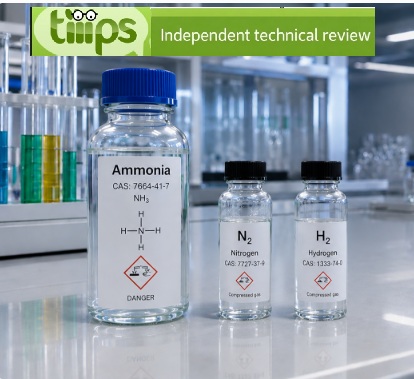
Ammonia
Rating : 5
| Evaluation | N. Experts | Evaluation | N. Experts |
|---|---|---|---|
| 1 | 6 | ||
| 2 | 7 | ||
| 3 | 8 | ||
| 4 | 9 | ||
| 5 | 10 |
Cons:
Cosmetics Regulation provisions (1) Possible eye irritant (1)0 pts from Al222
| Sign up to vote this object, vote his reviews and to contribute to Tiiips.Evaluate | Where is this found? |
| "Descrizione" about Ammonia by Al222 (24919 pt) | 2026-Jul-01 09:13 |
| Read the full Tiiip | (Send your comment) |
Ammonia: properties, uses, pros, cons, safety
Ammonia is an inorganic nitrogen compound with the formula NH3, a molecular weight of about 17.03 g/mol, and CAS number 7664-41-7. At room temperature, in its pure anhydrous form, it is a colorless gas, highly volatile, with a pungent and easily recognizable odor. In water it forms a basic solution commonly referred to as aqueous ammonia or ammonium hydroxide, often conventionally represented by the formula NH4OH, although from a chemical standpoint it is an equilibrium between dissolved ammonia, ammonium ions, and hydroxide ions. Chemical databases therefore distinguish between anhydrous ammonia, CAS 7664-41-7, and ammonium hydroxide, CAS 1336-21-6.

Description
Ammonia is a simple molecule but of enormous technical, biological, and industrial importance. It occurs naturally in nitrogen metabolism, in the degradation of nitrogen-containing organic substances, and in many environmental processes. However, when discussing industrial, food, or cosmetic use, it is necessary to distinguish precisely between anhydrous ammonia, used mainly in technical and industrial contexts, and aqueous ammonia solutions, used in many applications as pH regulators, alkalizing agents, or process intermediates.
From a chemical standpoint, it is a weak base, capable of accepting protons and forming the ammonium ion NH4+. This property explains many of its uses: pH regulation, acid neutralization, production of ammonium salts, surface treatment, technical cleaning, fertilizers, chemical synthesis, and, at controlled concentrations, some food and cosmetic applications.
Production process
Industrially, ammonia is produced mainly through the Haber-Bosch process, which combines atmospheric nitrogen N2 and hydrogen H2 in the presence of catalysts, at high temperatures and pressures, according to the reaction:
N2 + 3 H2 ⇌ 2 NH3
Hydrogen has historically been obtained largely from natural gas through steam reforming, although more recent supply chains are oriented toward so-called green ammonia, based on hydrogen produced by water electrolysis using renewable energy. The Haber-Bosch process remains one of the pillars of modern chemical industry, especially for the production of nitrogen fertilizers.
Ammonium hydroxide, on the other hand, is obtained by absorbing gaseous ammonia in water. United States food regulations describe ammonium hydroxide as a product obtained by passing ammonia gas into water.
Main compounds present
In the case of anhydrous ammonia, the main compound is NH3. In aqueous solutions, however, it is not correct to imagine a single stable substance “NH4OH” as an isolated molecule: the system is an equilibrium between:
NH3: free dissolved ammonia;
NH4+: ammonium ion;
OH-: hydroxide ion;
H2O: water as solvent.
Commercial solutions may also contain small amounts of impurities or stabilizers, depending on whether the grade is technical, food, pharmaceutical, or cosmetic. For this reason, it is always important to distinguish between technical grade, food grade, cosmetic grade, and laboratory grade.
Identification data and specifications
| Characteristic | Value | Note |
|---|---|---|
| Common name | Ammonia | anhydrous substance or NH3 gas |
| INCI name | AMMONIA | in cosmetics as an ingredient/technical function |
| Molecular formula | NH3 | anhydrous ammonia |
| Conventional formula in solution | NH4OH | representation of ammonia in water |
| Molecular weight | about 17.03 g/mol | referred to NH3 |
| CAS anhydrous ammonia | 7664-41-7 | main reference |
| EC anhydrous ammonia | 231-635-3 | EU reference |
| CAS ammonium hydroxide | 1336-21-6 | aqueous solution |
| EC ammonium hydroxide | 215-647-6 | EU reference |
| E-number / INS | E527 / INS 527 | food-grade ammonium hydroxide |
| Chemical category | inorganic base / nitrogen compound | alkalizing agent and pH regulator |
| Technical origin | synthetic or from natural/environmental processes | industrially mainly Haber-Bosch |
| Cosmetic functions | buffering, masking; for ammonium hydroxide also denaturant | according to CosIng |
Indicative physicochemical properties
| Characteristic | Indicative value | Note |
|---|---|---|
| Appearance | colorless gas | for anhydrous ammonia |
| Odor | pungent, characteristic | detectable even at low concentrations |
| Boiling point | about -33 °C | referred to anhydrous NH3 |
| Water solubility | very high | forms alkaline solutions |
| pH of solutions | basic | depends on concentration |
| Relative gas density | lower than air | gas lighter than air |
| Flammability | explosive range about 15–28% in air | relevant in industrial contexts |
| Compatibility | incompatible with strong acids, oxidizers, halogens, and some metals | may corrode copper and galvanized surfaces |
| Main hazard | irritant/corrosive depending on concentration | risk for eyes, skin, and respiratory tract |
NIOSH reports ammonia explosive limits in air of about 15–28%, incompatibility with strong oxidizers, acids, halogens, and some metal salts, and relevant exposure routes such as inhalation, skin/eye contact, and ingestion of solutions.
Food
In the food sector, anhydrous ammonia is not used as such; instead, ammonium hydroxide, namely ammonia dissolved in water, is used as an additive/acidity regulator. In the European Union it is identified as E527, while in the international INS/JECFA system it is listed as INS 527 and classified as an acidity regulator.
In the United States, ammonium hydroxide is recognized as a GRAS food ingredient under 21 CFR § 184.1139, used according to good manufacturing practice as a leavening agent, pH control agent, surface-finishing agent, and boiler-water additive under specific conditions.
From a nutritional standpoint, it has no direct value: it is not a nutrient, but a technological aid or chemical-physical regulator. Its use mainly serves to modify pH, facilitate certain processing transformations, or obtain specific technological effects in industrial food products.
Cosmetics
In cosmetics, ammonia and ammonium hydroxide are used mainly as pH regulators and alkalizing agents. The best-known sector is hair dyes, where ammonia helps open the hair cuticle and creates an alkaline environment favorable to the action of oxidative dyes and hydrogen peroxide. It may also be present in some technical hair products and in formulations where pH correction or stabilization is required.
Within the European cosmetic framework, ammonia is a restricted substance: Annex III of the cosmetic regulation sets for ammonia a maximum concentration of 6% calculated as NH3, with the obligation to indicate “Contains ammonia” when the concentration exceeds 2%.
This does not mean that ammonia is prohibited in cosmetics, but that it must be used within precise limits and with appropriate labeling. In hair products, its pungent odor and irritant potential have encouraged the development of “ammonia-free” formulas, often based on other alkalizing agents, but this does not automatically mean greater gentleness: safety always depends on the entire formula and the final pH.
Industrial and household uses
In addition to food and cosmetic applications, ammonia has an enormous role in industry. It is used in the production of nitrogen fertilizers, ammonium salts, urea, nitric acid, technical detergents, industrial refrigeration, and numerous chemical processes. As a refrigerant it is also known by the code R-717.
In household use, diluted ammonia solutions are used as cleaners and degreasers, especially for glass, hard surfaces, and greasy dirt. However, they must never be confused with harmless ingredients: even household solutions can be irritating and must never be mixed with bleach, acids, or other chemicals, because toxic vapors or dangerous reactions may develop.
Pros
It is a chemically simple substance, very effective as a base and pH regulator.
It plays a fundamental industrial role in the production of nitrogen fertilizers.
In the form of ammonium hydroxide, it is authorized as the food additive E527/INS 527 with the function of acidity regulator.
In cosmetics it is useful in hair products, especially oxidative hair dyes, to create the alkaline environment required for the process.
It is highly volatile, so in many applications it tends not to leave high permanent residues.
It is a well-known substance, extensively studied from chemical, toxicological, and industrial viewpoints.
Cons
It has a strong, pungent, and easily perceptible odor.
It is irritating to eyes, skin, and respiratory tract; at high concentrations it can be corrosive.
Concentrated solutions require professional handling, protective equipment, and good ventilation.
In cosmetics it is subject to specific limits and warnings when it exceeds certain concentrations.
In household use it can become dangerous if improperly mixed with other products, especially bleach or acids.
Traditional industrial production through Haber-Bosch, when based on fossil fuels, has significant energy and climate impact.
Safety, regulation, and environment
From a safety standpoint, ammonia is primarily a local contact toxicant: the most important targets are the respiratory tract, eyes, skin, and mucous membranes. ATSDR/NCBI emphasizes that ammonia is most hazardous as a substance that damages the site of contact: after inhalation, the respiratory system is the main target; after oral exposure, the gastrointestinal tract and mucous membranes are the main targets; after dermal/ocular contact, the skin and eyes are the targets.
Acute exposure may cause irritation, coughing, burning eyes, tearing, and breathing difficulty; high concentrations may cause chemical burns, airway edema, and lung damage. The NIOSH IDLH value for ammonia is used as a reference for immediate danger to life and health in occupational settings, confirming the need for strict management in industrial situations.
From the cosmetic standpoint, the substance is not prohibited but is restricted. The maximum permitted concentration is 6% as NH3, and above 2% the warning “contains ammonia” is required. In food, the relevant substance is mainly ammonium hydroxide E527, used as an acidity regulator and not as a nutritional substance.
From an environmental standpoint, ammonia is a natural part of the nitrogen cycle, but excessive emissions can contribute to eutrophication, formation of secondary particulate matter, and ecosystem alteration. The environmental balance depends greatly on the specific use: fertilizers, livestock farming, industrial processes, refrigeration, and chemical treatment have very different impact profiles.
Conclusion
Ammonia is a substance of great technical importance: simple in formula, but extremely relevant in industrial chemistry, agriculture, food, cosmetics, and cleaning. Its main value derives from its ability to act as a base, pH regulator, chemical intermediate, and source of reactive nitrogen.
In practical assessment it is essential to distinguish between anhydrous ammonia, aqueous ammonia/ammonium hydroxide, food grade, cosmetic grade, and technical grade. In food it is relevant as E527, in cosmetics as an alkalizing and pH-regulating substance subject to restrictions, while in industry it remains one of the most important molecules in the modern chemical economy.
The critical point is safety: ammonia should not be considered harmless simply because it is common or natural in the nitrogen cycle. In concentrated form it is irritating, corrosive, and potentially dangerous by inhalation, eye contact, and skin contact. In correct, controlled, and regulation-compliant formulations, it can be used effectively; outside appropriate technical use, however, it requires great caution.
References__________________________________________________________________________
Olde Damink SW, Deutz NE, Dejong CH, Soeters PB, Jalan R. Interorgan ammonia metabolism in liver failure. Neurochem Int. 2002 Aug-Sep;41(2-3):177-88. doi: 10.1016/s0197-0186(02)00040-2.
Abstract. In the post-absorptive state, ammonia is produced in equal amounts in the small and large bowel. Small intestinal synthesis of ammonia is related to amino acid breakdown, whereas large bowel ammonia production is caused by bacterial breakdown of amino acids and urea. The contribution of the gut to the hyperammonemic state observed during liver failure is mainly due to portacaval shunting and not the result of changes in the metabolism of ammonia in the gut. Patients with liver disease have reduced urea synthesis capacity and reduced peri-venous glutamine synthesis capacity, resulting in reduced capacity to detoxify ammonia in the liver. The kidneys produce ammonia but adapt to liver failure in experimental portacaval shunting by reducing ammonia release into the systemic circulation. The kidneys have the ability to switch from net ammonia production to net ammonia excretion, which is beneficial for the hyperammonemic patient. Data in experimental animals suggest that the kidneys could have a major role in post-feeding and post-haemorrhagic hyperammonemia.During hyperammonemia, muscle takes up ammonia and plays a major role in (temporarily) detoxifying ammonia to glutamine. Net uptake of ammonia by the brain occurs in patients and experimental animals with acute and chronic liver failure. Concomitant release of glutamine has been demonstrated in experimental animals, together with large increases of the cerebral cortex ammonia and glutamine concentrations. In this review we will discuss interorgan trafficking of ammonia during acute and chronic liver failure. Interorgan glutamine metabolism is also briefly discussed, since glutamine synthesis from glutamate and ammonia is an important alternative pathway of ammonia detoxification. The main ammonia producing organs are the intestines and the kidneys, whereas the major ammonia consuming organs are the liver and the muscle.
Rose CF. Ammonia-lowering strategies for the treatment of hepatic encephalopathy. Clin Pharmacol Ther. 2012 Sep;92(3):321-31. doi: 10.1038/clpt.2012.112.
Abstract. Hyperammonemia leads to neurotoxic levels of brain ammonia and is a major factor involved in the pathogenesis of hepatic encephalopathy (HE). Ammonia-lowering treatments primarily involve two strategies: inhibiting ammonia production and/or increasing ammonia removal. Targeting the gut has been the primary focus for many years, with the goal of inhibiting the generation of ammonia. However, in the context of liver failure, extrahepatic organs containing ammonia metabolic pathways have become new potential ammonia-lowering targets. Skeletal muscle has the capacity to remove ammonia by producing glutamine through the enzyme glutamine synthetase (amidation of glutamate) and, given its large mass, has the potential to be an important ammonia-removing organ. On the other hand, glutamine can be deaminated to glutamate by phosphate-activated glutaminase, thus releasing ammonia (ammonia rebound). Therefore, new treatment strategies are being focused on stimulating the removal of both ammonia and glutamine.
Sørensen M. Update on cerebral uptake of blood ammonia. Metab Brain Dis. 2013 Jun;28(2):155-9. doi: 10.1007/s11011-013-9395-1.
Abstract. Ammonia is believed to play a key role in the development of hepatic encephalopathy (HE) with increased formation of glutamine playing a central role. It has been debated whether blood ammonia enters the brain by passive diffusion and/or active transport by ion-transporters and that changes in blood pH could affect the blood-to-brain transfer of ammonia. It has also been proposed that the permeability-surface area product for ammonia across the blood-brain barrier (PSBBB) should be increased in cirrhosis and HE. In the present paper it is argued that changes in blood pH does not alter PSBBB for ammonia and the question of passive diffusion versus active transport of ammonia remains unresolved. Furthermore, recent studies do not find evidence for increased PSBBB for ammonia in cirrhosis. The main determent for cerebral uptake of blood ammonia (i.e. flux) is the arterial blood ammonia concentration. This means that the only way to protect the brain from hyperammonemia is by lowering blood ammonia, inhibit cerebral uptake of ammonia, or by manipulating cerebral ammonia metabolism so that less glutamine is produced.
Edwards TM, Puglis HJ, Kent DB, Durán JL, Bradshaw LM, Farag AM. Ammonia and aquatic ecosystems - A review of global sources, biogeochemical cycling, and effects on fish. Sci Total Environ. 2024 Jan 10;907:167911. doi: 10.1016/j.scitotenv.2023.167911.
Abstract. The purpose of this review is to better understand the full life cycle and influence of ammonia from an aquatic biology perspective. While ammonia has toxic properties in water and air, it also plays a central role in the biogeochemical nitrogen (N) cycle and regulates mechanisms of normal and abnormal fish physiology. Additionally, as the second most synthesized chemical on Earth, ammonia contributes economic value to many sectors, particularly fertilizers, energy storage, explosives, refrigerants, and plastics. But, with so many uses, industrial N2-fixation effectively doubles natural reactive N concentrations in the environment. The consequence is global, with excess fixed nitrogen driving degradation of soils, water, and air; intensifying eutrophication, biodiversity loss, and climate change; and creating health risks for humans, wildlife, and fisheries. Thus, the need for ammonia research in aquatic systems is growing. In response, we prepared this review to better understand the complexities and connectedness of environmental ammonia. Even the term "ammonia" has multiple meanings. So, we have clarified the nomenclature, identified units of measurement, and summarized methods to measure ammonia in water. We then discuss ammonia in the context of the N-cycle, review its role in fish physiology and mechanisms of toxicity, and integrate the effects of human N-fixation, which continuously expands ammonia's sources and uses. Ammonia is being developed as a carbon-free energy carrier with potential to increase reactive nitrogen in the environment. With this in mind, we review the global impacts of excess reactive nitrogen and consider the current monitoring and regulatory frameworks for ammonia. The presented synthesis illustrates the complex and interactive dynamics of ammonia as a plant nutrient, energy molecule, feedstock, waste product, contaminant, N-cycle participant, regulator of animal physiology, toxicant, and agent of environmental change. Few molecules are as influential as ammonia in the management and resilience of Earth's resources. Published by Elsevier B.V.
| Sign up to vote this object, vote his reviews and to contribute to Tiiips.EvaluateClose | (0 comments) |
Read other Tiiips about this object in __Italiano (1)
Component type:   Chemical Main substances:  
Last update:   2026-07-01 08:37:57 | Chemical Risk:   |

