

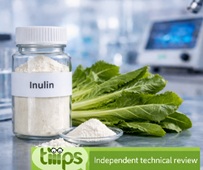
Chicory inulin: properties, uses, pros, cons, safety
Chicory inulin is a soluble dietary fiber extracted from the root of Cichorium intybus. Chemically, it is a fructan, meaning a chain of fructose molecules ending with one glucose molecule. The length of the chain (degree of polymerization) influences its properties.

Definition
Inulin is a natural polysaccharide, indigestible by the human small intestine. It reaches the colon, where it acts as a prebiotic: it nourishes gut bacteria (particularly bifidobacteria), supporting the microbiota’s health.
Production process
Chicory inulin is industrially extracted from the roots. The process involves water extraction, purification, and concentration. Depending on processing, inulins of different chain lengths (short-chain or long-chain) are obtained.
Main constituents
Being a fiber, it consists mainly of fructose chains, with one terminal glucose molecule. It contains no significant other substances in purified form.
Identification data and specifications
| Characteristic | Value | Note |
|---|
| Name | chicory inulin | prebiotic fiber |
| Molecular formula | variable (C₆H₁₀O₅)ₙ | polysaccharide (fructan) |
| CAS number | 9005-80-5 | substance identifier |
| Caloric value | approx. 1.5 kcal/g | colonic fermentation |
| Food function | soluble fiber, prebiotic | microbiota support |
Physicochemical properties (indicative)
| Characteristic | Indicative value | Note |
|---|
| Physical state | powder/small granules | from white to light beige |
| Water solubility | good | forms viscous solutions |
| Taste | mildly sweet | sweetness about 10% of sucrose |
| Heat stability | good | stable in cooking processes |
| Effect on pH | neutral | does not alter pH |
| Intestinal fermentation | high | promotes beneficial flora |
Functional role and mechanism of action
Inulin is not digested in the stomach or small intestine. It reaches the colon, where gut bacteria ferment it, producing short-chain fatty acids (SCFAs) that have beneficial effects on gut health. It supports the growth of “good” bacteria (e.g., bifidobacteria), contributing to microbiota well-being. In some food formulations, it is used to enhance texture or partially replace sugars or fats.
Main uses in food
Prebiotic: supports gut health and the balance of gut flora.
Texture enhancement: used to add body to low-fat products.
Sugar replacement: to reduce calories and increase fiber in functional or diet foods.
Fiber fortification: added to baked goods, dairy products, bars, and beverages.
Pros and cons
Pros
Prebiotic: supports the intestinal microbiota.
Versatility: used in a wide range of food formulations (from dairy to baked goods).
Low glycemic impact: does not cause glucose spikes (useful for low glycemic index products).
Improves texture: can add creaminess or body to products with reduced fat content.
Cons
Fermentation: at high doses, it can cause bloating, gas, and intestinal discomfort.
Individual tolerance: some sensitive individuals may experience gastrointestinal distress.
Limited solubility at high concentrations: in certain formulations, if unbalanced, it may result in undesirable texture.
Safety, regulatory, and practical aspects
Safety profile in the finished product
Chicory inulin is considered safe as a food ingredient. It is approved in the EU and many other countries for use in foods. There is no strict dosage limit, but a gradual introduction into the diet is recommended to avoid gastrointestinal effects.
Allergen
It is not an allergen. However, individuals with irritable bowel syndrome (IBS) or sensitivity to FODMAPs (fermentable carbohydrates) may need to limit intake.
Practical guidance
It is advised to test individual tolerance and increase inulin intake gradually. In supplementation, inulin is often dosed between 5 and 10 g per day, though in functional foods the quantity may vary according to the recipe.
Conclusion
Chicory inulin is a versatile prebiotic fiber, with uses ranging from promoting gut microbiota to modulating food texture. Its key benefits lie in its prebiotic function and its use as a functional ingredient. The main limitation is individual intestinal tolerance, which requires attention to dosage.
Studies
Improves and cures digestive functions (1) reducing the risk of colon cancer (2).
Improves and reduces the values of harmful cholesterol (3).
Not being assimilated by the body, it does not affect glucose levels, but modulates them (4). It is therefore a food suitable for diabetics.
The most relevant studies on this carbohydrate have been selected with a summary of their contents:
Inulin studies
References______________________________________________________________________
(1) Gibson GR, Beatty ER, Wang X, Cummings JH Selective stimulation of bifidobacteria in the human colon by oligofructose and inulin. Gastroenterology. 1995 Apr; 108(4):975-82.
(2) Rafter J, Bennett M, Caderni G, Clune Y, Hughes R, Karlsson PC, Klinder A, O'Riordan M, O'Sullivan GC, Pool-Zobel B, Rechkemmer G, Roller M, Rowland I, Salvadori M, Thijs H, Van Loo J, Watzl B, Collins JK Dietary synbiotics reduce cancer risk factors in polypectomized and colon cancer patients. Am J Clin Nutr. 2007 Feb; 85(2):488-96.
(3) de Luis DA, de la Fuente B, Izaola O, Conde R, Gutiérrez S, Morillo M, Teba Torres C. Randomized clinical trial with a inulin enriched cookie on risk cardiovascular factor in obese patients. Nutr Hosp. 2010 Jan-Feb;25(1):53-9. Spanish.
(4) Verbrugghe A, Hesta M, Gommeren K, Daminet S, Wuyts B, Buyse J, Janssens GP. Oligofructose and inulin modulate glucose and amino acid metabolism through propionate production in normal-weight and obese cats. Br J Nutr. 2009 Sep;102(5):694-702. doi: 10.1017/S0007114509288982.