

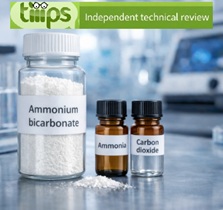
Ammonium hydrogencarbonate: properties, uses, pros, cons, safety
Ammonium hydrogencarbonate (synonyms: Ammonium bicarbonate, NH₄HCO₃) is a food additive used mainly as a leavening agent in dry baked goods. On labels it may appear as E503(ii). Chemically, it decomposes with heat, releasing carbon dioxide (CO₂), ammonia (NH₃), and water—and it is this decomposition that provides leavening power and the characteristic porosity of cookies and crackers.

Definition
It is the ammonium salt (NH₄⁺) of hydrogencarbonate (HCO₃⁻). Its key technological feature is the volatility of its decomposition products (especially ammonia), which tends to escape from the dough during baking if the product is thin and low in moisture.
Production process
Industrially, it is produced in a controlled manner by reacting ammonia and carbon dioxide in the presence of water, followed by crystallization, separation, and drying to the required specifications (food grade). For food applications, the main quality drivers are purity, control of impurities, and predictable thermal decomposition behavior during baking.
Key constituents
In a product compliant with specifications, the “constituents” essentially correspond to the substance itself: NH₄HCO₃. The most relevant practical variables are residual moisture, particle size (powder/crystals), and storage conditions that minimize degradation and loss of leavening performance.
Identification data and specifications
| Characteristic | Value | Note |
|---|
| Name | ammonium bicarbonate / ammonium hydrogen carbonate | leavening additive |
| E number | E503(ii) | “ammonium hydrogen carbonate” |
| Molecular formula | NH₄HCO₃ | ammonium salt |
| Molecular weight | 79.06 g/mol | theoretical value |
| CAS number | 1066-33-7 | substance identification |
| EC number (EINECS) | 213-911-5 | EU identifier |
| Caloric value | 0 kcal | inorganic salt, no energy contribution |
| Typical food function | leavening agent | mainly in dry products |
Physicochemical properties (indicative)
| Characteristic | Indicative value | Note |
|---|
| Physical state | solid (powder/crystals) | typical for salts |
| Color | white | may yellow if degraded/impure |
| Odor | slight ammoniacal | more noticeable with moisture |
| Water solubility | good | useful in doughs/solutions |
| Stability | sensitive to heat and humidity | may release NH₃ and lose activity |
| Baking behavior | thermal decomposition with gas release | CO₂ for leavening; NH₃ must vent |
| Potential sensory impact | ammoniacal note | if product is thick/moist or underbaked |
Functional role and mechanism of action
During baking, ammonium bicarbonate generates gases that expand the dough structure. CO₂ contributes to leavening, while NH₃ is expected to evaporate. For this reason, it performs best in cookies, crackers, rusks, and other thin products, where venting is complete and a brittle and dry texture is achieved.
In moist or thick products (cakes, loaf cakes, soft breads), the risk increases that some ammonia remains trapped, producing unwanted odor/flavor. In such cases, other leavening systems are typically preferred (e.g., sodium bicarbonate with acids, balanced baking powders, or yeast, depending on the product).
Main uses in food
It is used as a leavening agent in formulations where the goal is:
A rapid lift in the oven with fine pore development.
A crisp, low-moisture texture.
A clean sensory profile after baking, which requires complete NH₃ venting.
Pros and cons
Pros
Highly effective in dry baked goods: good porosity and brittleness.
“Clean” decomposition when properly managed: does not leave significant salty residues like some other leaveners.
Can support a lighter structure in thin crackers and cookies.
Cons
Risk of ammoniacal notes if the product is too thick, moist, or underbaked.
Limited stability to humidity/heat: requires suitable packaging and dry storage.
More “selective” in application: not a universal solution for all leavened products.
Safety, regulatory, and practical aspects
Safety profile in the finished product
When used under conditions foreseen for food additives, it is considered fit for technological use: during baking it must decompose and NH₃ must evaporate. Proper recipe design (thickness, moisture, baking time/temperature) is integral to both sensory safety and final quality.
Allergen
It is not a label-declarable food allergen. The main concern is technological (ammonia venting) and, for the pure substance, irritation from dust.
Operational precautions (raw material)
As a powder it may irritate mucosa and the respiratory tract; in industrial settings it is managed with good occupational hygiene practices (dust control, ventilation, PPE where required).
Conclusion
Ammonium bicarbonate (E503(ii)) is a targeted leavening agent, particularly suitable for dry, thin baked goods where thermal decomposition during baking delivers crispness and porosity without sensory defects. Its main practical limitation is potential ammonia retention in moist/thick products, so it should be selected and dosed consistently with the matrix and baking profile.
Studies
This study examined the mechanism by which ammonium bicarbonate inhibits mycotoxigenic fungi (1).
Action against the parasitic fungus Fusarium oxysporum. In a soil sprayed with calcium-ammonium bicarbonate or ammonium carbonate, the population of this fungus decreased by 95.4% and 71.4% in the cultivation of cucumbers, while in that of watermelons it decreased by 87, 3% and 61.2%, respectively, compared with non-irrigated crops (2).
Action against bedbugs Cimex lectularius L. with a 3% mixture of ammonium acid carbonate (3).
Bacteria withering is a systemic vascular disease of plants caused by Ralstonia solanacearum, an important bacterial pathogen transmitted from the soil.
Calcium cyanamide, ammonia water and a mixture of ammonium carbonate with lime are commonly used as fumigants to control the disease transmitted from soil in China (4).
Molecular Formula: CH5NO3 or NH4HCO3
Molecular Weight: 79.055 g/mol
CAS: 1066-33-7 10361-29-2
EINECS: 213-911-5
Synonyms:
- Ammonium hydrogen carbonate
- Monoammonium carbonate
- Carbonic acid, monoammonium salt
- Ammonium acid carbonate
- Ammonium hydrogencarbonate
- ammoniumbicarbonate
- Acid ammonium carbonate
- Azanium hydrogen carbonate
- Ammonium hydrogencarbonate
- Ammonium bicarbonate (1:1)
- Carbonic acid, ammonium salt (1:1)
- ammoniumcarbonate
References___________________________________________________________
(1) D A DePasquale and T J Montville Mechanism by which ammonium bicarbonate and ammonium sulfate inhibit mycotoxigenic fungi. Appl Environ Microbiol. 1990 Dec; 56(12): 3711–3717.
(2) Shen ZZ, Sun L, Wang DS, Lyu NN, Xue C, Li R, Shen QR. Effects of lime-ammonium bicarbonate fumigation and biofertilizer application on Fusarium wilt and biomass of continuous cropping cucumber and watermelon. Ying Yong Sheng Tai Xue Bao. 2017 Oct;28(10):3351-3359. doi: 10.13287/j.1001-9332.201710.036.
(3) Anderson JF, Ferrandino FJ, Vasil MP, Bedoukian RH, Maher M, Mckenzie K. Relatively Small Quantities of CO2, Ammonium Bicarbonate, and a Blend of (E)-2-Hexenal Plus (E)-2-Octenal Attract Bed Bugs (Hemiptera: Cimicidae). J Med Entomol. 2017 Mar 1;54(2):362-367. doi: 10.1093/jme/tjw189.
(4) Liu L, Sun C, Liu X, He X, Liu M, Wu H, Tang C, Jin C, Zhang Y. Effect of calcium cyanamide, ammonium bicarbonate and lime mixture, and ammonia water on survival of Ralstonia solanacearum and microbial community. Sci Rep. 2016 Jan 7;6:19037. doi: 10.1038/srep19037.