

Gomma xantana
Rating : 7
| Evaluation | N. Experts | Evaluation | N. Experts |
|---|---|---|---|
| 1 | 6 | ||
| 2 | 7 | ||
| 3 | 8 | ||
| 4 | 9 | ||
| 5 | 10 |
0 pts from Al222
| Sign up to vote this object, vote his reviews and to contribute to Tiiips.Evaluate | Where is this found? |
| "Descrizione" about Gomma xantana by Al222 (24019 pt) | 2026-Jan-23 15:52 |
| Read the full Tiiip | (Send your comment) |
Xanthan gum (E415): properties, uses, pros, cons, safety
Xanthan gum is a high-molecular-weight polysaccharide used as a thickener, stabilizer, and rheology modifier. In foods it is the additive E415; in cosmetics it is a functional ingredient used to control viscosity, stabilize emulsions, and improve sensorial performance.

Synonyms: xanthan gum; gummi xanthanum (Ph. Eur.); xanthan (descriptive).
Definition
Xanthan gum is a UVCB-type substance (variable composition) consisting of a “gum-like” high-molecular-weight polysaccharide. Functionally, it produces highly viscous solutions even at low use levels and shows pseudoplastic behavior (viscosity decreases under shear), which is useful for stabilizing suspensions, improving spreadability, and preventing phase separation.
It is commonly described as being obtained via microbial fermentation (typically Xanthomonas campestris) followed by purification; in practical terms, what matters to users is standardization against specifications (purity, contaminants, rheological performance) and batch-to-batch consistency.
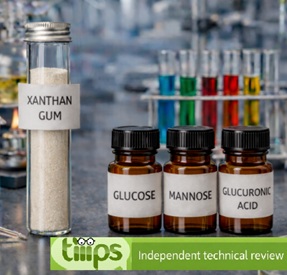
It consists mainly of glucose, mannose and glucuronic acid (1).
Main uses
Food.
As E415, it is used primarily as a thickener and stabilizer across a wide range of products (sauces, dressings, pourable systems, gluten-free products, beverages/suspensions), because it improves texture, suspension stability, and resilience to moderate thermal cycles. Actual use depends on food category and applicable conditions of use.
Cosmetics.
Used in creams/lotions, gels, cleansers, and haircare products to control viscosity, stabilize oil-in-water systems, and improve slip. It is also useful for stabilizing suspensions (pigments, fine powders) and for building “cushiony” textures with good product release.
INCI functions
Binder agent. A binding compound that is used in cosmetic, food and pharmaceutical products as an anti-caking agent with the function of making the product in which it is incorporated silky, compact and homogenous. The binder, either natural such as mucilage, gums and starches or chemical, may be in the form of a powder or liquid.
Emulsion stabilizer. Emulsions are thermodynamically unstable. Emulsion stabilisers improve the formation and stability of single and double emulsions. It should be noted that in the structure-function relationship, molar mass plays an important role.
Skin conditioning agent - Miscellaneous. This ingredient has the task of modifying the condition of the skin when it is damaged or dry by reducing its flakiness and restoring its elasticity.
Surfactant - Emulsifying agent. Emulsions are thermodynamically unstable. Emulsifiers have the property to reduce the oil/water or water/oil interfacial tension, improve emulsion stability and also directly influence the stability, sensory properties and surface tension of sunscreens by modulating their filmometric performance.
Viscosity Enhancing Agent - aqueous. Since viscosity is important for increasing the chemical and physical stability of the product, Viscosity Enhancing Agent acqueous is an important dosage factor in gels, suspensions, emulsions, solutions. Increasing viscosity makes formulations less sedimentary and more homogeneously thickened.
In the context of toothpaste, xanthan gum can be used for several reasons:
Viscosity Enhancement: Xanthan gum can help give the toothpaste a thicker consistency, making it less runny.
Stabilization: It can prevent the separation of different ingredients within the toothpaste.
Gelling Agent: Xanthan gum can give toothpaste a smoother feel, making it more pleasant to use.
Controlled Release: In some formulations, xanthan gum can help control the release of active ingredients during brushing, ensuring they are delivered effectively.
Oil industry
Due to its pseudoplasticity it can maintain the viscosity of drilling fluid and improve the oil recovery rate.
Key constituents
As a polysaccharide, it is made predominantly of sugar units; technical descriptions typically cite D-glucose and D-mannose as dominant hexoses, with D-glucuronic acid and associated groups (e.g., pyruvic acid) in proportions that depend on grade and specification.
Nutritional use note and bioactive compounds
In foods, xanthan gum is a technological additive: it is not used to deliver micronutrients or “bioactives,” but to improve structure and stability. Conceptually, it can be considered a non-digestible carbohydrate partly fermented by the microbiota; however, typical use levels are low and the target is rheology.
Calories (energy value)
For dietary fiber, several systems (including the European approach) apply an indicative energy factor of ~2 kcal/g (≈8 kJ/g). In practice, since xanthan gum is used at low percentages, its energy contribution to the finished product is generally negligible and should be assessed only within the overall recipe balance.
Identification data and specifications
| Characteristic | Value |
|---|---|
| Common name | xanthan gum |
| English name | xanthan gum |
| E number (EU, foods) | E415 |
| CAS number | 11138-66-2 (primary) |
| CAS number | 98112-77-7 (reported in some databases as an additional/alternative entry for xanthan gum) |
| EC/EINECS number | 234-394-2 |
| UNII | TTV12P4NEE |
| MDL number | MFCD00131256 |
| Molecular formula | (C35H49O29)n (polymer) |
| Molecular weight | not applicable as a single value (high and variable; grade-dependent) |
| Origin (typical) | biopolymer from microbial fermentation (qualified to specification) |
| Typical commercial form | white to off-white powder (grade-dependent) |
Physico-chemical properties (indicative)
| Characteristic | Value | Note |
|---|---|---|
| Chemical nature | high-molecular-weight polysaccharide | UVCB; strong rheological behavior |
| Water solubility | high (dispersion + hydration) | forms very viscous solutions |
| Solubility in organic solvents | negligible | typical of polysaccharides |
| Rheological behavior | pseudoplastic | viscosity decreases as shear increases |
| pH stability | generally good in moderate ranges | extremes can affect viscosity over time |
| Thermal stability | good under moderate processing | prolonged heat stress can reduce viscosity |
| Electrolyte sensitivity | variable | salts can change hydration/viscosity (formula-dependent) |
| Critical parameters | particle size, purity, microbiology, rheology | drive repeatability and stability |
Functional role and practical mechanism of action
Xanthan gum builds viscosity and structure through hydration and formation of a polymer network in water. In foods and cosmetics it helps suspend particles, reduce syneresis/phase separation, and stabilize emulsions, while also improving sensorial properties (spreadability, slip, product “body”).
Formulation compatibility
It is generally compatible with most aqueous systems and O/W emulsions. Practical watchpoints include: correct dispersion (avoid lumping), interaction with electrolytes and with some surfactants/polymers, and achieving the viscosity target depending on process conditions (shear, order of addition, temperature). With high salt loads or strongly acidic/alkaline systems, rheological stability over shelf-life should be verified.
Use guidelines (indicative)
In foods it is often effective at low doses (from fractions of a percent up to ~1% depending on the target). In cosmetics, typical use is in the low range (often ~0.1–1%), modulated by desired texture and synergy with other thickeners. Validation should include accelerated stability (hot/cold cycling), shear behavior (filling/dispensing), and compatibility with electrolytes and preservatives.
Quality, grades, and specifications
Quality is assessed via purity (undesired proteins/starches when relevant), limits for metals and contaminants, microbiological requirements, and especially rheological performance (viscosity at defined conditions). For sensitive projects, it is advisable to select grades with tighter specifications and comprehensive documentation, including compliance statements and traceability.
Safety, regulatory, and environment
In the EU, xanthan gum is authorized as E415 and has official specifications. From a food-safety standpoint, dedicated scientific evaluations consider its use as a food additive compatible with consumer safety under authorized conditions, with attention to specific subpopulations where age-related considerations may require a more cautious, category-specific approach.
In cosmetics, use is primarily technological and generally well tolerated, subject to the mandatory safety assessment of the finished product (concentration, use area, population).
Implementation of GMP (good manufacturing practice; benefit: reduces variability and contamination) and, in food, HACCP (hazard analysis and critical control points; benefit: strengthens preventive control of critical points) supports quality and compliance across the supply chain.
Formulation troubleshooting
Lumps (“fish eyes”) and incomplete hydration.
Typical cause: incorrect dispersion or overly fast addition into water. Action: dry blend with sugars/salts or other powders, use adequate vortexing, and allow sufficient hydration time.
Unstable viscosity in the presence of salts or extreme pH.
Typical cause: ionic interactions or non-optimal chemical conditions. Action: retune electrolyte load/pH, evaluate synergy with other thickeners, and confirm via accelerated stability.
Conclusion
Xanthan gum is a high-efficiency thickener and stabilizer used as E415 in foods and as a functional ingredient in cosmetics. Key success factors are: grade quality, correct dispersion/hydration, management of salt and pH interactions, and rheological validation during processing and over shelf-life.
The most relevant studies on the subject have been selected with a summary of their contents:
Typical optimal commercial product characteristics Xanthan gum
| Appearance | White or light yellowpowder |
| pH | 6.0- 8.0 |
| Viscosity (1% KCl, cps) | ≥1200 |
| Loss on Drying (%) | ≤14 |
| Ashes (%) | ≤15 |
| Heavy Metals | ≤10 ppm |
| Arsenic | ≤3 ppm |
| Lead | ≤2 ppm |
| Nitrogen (%) | ≤1.5 |
| Ethanol and propan-2- ol | ≤400 |
| Plate Count (cfu/g) | ≤ 2000 |
| Moulds/Yeasts (cfu/g) | ≤100 |
| Coliform | ≤30 MPN/100g |
Correct correspondences for xanthan gum (xanthan gum)
| Field | Value | Description / notes |
|---|---|---|
| Molecular formula | (C35H49O29)n | C35H49O29 is commonly reported as the repeat-unit (“monomer unit”). As a polymer, it is more correctly expressed as (C35H49O29)n. |
| CAS (primary) | 11138-66-2 | Main CAS Registry Number for xanthan gum. |
| CAS (also reported) | 98112-77-7 | Additional/alternative CAS reported in some databases for xanthan gum. |
| EC number (EINECS) | 234-394-2 | European Community (EINECS/EC) identifier associated with xanthan gum. |
| UNII | TTV12P4NEE | UNII code corresponding to xanthan gum. |
| MDL number | MFCD00131256 | MDL identifier reported for xanthan gum in chemical catalogues/databases. |
References______________________________________________________________________
(1) Coviello T., Matricardi P., Marianecci C., Alhaique F. Polysaccharide hydrogels for modified release formulations. Journal of Controlled Release. 2007
Cortes H, Caballero-Florán IH, Mendoza-Muñoz N, Escutia-Guadarrama L, Figueroa-González G, Reyes-Hernández OD, González-Del Carmen M, Varela-Cardoso M, González-Torres M, Florán B, Del Prado-Audelo ML, Leyva-Gómez G. Xanthan gum in drug release. Cell Mol Biol (Noisy-le-grand). 2020 Jun 25;66(4):199-207.
Abstract. Controlled release is of vital relevance for many drugs; thus, there is a keen interest in materials that can improve the release profiles of formulations administered via buccal, transdermal, ophthalmic, vaginal, and nasal. The desirable effects of those materials include the improvement of stability, adhesiveness, solubility, and retention time. Hence, different synthetic and natural polymers are utilized to achieve these objectives. In this respect, xanthan gum is an anionic polysaccharide that can be obtained from Xanthomonas bacteria. It is a natural polymer broadly employed in numerous food products, lotions, shampoos, and dermatological articles. Furthermore, due to its physicochemical features, xanthan gum is growingly utilized for the development and improvement of drug delivery systems. In this regard, encouraging findings have been revealed by recent formulations for pharmaceutical applications, including antiviral carriers, antibacterial transporters, transdermal patches, vaginal formulations, and anticancer medications. In this article, we perform a concise description of the chemical properties of xanthan gum and its role as a modifier of drug release. Furthermore, we present an outlook of the state of the art of research focused on the utilization of xanthan gum in varied pharmaceutical formulations, which include tablets, films, hydrogels, and nanoformulations. Finally, we discuss some perspectives about the use of xanthan gum in these formulations.
| Sign up to vote this object, vote his reviews and to contribute to Tiiips.EvaluateClose | (0 comments) |
Read other Tiiips about this object in __Italiano (1)
Component type:   Natural Main substances:   Last update:   2026-01-23 09:06:09 | Chemical Risk:   |

