

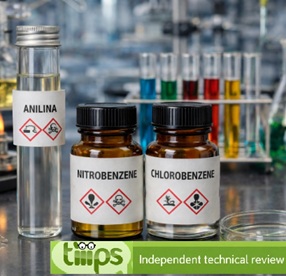
Aniline: properties, uses, pros, cons, safety
Aniline – a primary aromatic amine (benzenamine) used mainly as a chemical intermediate in the synthesis of dyes, polymers, and industrial additives. In cosmetics it is not usable as an ingredient, as it is prohibited in EU cosmetics.
Synonyms: benzenamine; aminobenzene; phenylamine; aniline (EN).
INCI / functions: not a typical cosmetic ingredient; prohibited in EU cosmetics (aniline and specified salts/derivatives).

Definition
Aniline is an aromatic organic substance consisting of a benzene ring bonded to an amino group (–NH₂). It is an oily liquid with chemical behavior typical of aromatic amines: it can react with acids (forming salts), with oxidizing agents (with possible darkening and by-products), and with electrophiles in substitution and derivatization reactions.
From an application standpoint, it should be considered an industrial and regulated raw material; any use in consumer products is strongly constrained (and, in EU cosmetics, excluded).
The most typical routes to produce aniline (from common precursors) are:
Catalytic hydrogenation of nitrobenzene (main industrial route)
Reagents: nitrobenzene + H₂
Typical catalysts: Pd/C, Pt, Raney Ni (under suitable pressure/temperature conditions).
Béchamp reduction of nitrobenzene (classical route)
Reagents: nitrobenzene + iron (Fe) + HCl (or Fe in an equivalent acidic medium).
Amination of chlorobenzene (alternative route)
Reagents: chlorobenzene + NH₃
Generally requires high temperature/pressure and copper-based catalysts (Dow-type processes).
Amination of phenol (less common)
Reagents: phenol + NH₃ with specific catalysts at elevated temperature.
Main uses
Industrial use.
Intermediate for the manufacture of dyes/pigments, process chemicals, and polymeric materials; also used as a laboratory/analytical reagent and reference material.
Identification data and specifications
| Characteristic | Value |
|---|
| common name | aniline |
| english name | aniline |
| technical synonyms | benzenamine; aminobenzene; phenylamine |
| molecular formula | C6H7N |
| molecular weight | 93.13 g/mol |
| CAS number | 62-53-3 |
| EC/EINECS number | 200-539-3 |
| physical state (typical) | liquid |
| cosmetic regulatory note (EU) | prohibited substance in cosmetics (aniline and specified derivatives) |
Physico-chemical properties (indicative)
| Characteristic | Value | Note |
|---|
| melting point | approx. −6 °C | indicative technical-datasheet value |
| boiling point | approx. 184 °C | at atmospheric pressure |
| density (20 °C) | approx. 1.02 g/cm³ | depends on purity and temperature |
| water solubility | limited (order of tens of g/L) | temperature-dependent; better in organic solvents |
| pH (aqueous solution, indicative) | basic (indicative ~8–9) | concentration-dependent |
| relevant reactivity | sensitive to strong oxidizers | possible darkening/oxidation products |
Functional role and practical mechanism of action
Aniline is not a cosmetic “active,” but an industrial building block. Its practical role is to enable chemical synthesis and transformations (derivatization of the aromatic ring, salt formation, coupling/transformations to obtain intermediates and finished products such as dyes and additives). Its functional behavior derives from the combination of nitrogen nucleophilicity and aromatic-ring stability.
Formulation compatibility
In mixtures and processes, aniline requires attention to known incompatibilities:
oxidizing agents and conditions that promote oxidation (risk of darkening and by-products);
strong acids (salt formation and changes in physical behavior);
materials/components that do not tolerate aromatic amines (case-by-case evaluation for seals/polymers and containment systems).
Use guidelines (indicative)
Use is typically confined to industrial and laboratory settings with safety procedures: exposure control, adequate ventilation, containment, and verification of purity/impurities per process or end-product specifications.
Quality, grades, and specifications
Specifications depend on the intended use (synthesis, analytics, standards). In practice, controls include:
assay/purity and impurity profile;
color and air stability (tendency to darken);
water content and parameters consistent with the use case (for example, “for synthesis” vs “analytical standard” requirements).
Safety, regulatory, and environment
Aniline is associated with a significant hazard profile (systemic toxicity and specific regulatory classifications). In industrial contexts, management must focus on minimizing exposure and rigorously controlling operational risks.
In the EU cosmetic framework, the key operational point is that aniline is prohibited in cosmetic products, so it is not formulable for that market. For chemical manufacturing and industrial supply chains, compliance relies on applicable registrations/obligations, safety data sheets, and quality systems appropriate to the sector (including GMP where relevant to the supply chain and industry expectations).
Formulation troubleshooting
Batch darkening over time.
Typical cause: oxidation from air/light/impurities. Action: protected storage (light/air), purity control, headspace management, and suitable containers.
Reaction yield variability.
Typical cause: impurities or water, uncontrolled conditions. Action: tighter specifications, assay verification, drying/moisture control, and process-profile repeatability.
Abnormal odor or contamination.
Typical cause: cross-contamination or degradation. Action: container qualification, segregation, incoming QC checks, and batch traceability.
Conclusion
Aniline is an aromatic chemical intermediate of broad industrial importance, but with a significant hazard profile and strong regulatory constraints. In EU cosmetics it is prohibited, so its handling is relevant mainly for industry and laboratories: controlled quality, oxidation prevention, and robust safety and compliance measures.
Mini-glossary
Aromatic amine: an amine bonded to an aromatic ring; shows specific reactivity versus aliphatic amines.
Building block: a substance used as a synthesis “unit” to obtain more complex molecules.
Oxidation: a chemical transformation that may generate by-products and color/odor changes.
GMP: good manufacturing practice; benefit: improves quality control and reduces variability/contamination throughout production.