

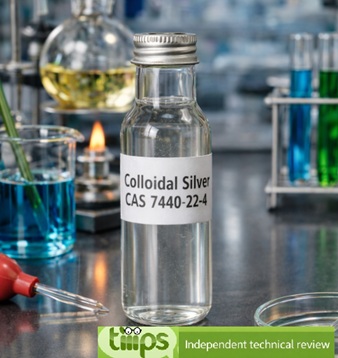
Colloidal silver
Rating : 5
| Evaluation | N. Experts | Evaluation | N. Experts |
|---|---|---|---|
| 1 | 6 | ||
| 2 | 7 | ||
| 3 | 8 | ||
| 4 | 9 | ||
| 5 | 10 |
Cons:
At risk (1)0 pts from Al222
| Sign up to vote this object, vote his reviews and to contribute to Tiiips.Evaluate | Where is this found? |
| "Descrizione" about Colloidal silver by Al222 (24068 pt) | 2026-Jan-20 16:00 |
| Read the full Tiiip | (Send your comment) |
Colloidal silver: properties, uses, pros, cons, safety
Colloidal silver – a dispersion of silver (Ag) particles in a liquid medium (typically water), often with a fraction of Ag+ ions and, in some products, stabilizers/dispersion aids (for example citrate salts or polymers). The defining feature is not “the molecule” but the physical state: micro- or nano-sized particles suspended in a liquid, with properties driven by particle size, size distribution, surface charge, and concentration.

Synonyms: colloidal silver (EN); silver hydrosol (commercial variants); silver dispersion/solution (descriptive).
INCI / functions: in cosmetics it may appear as “Silver” or as specific silver forms/derivatives; “nano colloidal silver” falls under a stricter regulatory perimeter than non-nano silver forms.
Definition
Colloidal silver is a dispersed system consisting of: a continuous liquid phase, metallic silver particles, and often a soluble fraction (ions). Performance and risk profile can vary materially depending on physico-chemical parameters such as: mean particle size and distribution (micro/nano), colloidal stability (aggregation tendency), medium purity, and the presence of stabilizers.
For completeness, the main use areas are summarized below:
Food: it is not an essential nutrient, and oral use as a supplement is associated with significant concerns and warnings in multiple institutional contexts.
Cosmetics: it may be used as a functional component in selected formulations (often positioned around “hygiene” concepts), with strong dependence on the regulatory framework (especially for nano forms).
Medicine and pharmaceutical: silver has established medical uses as a material/technology (for example in certain dressings or devices containing silver), but this does not automatically validate “colloidal” oral use or broad, general-purpose claims.
Main uses
Food.
Not a standard food ingredient. Oral use as a supplement is frequently promoted with unsupported claims and is associated with cumulative risks (long-term accumulation).
Cosmetics.
Potential uses in skin or hygiene products, with attention to: form (nano vs non-nano), concentration, application area (including products with potential oral exposure such as lip products or oral hygiene), and alignment with EU restrictions and updates.
Cosmetic safety. Restricted cosmetic ingredient II/1727 as Relevant entry in the Annexes to European Cosmetics Regulation No (EU) 2026/78. Substance or ingredient reported: Silver (nano) [1 nm < particle diameter ≤ 100 nm] Silver (massive) [particle diameter ≥ 1 mm]
INCI Functions
Slip modifier. It increases the spreadability of a product by helping other substances flow more smoothly and easily, without chemical reaction.
Antimicrobial agent. This ingredient is able to suppress or inhibit the growth and replication of a broad spectrum of microorganisms such as bacteria, fungi and viruses by making the stratum corneum temporarily bactericidal and fungicidal.
Medicine and Pharmaceutical
Silver is used in specific devices/dressings for local microbial control; these applications are typically professional/medical and regulated as devices. Not a “general purpose” active ingredient. Use in regulated products depends on category and authorizations (drug/device), supported by a product-specific dossier.
Nutritional use note and bioactive compounds
Not applicable nutritionally: silver is not a vitamin or an essential mineral, and it is not treated as a food “bioactive.” In supplement contexts, the central topic is risk/benefit and compliance with evidence and claim rules.
Identification data and CAS/EC notes
Common name: colloidal silver
Reference substance: silver (Ag)
CAS number (silver): 7440-22-4
EC/EINECS number (silver): 231-131-3
Important note: “colloidal silver” describes a physical form (a dispersion) and may include particle fractions of different sizes (including nano). For commercial products, technical and regulatory identification should be based on the technical dossier/SDS and on classification of the form (nano/non-nano) and intended use.
Physico-chemical properties (indicative)
| Characteristic | Value | Note |
|---|---|---|
| system nature | colloidal dispersion of Ag in a liquid | not a single “pure” substance |
| physical state | liquid with suspended particles | sediment may form if unstable |
| concentration (order of magnitude) | from ppm to higher levels (product-dependent) | highly variable across suppliers |
| particle size | micro or nano (product-dependent) | size drives stability and exposure profile |
| water solubility | metallic Ag: insoluble; Ag+ ions: soluble | in practice, fractions may co-exist |
| colloidal stability | depends on zeta potential, electrolytes, light, time | aggregation reduces “colloidal” behavior |
| appearance | colorless to yellow/grey | color often correlates with size/aggregation |
Critical quality and characterization parameters
| Parameter | What it controls “in practice” | Practical note |
|---|---|---|
| particle-size distribution (D50, span) | stability, appearance, and exposure profile | narrower distributions are typically easier to stabilize |
| zeta potential / surface charge | aggregation tendency | drift over time can predict sediment formation |
| total silver vs ionic silver fraction | functional behavior and interaction with formulation | ionic fraction can increase reactivity and incompatibilities |
| stabilizer identity and dosage | long-term dispersion stability | stabilizers can affect compatibility with preservatives/actives |
| light/heat stability (accelerated tests) | color drift and aggregation kinetics | packaging and storage conditions become decisive |
| impurity profile (salts/organics) | instability triggers and discoloration | purity of water and processing aids matters |
Functional role and practical mechanism of action
The technical interest in silver for topical uses is primarily linked to the controlled presence of silver species and their local interaction with microbial systems. However, translating this rationale to “general purpose” products (especially oral use) is not automatic: dose, exposure route, duration of use, bioavailability, and accumulation profile differ materially.
Formulation compatibility
In aqueous formulas, the main critical point is colloidal stability. Electrolytes (salts), pH changes, chelants, surfactants, and polymers can destabilize the dispersion, causing aggregation and precipitation. Light and temperature can also accelerate visible and physical changes. In complex cosmetic systems, compatibility must be verified through targeted testing (accelerated stability, thermal cycling, light exposure), because “colloidal silver” does not behave like a typical dissolved solute.
In addition, silver can interact with certain preservatives or actives, affecting color/odor and, in some cases, reducing finished-product clarity.
Use guidelines (indicative)
For topical/cosmetic use, a sound approach is driven by: form (nano vs non-nano), current EU regulatory alignment, and the safety assessment of the finished product (reasonably foreseeable exposure, sensitive areas, mucosal use, or products with potential oral exposure). For oral use, the recurring institutional position is that robust clinical evidence is lacking for many promoted indications, and cumulative risks are highlighted.
Quality, grades, and specifications
Critical quality parameters are less “classic chemistry” and more colloid-specific:
Particle size and distribution.
Actual total silver concentration and ionic fraction.
Stability over time (no sedimentation, no color shift).
Medium purity and declared stabilizers.
Variability among commercial products can be significant; for technical applications it is essential to request minimum characterization (size, concentration, stability) and batch-to-batch controls.
Safety, regulatory, and environment
Safety of use.
The best-known concern with chronic exposure (especially oral) is argyria, a blue-grey discoloration associated with silver deposition in tissues, often described as difficult to reverse. Additional caution points include potential interactions with certain medicines and uncertainties around prolonged exposures, particularly for very small particle sizes.
Warning: the scientific literature reports frequent cases of ionic silver labeled and sold as colloidal silver and reports that 70% of the commercial products evaluated contain only ionic silver (1). In addition scientifically unfounded claims about the efficacy and medical use of colloidal silver may appear on company websites selling colloidal silver (2).
I report some studies on the danger of colloidal silver (3).
Regulatory (practical points).
In the EU, silver and its particulate forms have seen meaningful regulatory attention in cosmetics, including differentiation between non-nano and nano forms, with direct impact on permitted conditions, labeling expectations, and listing status. For formulators and brand owners, compliance depends on aligning: material form, declared function, product category, and any applicable deadlines/conditions introduced by updates.
Quality process.
Applying GMP (Good manufacturing practice; benefit: reduces variability and contamination) and, where relevant, a HACCP-style critical control approach (benefit: preventive control of critical process points) supports risk management, especially where purity and stability are determinative.
Formulation troubleshooting
Instability with precipitation or sediment.
Typical cause: electrolytes or formula components that screen charges and promote aggregation. Practical action: reduce salts, adjust pH and chelation strategy, select a compatible stabilizer, validate order of addition.
Color shift over time.
Typical cause: progressive aggregation or surface reactions accelerated by light. Practical action: light-protective packaging, careful control of light/heat exposure, and compatibility screening of any auxiliary stabilizing strategy.
Loss of clarity in cosmetic bases.
Typical cause: incompatibility with polymers, surfactants, or actives. Practical action: family-based compatibility screening, accelerated tests, and selection of a grade with a different stabilization approach.
Regulatory non-compliance (EU cosmetics).
Typical cause: nano form not properly documented/declared or not permitted for the intended use, or conditions of use not aligned. Practical action: supplier qualification, particle-size documentation, dossier review, and labeling alignment.
Conclusion
Colloidal silver is a dispersion of silver particles in a liquid, with properties and risks driven more by colloidal parameters (size, stability, ionic fraction) than by a single chemical identity. In regulated topical applications, silver has specific rationales, but broad “general purpose” use—especially oral use—is associated with well-known concerns (accumulation and argyria) and insufficient clinical evidence for many promoted indications. In EU cosmetics, compliance depends critically on the nano vs non-nano distinction and on up-to-date regulatory alignment.
Mini-glossary
Colloidal silver: a dispersion of silver particles in a liquid; it may also include an ionic fraction.
Nanoparticle: a particle typically in the 1–100 nm range; size influences exposure and behavior.
Zeta potential: an indicator of electrostatic stability of a dispersion; more stable values reduce aggregation.
Argyria: blue-grey discoloration from silver deposition in tissues after high or prolonged exposure.
GMP: Good manufacturing practice; benefit: reduces variability and contamination, improves quality control.
HACCP: Hazard analysis and critical control points; benefit: preventive identification and control of critical process points.
References_________________________________________________________________________
(1) Kumar A, Goia DV. Comparative Analysis of Commercial Colloidal Silver Products. Int J Nanomedicine. 2020 Dec 22;15:10425-10434. doi: 10.2147/IJN.S287730.
(2) Leino V, Airaksinen R, Viluksela M, Vähäkangas K. Toxicity of colloidal silver products and their marketing claims in Finland. Toxicol Rep. 2020 Dec 26;8:106-113. doi: 10.1016/j.toxrep.2020.12.021. PMID: 33437653; PMCID: PMC7786010.
(3) Tobarran N, Hieger MA. Acute Silver Toxicity From Colloidal Silver Overdose. Am J Ther. 2020 Nov/Dec;27(6):e682-e684. doi: 10.1097/MJT.0000000000001047. PMID: 31385825.
Stjernbrandt A. Colloidal silver ingestion and severe anemia - A case report. Toxicol Rep. 2023 Sep 20;11:270-272. doi: 10.1016/j.toxrep.2023.09.012. PMID: 37767535; PMCID: PMC10520504.
Newlands SJ, Betts TD, Stack RR. Colloidal silver optic neuropathy. N Z Med J. 2018 Oct 5;131(1483):63-65. PMID: 30286067.
Mohan N, Gomez C, Khawar N, Narula P, John M. Colloidal Silver Ingestion Associated with Leukocytoclastic Vasculitis in an Adolescent Female. Am J Case Rep. 2019 May 23;20:730-734. doi: 10.12659/AJCR.915499. PMID: 31118408; PMCID: PMC6543947.
Ovais M, Ahmad I, Khalil AT, Mukherjee S, Javed R, Ayaz M, Raza A, Shinwari ZK. Wound healing applications of biogenic colloidal silver and gold nanoparticles: recent trends and future prospects. Appl Microbiol Biotechnol. 2018 May;102(10):4305-4318. doi: 10.1007/s00253-018-8939-z.
Abstract. Nanotechnology has emerged as a prominent scientific discipline in the technological revolution of this millennium. The scientific community has focused on the green synthesis of metal nanoparticles as compared to physical and chemical methods due to its eco-friendly nature and high efficacy. Medicinal plants have been proven as the paramount source of various phytochemicals that can be used for the biogenic synthesis of colloidal silver and gold nanoparticles as compared to other living organisms, e.g., microbes and fungi. According to various scientific reports, the biogenic nanoparticles have shown promising potential as wound healing agents. However, not a single broad review article was present that demonstrates the wound healing application of biogenic silver and gold nanoparticles. Foreseeing the overall literature published, we for the first time intended to discuss the current trends in wound healing via biogenic silver and gold nanoparticles. Furthermore, light has been shed on the mechanistic aspects of wound healing along with futuristic discussion on the faith of biogenic silver and gold nanoparticles as potential wound healing agents.
| Sign up to vote this object, vote his reviews and to contribute to Tiiips.EvaluateClose | (0 comments) |
Read other Tiiips about this object in __Italiano (1)
Component type:   Chemical Main substances:   Last update:   2026-01-20 15:45:16 | Chemical Risk:   |

