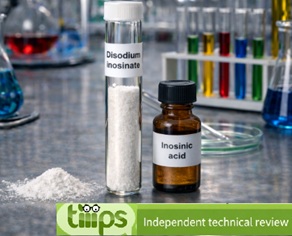
Disodium 5’-inosinate Disodium inosinate : properties, uses, pros, cons, safety
Disodium inosinate – disodium salt of inosinic acid, more precisely inosine-5’-monophosphate (IMP)
Synonyms: disodium 5’-inosinate, sodium inosinate (technical use), IMP (technical use), INS 631 (international coding)
INCI / Functions (cosmetics): skin conditioning (emollient)
Definition
Disodium inosinate is a nucleotide (the salt of a ribonucleotide) used mainly as a flavor enhancer to strengthen and “extend” the perception of umami taste in food matrices. Chemically, it is the disodium salt of inosine-5’-monophosphate (IMP): a substance naturally present in various foods (especially meat and fish) and produced industrially under additive-grade specifications and controls.

From an application standpoint, the value of E631 is not to “create flavor” on its own, but to potentiate and make more persistent savory notes that are already present (or provided by other ingredients). In formulation, it is often paired with glutamates and/or other 5’-ribonucleotides (e.g., disodium guanylate) to achieve a stronger sensory effect at relatively low total use levels.
Main uses
Food.
In food applications, disodium inosinate is the additive E631 (functional class: flavor enhancer). It is used across many savory categories where a fuller taste impact is desired without proportionally increasing salt or added flavors: snacks, potato products, dehydrated preparations, seasonings, sauces, soups, noodles, and ready-to-eat foods. In practice, E631 performs best in matrices where umami components are already present (naturally or added), because it contributes to synergistic taste enhancement and improved persistence of savory perception.
From an industrial perspective, the decisive aspects are dosage control (often at low levels), achieving homogeneous distribution in dry blends or solutions, and alignment with labeling requirements: it may appear as “flavor enhancer: disodium inosinate” or as “E631”, depending on applicable rules and market practice.
Cosmetics.
In cosmetics, it appears as Disodium Inosinate (INCI) with the listed function skin conditioning (emollient). In practice, when used, it tends to behave more as a functional “system component” (supporting sensorial/conditioning within a matrix) than as a defining active. Its selection is typically linked to formulation strategy and product concept (e.g., texture and feel) and requires verification of stability and compatibility with preservative systems and fragrance.
Medicine.
It is not a “medical” ingredient in the strict sense. The physiological link is that IMP is a nucleotide; however, E631 use is primarily technological/food-related. Any clinical considerations are more connected to the broader dietary topic of purines than to therapeutic use.
Pharmaceutical.
It is not a common pharmaceutical excipient in standard dosage forms. It may, however, appear as a reference material or be used in research/analytical contexts. In such cases, attention centers on identity, purity, impurity profile, and batch traceability.
Industrial use.
Beyond food, disodium inosinate is available as a technical/laboratory substance for analytical or R&D purposes. Operational themes include correct assay basis (anhydrous vs hydrated), moisture control, storage, and powder handling.
Identification data and specifications
| Identifier | Value |
|---|
| INCI name | Disodium Inosinate |
| EU food additive | E631 |
| Chemical name | disodium inosine-5’-monophosphate (disodium 5’-inosinate) |
| Formula (anhydrous basis) | C10H11N4Na2O8P |
| Molecular weight (anhydrous basis) | 392.17 g/mol |
| CAS number | 4691-65-0 |
| EC/EINECS number | 225-146-4 |
| Typical commercial appearance | white crystals/powder, odorless (grade-dependent) |
Chemical-physical properties (indicative)
| Property | Value | Note |
|---|
| Water solubility | high | supports use in dry mixes (with proper dispersion) and in solutions |
| Matrix stability | good under standard conditions | confirm under extreme systems (high ionic strength, severe heat treatments) |
| Hygroscopicity/moisture | possible (grade-dependent) | impacts flowability and dosing in premixes |
| Sensory profile | umami flavor enhancer | typically not an “aroma” by itself, but a potentiator |
Functional role and practical mechanism
| Function | What it does in formula | Technical note |
|---|
| Flavor enhancer (food) | amplifies and prolongs umami perception | often combined with other umami contributors |
| Support for perceived salt/flavor reduction (food) | improves roundness and overall taste fullness | validate via sensory panel and benchmark comparisons |
| Skin conditioning (cosmetics) | sensorial/conditioning contribution within the system | generally not the primary element of the product concept |
Formulation compatibility
In foods, E631 is generally straightforward to handle, but the sensory result depends on the matrix, incorporation method, and the presence of other savory/umami contributors. In dry blends, it is important to avoid segregation and ensure uniformity (premixes, compatible particle size, correct mixing sequence). In liquid or semi-liquid systems, high solubility helps, but it is still good practice to confirm behavior in the presence of high salt, proteins, flavors, and heat treatments.
In cosmetics (when used), compatibility should be checked case-by-case: as an ionic salt, it can influence rheology and sensorial profile in electrolyte-rich systems or polymer gels. Accelerated stability testing and thermal cycling remain essential to prevent issues (haze, viscosity drift, preservative interactions).
Use guidelines (indicative)
| Application | Typical range | Technical note |
|---|
| Snacks, seasonings, savory preparations | 0.01–0.10% | often synergistic with glutamates and/or other ribonucleotides |
| Soups/sauces/ready meals | 0.01–0.08% | calibrate to the aroma profile and salt level |
| Dry premixes (noodles, seasoning blends) | 0.02–0.12% | manage blend uniformity and moisture |
| Cosmetics (less common use) | 0.01–0.50% | define based on sensorial target and finished-product stability |
Quality, grades, and specifications
| QC parameter | What to check |
|---|
| Identity | naming alignment (E631/INCI), CAS/EC, analytical profile |
| Assay | compliance with specifications (often on anhydrous basis) |
| Moisture | impacts dosing, flowability, and premix stability |
| Impurities | limits for metals/contaminants per spec and intended use |
| Appearance/color/odor | lot-to-lot consistency and absence of off-notes |
| Microbiology (if required) | especially for food grades with specific requirements |
Safety, regulatory, and environment
From a toxicological standpoint, disodium inosinate is among additives for which international evaluations have historically indicated a favorable safety profile when used according to good practice and authorized conditions. Practically, correct management is mainly regulatory: use in permitted categories, compliance with any restrictions, and correct labeling.
Because E631 is a nucleotide, a sensible “awareness point” (not specific to the additive per se, but to purine intake in general) can concern consumers who have medical advice to limit purines: at typical use levels the impact is usually limited, but in sensitive contexts it is appropriate to align with case-specific nutritional/medical guidance.
In manufacturing, applying GMP (Good manufacturing practice; first occurrence) supports repeatability and process control. Benefit: improved batch consistency and reduced operational risk. In food contexts, HACCP (Hazard analysis and critical control points; first occurrence) remains central. Benefit: preventive risk management and a more robust quality system.
EFSA's Scientific Panel was unable to conclude on the safety of the additive for target species, consumers, users and the environment (1).
Formulation troubleshooting
| Problem | Possible cause | Recommended intervention |
|---|
| Sensory impact below expectations | matrix low in umami notes, dose too low, missing synergy | re-balance dosage, evaluate combinations with other umami contributors, validate with sensory panel |
| Premix lot-to-lot variability | moisture/hygroscopicity, particle size segregation | control moisture, use premixes, harmonize particle size, revise mixing process |
| Lumps or non-uniformity in liquids | direct addition without dispersion, high viscosity | pre-dissolve, increase shear, optimize addition order |
| Off-notes perceived | aroma/extract quality, interactions with spices or proteins | revise flavor system, reduce reactive factors, run shelf-life tests |
Conclusion
Disodium inosinate (E631) is a highly efficient flavor enhancer, particularly useful for reinforcing umami perception and improving roundness and persistence in many savory matrices. Practical success depends more on the overall sensory strategy (synergies and matrix design) and on correct process and premix management than on chemical complexity. With appropriate specifications and a coherent quality approach, it remains a well-established and effective technical ingredient.
Mini-glossary
E631: EU code for disodium inosinate as a food additive.
IMP: inosine-5’-monophosphate, a nucleotide associated with umami perception; in foods it acts as a taste potentiator.
INS: International Numbering System for Food Additives.
Quantum satis: principle allowing an additive to be used “as much as needed” to achieve the technological effect, without exceeding what is necessary.
GMP: Good manufacturing practice; benefit: reduces variability and operational risks.
HACCP: Hazard analysis and critical control points; benefit: strengthens prevention and control across regulated supply chains.
Disodium Inosinate studies
- Molecular Formula C10H11O8N4Na2P·7.5H2O
- Molecular Weight 392.171 g/mol
- CAS 4691‐65‐0
- EC number 225‐146‐4
Synonyms:
- Disodium 5'-inosinate
- Sodium inosinate
- Inosinic Acid
- 5′-IMP-Na2
- 5'-Inosinic Acid Disodium Salt
- 5′-Inosinic acid disodium salt hydrate
- Inosine 5′-monophosphate disodium salt hydrate
- Inosin-5'-monophosphate disodium
- IMP
- I-5′-P
- MDL number MFCD00150372
References____________________________________________________________
(1) EFSA Panel on Additives and Products or Substances used in Animal Feed (FEEDAP); Bampidis V, Azimonti G, Bastos ML, Christensen H, Dusemund B, Fašmon Durjava M, Kouba M, López-Alonso M, López Puente S, Marcon F, Mayo B, Pechová A, Petkova M, Ramos F, Sanz Y, Villa RE, Woutersen R, Anguita M, Brozzi R, Galobart J, Manini P, Tarrés-Call J, Pettenati E. Safety and efficacy of a feed additive consisting of disodium 5'-inosinate (IMP) produced by Corynebacterium stationis KCCM 80235 for all animal species (CJ Europe GmbH). EFSA J. 2022 Mar 7;20(3):e07153. doi: 10.2903/j.efsa.2022.7153.



 Disodium 5’-inosinate