

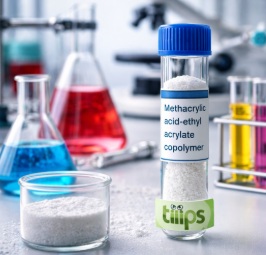
Methacrylic Acid and Ethyl Acrylate Copolymer (1:1)
Rating : 7
| Evaluation | N. Experts | Evaluation | N. Experts |
|---|---|---|---|
| 1 | 6 | ||
| 2 | 7 | ||
| 3 | 8 | ||
| 4 | 9 | ||
| 5 | 10 |
0 pts from Al222
| Sign up to vote this object, vote his reviews and to contribute to Tiiips.Evaluate | Where is this found? |
| "Descrizione" about Methacrylic Acid and Ethyl Acrylate Copolymer (1:1) by Al222 (23820 pt) | 2026-Jan-03 18:00 |
| Read the full Tiiip | (Send your comment) |
Methacrylic Acid and Ethyl Acrylate Copolymer (1:1)
Methacrylic acid-ethyl acrylate copolymer (1:1) – (anionic copolymer, acrylic polymer)
Synonyms: methacrylic acid–ethyl acrylate copolymer, ethyl acrylate–methacrylic acid copolymer, “methacrylic acid copolymer (type B/C)” (pharmaceutical context)
INCI / functions: film former, viscosity control (in specific systems), binder; pharmaceutical use: polymer for enteric coatings
Definition
An anionic copolymer from the acrylic family, composed of repeating units primarily derived from methacrylic acid and ethyl acrylate, typically in a 1:1 ratio. In compositional terms, the ingredient is therefore a polymer built from these two monomeric units (with possible trace residual monomers and polymerization auxiliaries depending on grade). The presence of carboxylic groups (from methacrylic acid) confers marked pH sensitivity: the film is poorly soluble in acidic media and tends to dissolve/swell when pH exceeds a threshold (indicatively > 5.5), a property mainly exploited for enteric protection and targeted release.

Calories (energy value)
| Item | Value |
|---|---|
| Energy value (100 g) | Not practically significant at typical use levels (technological use, not nutritional) |
| Technical note | High-molecular-weight polymer: the energy impact on the finished product is typically negligible |
Identification data and specifications
| Item | Value |
|---|---|
| Name | Methacrylic acid-ethyl acrylate copolymer |
| English name | Methacrylic acid-ethyl acrylate copolymer (1:1) |
| Chemical nature | acrylic copolymer with acidic groups (anionic) |
| Typical monomer ratio | 1:1 (methacrylic acid : ethyl acrylate) |
| CAS number | 25212-88-8 |
| EC number (EINECS) | 250-477-6 |
| Chemical designation (technical sheets/SDS) | 2-Propenoic acid, 2-methyl-, polymer with ethyl 2-propenoate |
| Functional properties (indicative) | Indication |
|---|---|
| Key mechanism | pH-sensitive (ionization of carboxyl groups) |
| Behaviour in acidic media | tendency toward low solubility / “closed” film |
| Behaviour at higher pH | tendency toward dissolution/swelling with release |
| Dissolution threshold (indicative) | rapid release at pH > 5.5 (depends on grade and system) |
Functional role and clarification “film former / pH-sensitive”
| Function | What it does in the formulation | Typical use |
|---|---|---|
| Film former | forms a continuous film acting as a barrier and matrix | coatings, film-forming systems |
| Enteric protection (pharma) | protects in acidic media and releases at higher pH | enteric coating of tablets/pellets/capsules |
| Release control (pharma) | supports pH-dependent release profiles | intestinal targeted release |
| Rheology support (where applicable) | may contribute to structure/viscosity in compatible systems | dispersions/specific systems, to be validated case-by-case |
Formulation compatibility
| System / variable | Compatibility | Control notes |
|---|---|---|
| pH | critical | performance strongly depends on pH (pH-sensitive behaviour) |
| Plasticizers (pharma) | generally required | often used to reduce film brittleness (optimize ratio) |
| Fillers/minerals (pharma) | commonly used | talc and other anti-tack agents are frequent in coating; verify adhesion and porosity |
| High-dust processes | caution | manage powders to reduce aerosol formation and buildup (operational safety) |
| Electrolytes/cations | to be assessed | possible interactions with cationic species (changes in film and dispersion stability) |
Use guidelines (indicative)
| Application | Typical range | Technical note |
|---|---|---|
| Enteric coating (pharma, on finished units) | ~5–12% weight gain on the dosage form (typical order) | depends on target thickness and release profile |
| Coating dispersions/solutions | variable (grade-dependent) | optimize solids, viscosity, anti-tack, and plasticizer |
| Non-pharmaceutical uses | to be validated | use and dosage depend strongly on grade and the required function |
| Operational good practices | Detail |
|---|---|
| Process pH control | set and maintain a pH window consistent with the desired film/dissolution behaviour |
| Release testing | verify dissolution threshold and kinetics on the real product (not only in beaker tests) |
| Dust management | minimize dust formation and accumulation; ensure adequate ventilation and housekeeping |
Typical applications
Pharmaceutical: enteric coatings for tablets, pellets, and capsules; protection of acid-sensitive APIs and reduction of gastric irritation; targeted release at intestinal pH.
Technical: pH-dependent film-forming systems where a barrier in acid and opening at higher pH is desired (case-by-case evaluation depending on grade).
Quality, grades and specifications
| Grade | Typical use | Common checks |
|---|---|---|
| Pharmaceutical (Ph. Eur./USP-NF, depending on manufacturer) | enteric coating | identification, purity/impurities, dissolution performance, film parameters |
| Technical | industrial applications | functional parameters and impurity profile depending on sector |
Note: in pharma, “type” grades (e.g., Type B) and supply forms as powder or aqueous dispersion are common; selection affects both process and coating outcome.
Safety, regulation and environment
| Topic | Operational guidance |
|---|---|
| Use safety | primary risk relates to inhalation of dust and operational handling; implement containment measures and appropriate PPE |
| Classification (some SDS) | may be classified as harmful if inhaled (dust) depending on supplier/product classification |
| Combustible dust | like many organic powders, under certain conditions it may present combustible dust hazards |
| Environment | manage spills and dust to avoid dispersion; dispose according to local regulations and supplier documentation |
Formulation troubleshooting
| Issue | Possible cause | Corrective actions |
|---|---|---|
| Release too early in acid | insufficient film or excessive plasticization | increase coating weight gain, optimize plasticizer, check porosity/anti-tack level |
| Release too late at target pH | film too thick or threshold not centered | reduce coating, retune process, verify pH and test conditions |
| Brittle film / cracking | insufficient plasticizer or aggressive drying | increase plasticizer, optimize drying/temperature, review anti-tack strategy |
| Process issues (spray/coating) | suboptimal viscosity/solids or excessive dust | retune solids, rheology, and atomization; improve dust containment |
Conclusion
Methacrylic acid-ethyl acrylate copolymer is a pH-sensitive acrylic film former, mainly composed of methacrylic acid and ethyl acrylate units (typically 1:1). Its key technical value is the ability to provide a film that remains stable in acidic conditions and becomes more soluble above a pH threshold (order of > 5.5), making it a reference polymer for enteric protection and targeted release. Performance depends primarily on pH, film weight/thickness, plasticization, and process conditions; validation on the real dosage form is essential.
Studies
The need to use neutral methacrylate copolymer and anionic methacrylate copolymer in solid food supplements is dictated by technological reasons. Neutral methacrylate copolymer is intended to be used as a sustained-release coating agent. Sustained-release formulations allow the continuous dissolution of a nutrient over a period of time. Anionic methacrylate copolymer is intended to be used as a coating agent to protect the stomach wall from irritating ingredients and/or to protect sensitive nutrients from disintegration by gastric acid. (1).
In the European Food Additives List, neutral methacrylate copolymer has been assigned the number E 1206 and anionic methacrylate copolymer E 1207.
In this study, the effect that minor to moderate polymer degradation within the extrudates has on their long-term physical stability and dissolution characteristics is analyzed and discussed (2).
The intention of this study was to show under what conditions a film-forming methacrylic acid copolymer coating excipient, corresponding to pharmacopoeia requirements but obtained from different sources, can be replaced without serious problems (3).
Some studies on microencapsulation and active ingredient release techniques involving methacrylic acid-ethyl acrylate copolymer (4).
It appears as a white powder with a boiling point of 73-74 °C (pressure: 0.2 Torr).
Density: 1.168±0.06 g/cm3
PH: 2.1-3.0
Methacrylic Acid and Ethyl Acrylate Copolymer studies
Molecular Formula: C9H14O4
Molecular Weight: 186.20
CAS: 25212-88-8
NACRES: NA.24
Synonyms:
References____________________________________________________________________
(1) POOL/E3/2012/12756 European Commission
(2) Mathers A, Hassouna F, Malinová L, Merna J, Růžička K, Fulem M. Impact of Hot-Melt Extrusion Processing Conditions on Physicochemical Properties of Amorphous Solid Dispersions Containing Thermally Labile Acrylic Copolymer. J Pharm Sci. 2020 Feb;109(2):1008-1019. doi: 10.1016/j.xphs.2019.10.005.
(3) Binder V, Hirsch S, Scheiffele S, Bauer KH. Preliminary applicability tests of different methacrylic acid copolymers, type C NF, particularly relevant to spreading and film formation. Eur J Pharm Biopharm. 1998 Sep;46(2):229-32. doi: 10.1016/s0939-6411(97)00163-x.
Abstract. The intention of this study was to show under which conditions a film forming methacrylic acid copolymer coating excipient, corresponding to the requirements of pharmacopoeia, but obtained from different sources, can be substituted without severe problems. The mechanical properties of the film coats were investigated by dynamic-mechanical thermo-analysis (DMTA) experiments to determine with respect to the glass transition the storage modulus E', the loss modulus E'', and the loss factor tan delta. Further determinations concerned the surface tensions of the different coating dispersions. This attribute plays an important role in spreading, distribution and coalescence of the film forming preparations. Finally by a series of small experimental fluidized bed batches cores containing a model drug were coated with the different methacrylic acid copolymers. The resistance of these coated tablets in 0.1 N HC1 as well as their dissolution rates in artificial intestinal juice were tested. The coatings proved themselves so similar that in this case substitutions of products of different provenance are possible. The determinations of surface tension and the DMTA measurements seem to be useful and reliable preliminary applicability tests.
(4) Homayun B, Sun C, Kumar A, Montemagno C, Choi HJ. Facile fabrication of microparticles with pH-responsive macropores for small intestine targeted drug formulation. Eur J Pharm Biopharm. 2018 Jul;128:316-326. doi: 10.1016/j.ejpb.2018.05.014.
Fleer NA, Pelcher KE, Zou J, Nieto K, Douglas LD, Sellers DG, Banerjee S. Hybrid Nanocomposite Films Comprising Dispersed VO2 Nanocrystals: A Scalable Aqueous-Phase Route to Thermochromic Fenestration. ACS Appl Mater Interfaces. 2017 Nov 8;9(44):38887-38900. doi: 10.1021/acsami.7b09779.
Abstract. Buildings consume an inordinate amount of energy, accounting for 30-40% of worldwide energy consumption. A major portion of solar radiation is transmitted directly to building interiors through windows, skylights, and glazed doors where the resulting solar heat gain necessitates increased use of air conditioning. Current technologies aimed at addressing this problem suffer from major drawbacks, including a reduction in the transmission of visible light, thereby resulting in increased use of artificial lighting. Since currently used coatings are temperature-invariant in terms of their solar heat gain modulation, they are unable to offset cold-weather heating costs that would otherwise have resulted from solar heat gain. There is considerable interest in the development of plastic fenestration elements that can dynamically modulate solar heat gain based on the external climate and are retrofittable onto existing structures. The metal-insulator transition of VO2 is accompanied by a pronounced modulation of near-infrared transmittance as a function of temperature and can potentially be harnessed for this purpose. Here, we demonstrate that a nanocomposite thin film embedded with well dispersed sub-100-nm diameter VO2 nanocrystals exhibits a combination of high visible light transmittance, effective near-infrared suppression, and onset of NIR modulation at wavelengths <800 nm. In our approach, hydrothermally grown VO2 nanocrystals with <100 nm diameters are dispersed within a methacrylic acid/ethyl acrylate copolymer after either (i) grafting of silanes to constitute an amorphous SiO2 shell or (ii) surface functionalization with perfluorinated silanes and the use of a perfluorooctanesulfonate surfactant. Homogeneous and high optical quality thin films are cast from aqueous dispersions of the pH-sensitive nanocomposites onto glass. An entirely aqueous-phase process for preparation of nanocrystals and their effective dispersion within polymeric nanocomposites allows for realization of scalable and viable plastic fenestration elements.
| Sign up to vote this object, vote his reviews and to contribute to Tiiips.EvaluateClose | (0 comments) |
Read other Tiiips about this object in __Italiano (1)
Component type:   Chemical Main substances:   Last update:   2026-01-03 17:52:20 | Chemical Risk:   |

