

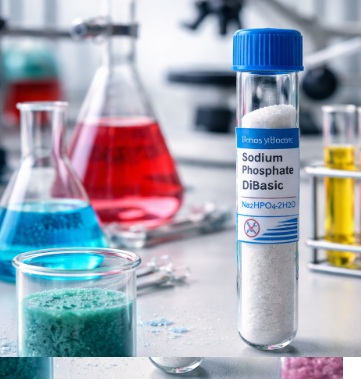
Sodium dibasic phosphate
Rating : 7
| Evaluation | N. Experts | Evaluation | N. Experts |
|---|---|---|---|
| 1 | 6 | ||
| 2 | 7 | ||
| 3 | 8 | ||
| 4 | 9 | ||
| 5 | 10 |
0 pts from Al222
| Sign up to vote this object, vote his reviews and to contribute to Tiiips.Evaluate | Where is this found? |
| "Descrizione" about Sodium dibasic phosphate by Al222 (23820 pt) | 2026-Jan-03 10:28 |
| Read the full Tiiip | (Send your comment) |
Sodium phosphate dibasic
Dibasic sodium phosphate – Na₂HPO₄
Synonyms: disodium phosphate, disodium hydrogen phosphate; E339(ii) (food use)
INCI / functions: buffering (pH regulator), aqueous phase stability support, anticorrosive (packaging protection), processing aid in oral care
Definition
An inorganic, alkaline salt of the phosphate system, commonly supplied as Na₂HPO₄ (anhydrous form) or as hydrated forms (e.g., dihydrate). It appears as a white crystalline solid/white powder, odorless, and soluble in water. Its primary use is as a component of buffer solutions to maintain pH in the neutral to slightly alkaline range, typically paired with NaH₂PO₄ (monobasic sodium phosphate). It is used in cosmetics, oral care, food, and technical/laboratory applications where repeatable and robust pH control is required.

Calories (energy value)
0 kcal per 100 g (inorganic compound, provides no metabolizable energy).
Identification data and specifications
| Item | Value |
|---|---|
| Name | Dibasic sodium phosphate |
| English name | Sodium phosphate dibasic |
| Formula | Na₂HPO₄ |
| Molar mass | 141.96 g/mol |
| CAS number | 7558-79-4 |
| EC number | 231-448-7 |
| Common commercial form | Na₂HPO₄·2H₂O (dihydrate) |
| Molar mass (dihydrate) | 177.99 g/mol |
| CAS number (dihydrate) | 10028-24-7 |
| Property | Indication |
|---|---|
| Appearance | white crystals/powder |
| Odor | none |
| Water solubility (20–25 °C) | high (order of tens of g/L) |
| Alcohol solubility | insoluble / very low |
| Typical pH (aqueous solution) | ~8.7–9.3 (depends on concentration and grade) |
| Hygroscopicity | low to moderate (depends on form and grade) |
| Stability | stable at room temperature; avoid humidity and CO₂ if maximum pH repeatability is needed |
| Decomposition (approx.) | at elevated temperature (order ~250 °C) with possible condensed phosphate species |
| Acid–base parameters (25 °C, buffer reference) | Value |
|---|---|
| pKa₁ (H₃PO₄) | ≈ 2.15 |
| pKa₂ (H₃PO₄) | ≈ 6.8–7.2 |
| pKa₃ (H₃PO₄) | ≈ 12.3–12.4 |
| NaH₂PO₄ / Na₂HPO₄ buffering window | ~pH 6.2–8.2 (maximum effectiveness around pKa₂) |
Functional role and “chelating” clarification
The primary role is buffering: it keeps pH stable by absorbing moderate acidic or basic additions.
Its “metal control” effect is limited: in the presence of Ca²⁺/Mg²⁺ (hard water), phosphates can promote haze or precipitation (e.g., calcium phosphates) depending on pH and concentration. It is not a strong chelator (unlike citrates or EDTA). If hardness/metal management is required, formulators typically add a dedicated sequestrant (where allowed) and optimize pH.
Formulation compatibility
Surfactants: generally excellent with anionics, amphoterics, and many nonionics; verify with high-dosage cationic systems (ionic interactions).
Polymers and gelling agents: generally compatible; for pH-dependent systems, check viscosity and stability after 24–48 h.
Pigments/minerals: useful for aqueous phase stabilization; caution with calcium-rich systems (risk of opalescence/precipitates).
pH-sensitive actives: supports a narrow, repeatable pH window.
Use guidelines (indicative)
| Application | Typical range | Technical note |
|---|---|---|
| Leave-on / rinse-off cosmetics | 0.05–0.50% | fine pH trim and routine stability; increase if true buffer capacity is required |
| Oral care (toothpaste/mouthwash) | 0.2–2.0% | often paired with NaH₂PO₄ for pH 6.0–7.5 targets |
| Food (E339(ii)) | by category | comply with applicable requirements/limits for the specific category |
| Buffer procedure | Good practice |
|---|---|
| Preparation | dissolve salts separately, then combine under agitation |
| pH adjustment | small additions of the acid species (NaH₂PO₄) or the base species (Na₂HPO₄) |
| pH measurement | measure after thermal equilibrium and complete dissolution |
Practical phosphate buffer examples (25 °C, indicative)
| Target pH | NaH₂PO₄ (indicative fraction) | Na₂HPO₄ (indicative fraction) | Note |
|---|---|---|---|
| 6.5 | ~80–85% | ~15–20% | mass percentages as “anh.” salt equivalents |
| 7.0 | ~60–65% | ~35–40% | always verify at bench |
| 7.4 | ~45–50% | ~50–55% | typical “physiological” buffer |
| 8.0 | ~25–30% | ~70–75% | caution with hard water (Ca²⁺) |
Note: ionic strength and total concentration affect final pH; confirm in the real formulation.
Typical applications
Cleansers and toiletries: pH stability and more consistent performance when water quality varies.
Gels and lotions: supports chemical–physical stability and pH-sensitive actives.
Oral care: buffer systems and controlled comfort (managed pH).
Water-based make-up: pH control for dispersion stability and color performance.
Food: acidity regulator/stabilizer; established technological uses depending on category.
Quality, grades and specifications
| Grade | Typical use | Common checks |
|---|---|---|
| Technical | industrial applications | assay, insolubles, solution pH, inorganic impurities |
| Food (E339(ii)) | food processing | purity requirements, impurities, category-specific checks |
| Pharmaceutical / analytical | buffers and controlled preparations | tighter limits on impurities/metals, repeatability and traceability |
Note: for hydrated forms, loss on drying (water of crystallization) is also relevant.
Safety, regulation and environment
| Topic | Operational guidance |
|---|---|
| Toxicity | low at use levels; dust may irritate eyes and respiratory tract |
| Allergenicity | not typically associated with contact sensitization |
| EU cosmetics | generally usable; apply GMP and finished-formula safety assessment |
| Food | E339(ii) additive with category-based conditions of use |
| Environment | phosphates may contribute to eutrophication if released in quantity: manage effluents and process losses |
| Storage | airtight containers, cool and dry place; avoid humidity and CO₂; keep away from strong acids |
Formulation troubleshooting
| Issue | Possible cause | Corrective actions |
|---|---|---|
| White haze/precipitates | Ca²⁺ (hard water), high pH, excess phosphate | lower target pH, reduce phosphate, use deionized water, consider citrate/EDTA (where allowed) |
| pH drift after 24–48 h | insufficient buffer capacity, temperature, dissolved CO₂ | increase buffer “strength,” control temperature, re-balance with acid/base pair |
| Active interference | ionic incompatibility or pH sensitivity | compatibility testing, optimize addition order and neutralization, revise pH window |
Studies
Medical
Together with Monobasic Sodium Phosphate, it is used in both adults and children in evacuative solutions such as disposable enemas for the treatment of constipation, as a pH regulator and saline laxative, for the treatment of acute and chronic constipation and also for colon cleansing as a preparation for surgical procedures (1). These chemical compounds increase water content and stool volume, creating a rectal distension effect. The required effect is usually produced within about 5 minutes.
Dibasic sodium phosphate is also used as therapy in lead poisoning.
Dentistry
The incorporation of dibasic sodium phosphate as a buffering agent in the composition of the mineral trioxide aggregate is recognised as one of the solutions to improve its properties, reduce time and achieve a diametral tensile strength of 4.9 MPa at the initial 6-hour period.(2). Nucleating agent.
Human nutrition
The addition of dibasic sodium phosphate to meat increases the pH value and ionic strength of the meat, improving water retention and the overall yield of the final product.
Baking agent to prevent oxidation, emulsifier
Animal feed
Dibasic sodium phosphate is used for oral phosphorus supplementation in animal feed. In Qianbei-Pockmarked goats suffering from a disorder referred to as 'Ruanguzheng's disorder', disodium hydrogen phosphate supplementation prevented and cured the disorder (3).
Conclusion
Dibasic sodium phosphate is a key ingredient for pH control in aqueous formulations: predictable, cost-effective, and widely standardized. When used correctly as a buffer with NaH₂PO₄, it improves stability and repeatability in cosmetics and oral care, and it also delivers established technological functions in food. It does not replace a chelator: when needed, it should be combined with dedicated sequestrants and with careful management of pH, hardness, and concentration.
For more information:
Disodium hydrogen phosphate studies
Typical commercial product characteristics Sodium Phosphate, Dibasic
| Appearance | White crystal or powder, |
| pH | 8.8~9.2 |
| Boiling Point | 158ºC at 760 mmHg |
| Melting Point | 243-245°C |
| Density | 1.064 g/mL at 20°C |
| PSA | 93.23000 |
| Vapor density | 4.9 |
| Water Solubility | >=10 g/100 mL at 20ºC |
| Water insoluble | ≤ 0.4% |
| Loss on drying | ≤ 5.0% |
| Fluoride | ≤0.002% |
| Chloride | ≤ 0.06% |
| Sulphate | ≤ 0.2% |
| Arsenic | ≤ 0.0003% |
| Heavy Metals (As Pb) | ≤ 0.001% |
![]() | ![]() |
![]() | ![]() |
Price
1 kg €168.00
12 kg €1,010.00
Synonyms
References_____________________________________________________________
(1) Osgard E, Jackson JL, Strong J. A randomized trial comparing three methods of bowel preparation for flexible sigmoidoscopy. Am J Gastroenterol. 1998 Jul;93(7):1126-30. doi: 10.1111/j.1572-0241.1998.00342.x
Abstract. Objective: The aim of this study was to assess the optimum method of bowel preparation for flexible sigmoidoscopy. Methods: A total of 164 adults undergoing flexible sigmoidoscopy at an ambulatory clinic were randomized to receive one of three preparations: a single hyperphosphate enema 1 h before the procedure; a hyperphosphate enema given 1 and 2 h before the procedure; or a hyperphosphate enema administered 1 and 2 h before the procedure, preceded by a 296 ml bottle of magnesium citrate taken p.o. the night before. Patients completed surveys on preparation and procedure comfort and satisfaction. The performing endoscopist assessed preparation quality, procedure duration, and depth of sigmoidoscope insertion. Results: All three preparations were equally well tolerated with slightly more diarrhea reported among patients receiving magnesium citrate (p = 0.007). The addition of magnesium citrate resulted in more procedures rated by the endoscopist as excellent or good (RR 1.5, 95% CI: 1.3-1.9), deeper sigmoidoscope insertion (56 vs 51 cm, p = 0.0036), fewer procedures requiring repeat preparation (RR: 0.21, 95% CI: 0.04-0.98) and more procedures rated by patients as discomfort free (RR: 2.2, 95% CI: 1.39-3.60). Excellent and good preparations were associated with shorter procedure duration (19 vs 14 min, p = 0.008) and greater depth of insertion (56 vs 50 cm, p = 0.003). Fewer diverticuli were noted with a single enema than the two enema preparation (p = 0.006) with the remaining outcomes equal between these two groups. Conclusion: The addition of bottle of magnesium citrate to a 2-hyperphosphate enema preparation is well tolerated and improves bowel preparation for flexible sigmoidoscopy.
(2) Ghasemi N, Rahimi S, Lotfi M, Solaimanirad J, Shahi S, Shafaie H, Salem Milani A, Shakuie S, Zand V, Abdolrahimi M. Effect of Mineral Trioxide Aggregate, Calcium-Enriched Mixture Cement and Mineral Trioxide Aggregate with Disodium Hydrogen Phosphate on BMP-2 Production. Iran Endod J. 2014 Summer;9(3):220-4.
(3) Shen X, Chi Y, Huo B, Xiong K. Studies on phosphorus deficiency in the Qianbei-Pockmarked goat. Asian-Australas J Anim Sci. 2019 Jun;32(6):896-903. doi: 10.5713/ajas.18.0622.
Abstract. Objective: Qianbei-Pockmarked goats are affected by a disorder locally referred to as 'Ruanguzheng Disorder', which is characterized by emaciation, lameness, muscular relaxation, stiffness of the extremities, and abnormal curvatures of the long bones. Our objective was to determine the relationship between the disorder and phosphorus deficiency. Methods: Tissue samples were collected from affected and healthy animals, while soil and herbage samples were collected from affected and healthy pastures. Biochemical parameters were determined using an automatic biochemical analyzer (OLYMPUS AU 640, Olympus Optical Co., Tokyo, Japan). Mineral contents in soil, forage, and tissue were determined using a Perkin-Elmer AAS5000 atomic absorption spectrophotometer (Perkin-Elmer, Norwalk, CT, USA). Results: The results showed that phosphorus contents in herbages from affected pastures were markedly lower than those from healthy areas (p<0.01), and the ratio of calcium to phosphorus in the affected herbages was 12.93:1. The phosphorus contents of wool, blood, tooth, and bone from affected animals were also markedly lower than those from healthy animals (p<0.01). Serum phosphorus values in affected animals were much lower than those in healthy animals, while serum alkaline phosphatase values from affected animals were markedly higher than those from healthy animals (p<0.01). Inorganic phosphorus values from affected animals were approximately half of that in the control group. Supplementation of disodium hydrogen phosphate prevented and cured the disorder. Conclusion: This study demonstrates that Ruanguzheng disorder in Qianbei-Pockmarked goats is primarily caused by phosphorus deficiencies in herbage due to fenced pastures and natural habitat fragmentation.
| Sign up to vote this object, vote his reviews and to contribute to Tiiips.EvaluateClose | (0 comments) |
Read other Tiiips about this object in __Italiano (1)
Component type:   Chemical Main substances:   Last update:   2026-01-03 10:05:54 | Chemical Risk:   |

