

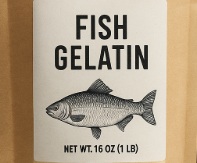
Fish gelatin
Rating : 7
| Evaluation | N. Experts | Evaluation | N. Experts |
|---|---|---|---|
| 1 | 6 | ||
| 2 | 7 | ||
| 3 | 8 | ||
| 4 | 9 | ||
| 5 | 10 |
Pros:
Antihypertensive (1) Antioxidant (1)0 pts from Al222
| Sign up to vote this object, vote his reviews and to contribute to Tiiips.Evaluate | Where is this found? |
| "Descrizione" about Fish gelatin by Al222 (23420 pt) | 2025-Dec-14 12:35 |
| Read the full Tiiip | (Send your comment) |
Fish gelatin is a natural animal-derived protein obtained through the partial hydrolysis of collagen extracted from fish skins, bones and scales. It is widely used as a functional ingredient in the food, nutraceutical, pharmaceutical and cosmetic industries.
Fish gelatin is commonly selected as an alternative to bovine and porcine gelatin, particularly for religious, cultural or market-driven requirements, and for applications requiring high purity and neutral sensory properties.
![]() | ![]() |
The production of fish gelatin begins with the selection and cleaning of fish-derived raw materials naturally rich in collagen. Pre-treatments remove lipids, non-collagen proteins and minerals to improve purity and stability.
Collagen is then subjected to controlled partial hydrolysis, most often through acid treatment, converting it into water-soluble gelatin while preserving its functional protein structure.
During extraction, fish gelatin retains a high concentration of collagen-specific amino acids, particularly glycine, proline and hydroxyproline, commonly associated with nutritional support for skin, joints and connective tissues.
Subsequent steps of filtration, purification and sterilisation significantly reduce undesirable components, including heavy metals, oxidised lipids and microbial contaminants.
The process concludes with concentration and drying (e.g. tunnel drying or spray-drying), yielding gelatin in powder, granular or sheet form. The final product is characterised by high protein content and very low fat levels. Potentially harmful components are limited mainly to trace residues inherent to fish raw materials, including fish allergens, managed through strict GMP and HACCP systems.
Fish gelatin typically appears as a translucent powder or granules, with colour ranging from white to pale yellow and minimal odour. Key physical characteristics include:
Solubility in hot water and swelling capacity in cold water
Lower gelling and melting temperatures compared to mammalian gelatin
Sensitivity to humidity and temperature, requiring controlled storage
Availability in different Bloom strengths, depending on processing and raw material
From a sensory perspective, refined fish gelatin is neutral in taste and does not significantly alter the flavour profile of finished products.
Technologically, it functions as:
Gelling agent, forming soft, elastic gels
Stabiliser and thickener in aqueous systems
Binder and film-forming agent, especially for capsules and coatings
Foaming agent and secondary emulsifier in selected formulations
Contributor to high gel transparency, valued in confectionery and nutraceuticals
A key limitation is its lower thermal stability compared to bovine or porcine gelatin.
Fish gelatin is widely used in:
Confectionery: gummies, jellies, marshmallows, gelled desserts
Dairy and dairy-style products: yoghurts, mousses, chilled desserts
Dietetic and nutraceutical products: protein bars, powdered and gel supplements
Soft capsules for food supplements and nutraceuticals
Beverage clarification, where applicable
It is particularly suitable for products formulated without porcine or bovine ingredients.
Fish gelatin consists almost entirely of protein (approximately 85–95%), derived from collagen. Its amino acid profile is rich in glycine, proline and hydroxyproline.
Key nutritional aspects:
It has some interesting biological characteristics: antihypertensive and antioxidant properties (1)
Contributes to protein intake, though it is not a complete protein
Contains negligible fat and carbohydrates
Exhibits high digestibility
Of interest for potential support of skin health, joint function and connective tissue maintenance when consumed within a balanced diet
Fish gelatin should be regarded as a functional protein ingredient, not as a sole dietary protein source.
Serving note
There is no standard serving size for fish gelatin as a standalone food. Intake depends on the finished product. In nutraceutical use, daily intakes of collagen- or gelatin-derived protein typically range from 2 to 10 g, depending on formulation and intended use.
Fish gelatin:
Is derived from fish and therefore unsuitable for individuals with fish allergy
Is generally free from gluten, lactose and soy, when produced in dedicated facilities
Is well tolerated by most consumers outside of allergy-related cases
The presence of FISH must always be clearly declared as an allergen.
Fish gelatin should be stored in a cool, dry environment, protected from humidity, light and foreign odours, in tightly closed packaging.
Under appropriate conditions, dry fish gelatin typically has a shelf-life of 24–36 months. Moisture absorption may negatively affect solubility, gel strength and microbiological stability.
Fish gelatin is considered a traditional food ingredient. It must comply with:
Microbiological safety criteria
Regulatory limits for heavy metals and environmental contaminants
Full traceability of fish raw materials
Manufacturing is conducted in accordance with GMP and HACCP principles. Fish gelatin is commonly acceptable for halal and, in many cases, kosher applications, subject to appropriate certification.
On product labels, fish gelatin must be declared as “fish gelatin”.
Key labelling requirements include:
Mandatory declaration of FISH as an allergen
Accurate description of its technological function (e.g. gelling agent, stabiliser)
Correct and non-misleading use of claims such as “free from porcine gelatin”
Common issues and solutions:
Gel too soft: insufficient dosage or low Bloom value; increase concentration or select higher-strength gelatin
Melting at room temperature: typical of fish gelatin; consider refrigeration or blending with other hydrocolloids
Residual odour: indicates suboptimal raw material quality or refining; use higher-grade gelatin
Poor solubility: improper dispersion; pre-hydrate in cold water before heating
In cosmetics, fish gelatin may appear as Fish Gelatin or as hydrolysed derivatives. Main INCI-related functions include:
Film forming
Skin conditioning
Hair conditioning
Viscosity controlling
These functions support the use of fish gelatin in skin care, hair care and mask formulations.
Fish gelatin is a versatile, high-protein functional ingredient valued for its alternative origin, neutral sensory profile and broad applicability across food, nutraceutical, pharmaceutical and cosmetic sectors.
Although its thermal stability is lower than that of mammalian gelatin, careful formulation, processing control and quality selection allow manufacturers to fully exploit its functional potential in modern, market-oriented products.
Collagen: structural protein of connective tissues and precursor of gelatin
Gelatin: product obtained by partial hydrolysis of collagen, forming thermoreversible gels
Bloom value: measure of gel strength
Hydrolysis: chemical cleavage of molecular bonds using water and acid treatment
Film forming: ability to create a continuous protective layer
GMP: Good Manufacturing Practice
HACCP: Hazard Analysis and Critical Control Points
References__________________________________________________________________________
(1) Shiao WC, Wu TC, Kuo CH, Tsai YH, Tsai ML, Hong YH, Huang CY. Physicochemical and Antioxidant Properties of Gelatin and Gelatin Hydrolysates Obtained from Extrusion-Pretreated Fish (Oreochromis sp.) Scales. Mar Drugs. 2021 May 14;19(5):275. doi: 10.3390/md19050275.
Abstract. Fish gelatin and its hydrolysates exhibit a variety of biological characteristics, which include antihypertensive and antioxidant properties. In this study, fish gelatins were extracted from extrusion-pretreated tilapia scales, and then subjected to analyses to determine the physicochemical properties and antioxidant activity of the extracted gelatins. Our findings indicate that TSG2 (preconditioned with 1.26% citric acid) possessed the greatest extraction yield, as well as higher antioxidant activities compared with the other extracted gelatins. Hence, TSG2 was subjected to further hydrolyzation using different proteases and ultrafiltration conditions, which yielded four gelatin hydrolysates: TSGH1, TSGH2, TSGH3, and TSGH4. The results showed that TSGH4 (Pepsin + Pancreatin and ultrafiltration < 3000 Da) had a higher yield and greater antioxidant activity in comparison with the other gelatin hydrolysates. As such, TSGH4 was subjected to further fractionation using a Superdex peptide column and two-stage reverse-phase column HPLC chromatography, yielding a subfraction TSGH4-6-2-b, which possessed the highest 2,2-diphenyl-1-picrylhydrazyl (DPPH) scavenging activity compared with the other fractions. Further LC-ESI/MS/MS analysis of TSGH4-6-2-b suggested two novel peptides (GYDEY and EPGKSGEQGAPGEAGAP), which could have potential as naturally-occurring peptides with antioxidant properties. These promising results suggest that these antioxidant peptides could have applications in food products, nutraceuticals, and cosmetics.
Kang MG, Lee MY, Cha JM, Lee JK, Lee SC, Kim J, Hwang YS, Bae H. Nanogels Derived from Fish Gelatin: Application to Drug Delivery System. Mar Drugs. 2019 Apr 25;17(4):246. doi: 10.3390/md17040246.
Abstract. The gelatin extracted from mammals of porcine and bovine has been prominently used in pharmaceutical, medical, and cosmetic products. However, there have been some concerns for their usage due to religious, social and cultural objections, and animal-to-human infectious disease. Recently, gelatin from marine by-products has received growing attention as an alternative to mammalian gelatin. In this study, we demonstrate the formation of nanogels (NGs) using fish gelatin methacryloyl (GelMA) and their application possibility to the drug delivery system. The fabrication of fish GelMA NGs is carried out by crosslinking through the photopolymerization of the methacryloyl substituent present in the nanoemulsion droplets, followed by purification and redispersion. There were different characteristics depending on the aqueous phase in the emulsion and the type of solvent used in redispersion. The PBS-NGs/D.W., which was prepared using PBS for the aqueous phase and D.W. for the final dispersion solution, had a desirable particle size (<200 nm), low PdI (0.16), and high drug loading efficiency (77%). Spherical NGs particles were observed without aggregation in TEM images. In vitro release tests of doxorubicin (DOX)-GelMA NGs showed the pH-dependent release behavior of DOX. Also, the MTT experiments demonstrated that DOX-GelMA NGs effectively inhibited cell growth, while only GelMA NGs exhibit higher percentages of cell viability. Therefore, the results suggest that fish GelMA NGs have a potential for nano-carrier as fine individual particles without the aggregation and cytotoxicity to deliver small-molecule drugs.
Chen H, Lin S, Wu J, Xu Y, Cai X, Wang S. The structure, antioxidant activity, and stability of fish gelatin/chitooligosaccharide nanoparticles loaded with apple polyphenols. J Sci Food Agric. 2023 Jun;103(8):4211-4220. doi: 10.1002/jsfa.12455. Epub 2023 Jan 27. PMID: 36647322.
| Sign up to vote this object, vote his reviews and to contribute to Tiiips.EvaluateClose | (0 comments) |
Read other Tiiips about this object in __Italiano (1)
Component type:   Natural Main substances:   Last update:   2025-12-14 12:15:20 | Chemical Risk:   |

