

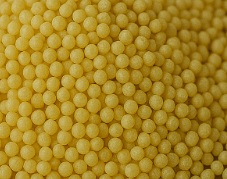
Millet seeds
Rating : 7
| Evaluation | N. Experts | Evaluation | N. Experts |
|---|---|---|---|
| 1 | 6 | ||
| 2 | 7 | ||
| 3 | 8 | ||
| 4 | 9 | ||
| 5 | 10 |
0 pts from Al222
| Sign up to vote this object, vote his reviews and to contribute to Tiiips.Evaluate | Where is this found? |
| "Descrizione" about Millet seeds by Al222 (24019 pt) | 2025-Dec-10 12:21 |
| Read the full Tiiip | (Send your comment) |
Millet seeds, Panicum miliaceum (Poaceae)
Millet seeds, obtained from the cereal Panicum miliaceum, are among the oldest cultivated foods in human history, originally domesticated in Asia and later adopted throughout Europe and Africa. Belonging to the family Poaceae, they represent a nutritionally valuable ingredient thanks to their content of complex carbohydrates, plant proteins, minerals, and bioactive compounds. They are naturally gluten-free, making them suitable for specific dietary requirements.
Morphologically, millet seeds are small, spherical grains, typically yellow-gold to cream in colour, with a smooth surface and firm texture. Their small size allows rapid cooking and easy incorporation into a wide range of culinary preparations. Their flavour is mild, with a slightly sweet, nutty profile characteristic of minor cereals.
![]() | ![]() |
Compositionally, millet seeds contain:
– complex carbohydrates (primarily starch), providing sustained energy;
– plant proteins, with a comparatively high methionine content relative to other cereals;
– dietary fibre, supporting intestinal function;
– significant levels of minerals, particularly magnesium, phosphorus, iron, and silicon;
– natural antioxidants, including phenolic compounds and carotenoids.
These components contribute to potential functional benefits related to glycaemic control, digestive wellness, and oxidative stress modulation.
Nutritionally, millet seeds are an easily digestible and balanced food source. Their gluten-free nature makes them suitable for individuals with coeliac disease or gluten sensitivity, while their fibre content supports satiety and intestinal regularity. Minerals such as magnesium and phosphorus contribute to muscle function and energy metabolism.
From a culinary perspective, millet seeds are versatile and commonly used:
– as an alternative to rice or couscous in main dishes and side preparations;
– in soups, vegetable patties, and protein-rich plant-based recipes;
– in traditional Asian and Middle Eastern dishes;
– for producing gluten-free flours used in baked goods;
– in porridges, creams, and cereal-based desserts.
Due to their favourable nutritional profile and adaptability, millet seeds are increasingly valued in modern healthy diets and natural cuisine.
(Commercial millet comes mainly from Panicum miliaceum – proso/common millet – and Setaria italica – foxtail millet. The botanical classification below refers to Panicum miliaceum, the most widespread species.)
| Category | Data |
|---|---|
| Common name | millet; millet seeds |
| Botanical name | Panicum miliaceum L. |
| Kingdom | Plantae |
| Clade | Angiosperms → monocots |
| Order | Poales |
| Family | Poaceae |
| Genus | Panicum |
| Species | Panicum miliaceum L. |
Average values refer to hulled millet before cooking; figures vary by species and degree of processing.
| Component | Approximate value per 100 g |
|---|---|
| Energy | ~ 355–370 kcal |
| Water | ~ 8–10 g |
| Total carbohydrates | ~ 72–73 g |
| — of which sugars | ~ 1–2 g |
| Dietary fiber | ~ 3–4 g (higher in whole varieties) |
| Protein | ~ 10–11 g |
| Total lipids | ~ 4–5 g |
| — saturated fatty acids (SFA) | ~ 0.7–0.9 g |
| — monounsaturated fatty acids (MUFA) | ~ 0.6–0.8 g |
| — polyunsaturated fatty acids (PUFA) | ~ 2.2–2.5 g |
| Sodium | ~ 5 mg |
| Main minerals | magnesium (≈ 115–120 mg), phosphorus (≈ 280–290 mg), potassium (≈ 190 mg), iron (≈ 3 mg), zinc |
| Relevant vitamins | B-vitamins (B1, B3, B6), small amounts of vitamin E and carotenoids |
Millet is a naturally gluten-free cereal, suitable for gluten-free diets.
Provides a significant amount of complex carbohydrates, offering long-lasting energy.
Moderately rich in lipids, mostly unsaturated (MUFA and PUFA).
Low in SFA relative to total fat content.
Notable mineral profile, especially magnesium, phosphorus, and iron.
B-vitamins support normal energy metabolism.
Production process
Millet seeds intended for food use are obtained through harvesting of the panicles, followed by threshing to separate the grains. The seeds are then cleaned to remove dust, plant residues and foreign materials, and may be dehulled (hulled or decorticated millet) depending on the final application. They can be marketed as whole grains, broken grains, puffed/granulated forms or milled into flour.
Physical properties
Millet seeds are small, round to oval grains, with a typical light yellow to golden colour, though colour can vary slightly by variety. In the raw state they are hard and somewhat glassy in texture; after cooking they become soft and mildly sticky. Moisture content is usually low, contributing to good shelf-life when properly stored. Millet is naturally gluten-free.
Sensory and technological properties
Millet has a mild, slightly nutty flavour and a relatively neutral aroma, allowing it to adapt well to both savory and sweet recipes.
From a technological standpoint, millet:
Shows good water absorption during cooking.
Develops a soft but cohesive texture, suitable for structured dishes (e.g. patties, grain mixes).
Provides starch that gelatinises readily, contributing to body and consistency in gluten-free products.
As a flour, exhibits functional behaviour useful in gluten-free doughs and batters, particularly when combined with other flours, starches or hydrocolloids.
Food applications
Millet seeds are used in a wide range of foods, for example:
Cooked grains: as a side dish, in grain bowls, pilafs, stews and soups.
Plant-based products: vegetable patties, grain burgers and other structured meat alternatives.
Gluten-free bakery: breads, crackers, biscuits and cakes when blended with other gluten-free flours.
Breakfast products: puffed millet, granola, muesli and cereal bars.
Beverages: plant-based drinks obtained by soaking, grinding and filtering the grains.
Baby foods: millet is often used in infant cereals due to its high digestibility when properly processed.
Nutrition and health
Millet seeds provide mainly complex carbohydrates, plant proteins, and a relevant amount of dietary fibre, together with minerals such as magnesium, phosphorus, iron and zinc, and B-group vitamins. Being naturally free of gluten, millet is suitable for coeliac and gluten-sensitive individuals, provided that cross-contamination is prevented.
The dietary fibre and the structure of the grain support satiety and contribute to intestinal function. The glycaemic impact of millet-based foods depends on processing (whole vs refined, cooking time, particle size, presence of other macronutrients). Some varieties and processing methods can yield moderate glycaemic index values compared with more refined cereals.
Serving note
Nutrition evaluation is usually based on the portion of cooked millet or the finished product. As a general reference, a common serving as a main grain dish is around 60–80 g of dry millet per person, but actual portion sizes depend on dietary context and recipe.
Allergens and intolerances
Millet is naturally gluten-free and is not among the major common allergens in most regulations. However:
It may cause rare, individual allergic reactions to specific millet proteins in sensitised people.
It can be contaminated with gluten during cultivation, transport or processing (shared equipment with wheat, barley, rye or oats).
For products advertised as “gluten-free”, manufacturers must ensure that gluten levels are kept below the regulatory threshold (commonly <20 ppm).
Storage and shelf-life
Whole millet seeds should be stored in a cool, dry, and dark place, protected from moisture, oxygen and light, to minimise lipid oxidation and preserve flavour. Under proper conditions, whole seeds typically have a shelf-life of about 12–24 months, depending on packaging and storage.
Millet flour has a shorter shelf-life than whole seeds because the milling process exposes lipids to oxygen, increasing the risk of rancidity. For flours, refrigerated or well-protected storage is often recommended if they are kept for extended periods.
Safety and regulatory aspects
Millet is considered a traditional cereal and does not require special novel-food authorisations in most jurisdictions. However, it must comply with regulations on:
Contaminants and residues (e.g. mycotoxins, heavy metals, pesticides).
Microbiological criteria for cereals and cereal products.
Gluten-free labelling requirements when relevant.
Standard HACCP and GMP principles apply along the supply chain to ensure safety and quality.
Labelling
On ingredient lists, millet may appear as “millet”, “millet seeds” or more specific terms such as “hulled millet” or “millet flour”.
For foods marketed as gluten-free, compliance with the legal definition (for example, <20 ppm gluten in the EU) must be ensured before any “gluten-free” claim is used. When millet is a characterising ingredient (e.g. “millet bread”), this is typically reflected in the product name and highlighted in product communication.
Troubleshooting
Overly sticky or gummy texture when cooked: usually due to excess water or overcooking; this can be corrected by reducing cooking time, using a lower water ratio, or pre-toasting the grains before boiling.
Dry or crumbly final product in bakery: insufficient hydration or lack of binding components (e.g. fibres, hydrocolloids, starches, eggs in non-vegan recipes); formulation adjustments are required.
Bitter or rancid flavour: likely due to oxidation of lipids in old or improperly stored millet or flour; check storage conditions and product age.
Poor structure in gluten-free doughs: millet flour alone has limited elasticity; combining it with other flours and structuring agents (starches, gums, proteins) helps improve volume and crumb structure.
Main INCI functions (cosmetics)
In cosmetics, derivatives of millet (e.g. millet seed extract, millet flour, millet-derived oils or peptides) can have several INCI-relevant functions, such as:
Skin conditioning (supporting softness and comfort of the skin).
Hair conditioning (improving feel, appearance and manageability of hair).
Antioxidant (helping protect the formula or skin/hair from oxidative processes).
Humectant (contributing to surface hydration when in appropriate forms).
Soothing (supporting skin comfort in mild cosmetic contexts).
The exact functions depend on the extract type, concentration, and the cosmetic vehicle.
Conclusion
Millet seeds are a versatile, nutrient-containing and naturally gluten-free cereal ingredient with wide applications in everyday nutrition, special diets and plant-based formulations. Their mild flavour, good cooking behaviour and functional starch make them suitable for gluten-free baking, structured vegan foods and breakfast products.
From a nutritional perspective, millet contributes complex carbohydrates, plant proteins, minerals and fibre, supporting satiety and digestive health when consumed as part of a balanced diet. In the cosmetic field, millet-derived ingredients are valued for conditioning and antioxidant properties, often fitting well into “natural-origin” product concepts. Proper storage, allergen management and labelling are essential to fully realise the potential of millet seeds in modern food and personal-care formulations.
Mini-glossary
Decortication / dehulling: Mechanical removal of the outer husk of the grain to obtain a more palatable, digestible kernel.
Starch gelatinisation: Process whereby starch granules absorb water and swell on heating, thickening the product and changing texture.
Cross-contamination: Unintentional contamination of a gluten-free ingredient or product with gluten from other cereals due to shared equipment or environments.
HACCP (Hazard Analysis and Critical Control Points): A systematic preventive approach to food safety, identifying and controlling potential hazards in the production process.
GMP (Good Manufacturing Practice): Set of procedures and guidelines ensuring products are consistently produced and controlled according to quality standards.
Studies
Millet (Panicum miliaceum L.) is an annual crop, is a tetraploid cereal with an exceptionally low water requirement and occurs in small grains. It has a very ancient history dating back to Neolithic China (1). There are about 20 different species cultivated all over the world, including :Pennisetum glaucum LR Br, Eleusine coracana, Paspalum setaceum, Setaria italica L., Panicum sumatrense, mEchinochloa utilis
It is the sixth most important cereal in the world (2)
Millet is an important source of energy and protein and has a high nutritional value, comparable to the main cereals such as wheat, rice, corn. It has a high content of calcium, iron, potassium, magnesium, phosphorus, zinc, dietary fiber, polyphenols (antioxidants) and proteins (3).
It is gluten-free and therefore ideal for those who are gluten intolerant and easy to digest.
It contains a large amount of lecithin, which provides excellent support for the health of the nervous system by helping to restore nerve cell function, regenerate myelin fiber and intensify brain cell metabolism.
Millet is also rich in micronutrients such as niacin or vitamin B3, the vitamins of the B complex, vitamin B6 and folic acid (4).
It generally contains significant amounts of essential amino acids, particularly those containing sulfur, is a good source of essential amino acids, except for lysine and threonine, but has a relatively high content of methionine. It also has a higher fat content than maize, rice and sorghum (5).
References________________________________________________________________________
(1) Lu H. Y., Zhang J. P., Liu K. B., Wu N. Q., Li Y. M., Zhou K. S., Ye M. L., et al. 2009. Earliest domestication of common millet (Panicum miliaceum) in East Asia extended to 10,000 years ago. Proceedings of the National Academy of Sciences, USA 106: 7367–7372
Abstract. The origin of millet from Neolithic China has generally been accepted, but it remains unknown whether common millet (Panicum miliaceum) or foxtail millet (Setaria italica) was the first species domesticated. Nor do we know the timing of their domestication and their routes of dispersal. Here, we report the discovery of husk phytoliths and biomolecular components identifiable solely as common millet from newly excavated storage pits at the Neolithic Cishan site, China, dated to between ca. 10,300 and ca. 8,700 calibrated years before present (cal yr BP). After ca. 8,700 cal yr BP, the grain crops began to contain a small quantity of foxtail millet. Our research reveals that the common millet was the earliest dry farming crop in East Asia, which is probably attributed to its excellent resistance to drought.
(2) Changmei S., Dorothy J. (2014). Millet-the frugal grain. Int. J. Sci. Res. Rev. 3 75–90.
(3) Devi P. B., Vijayabharathi R., Sathyabama S., Malleshi N. G., Priyadarisini V. B. (2014). Health benefits of finger millet (Eleusine coracana L.) polyphenols and dietary fiber: a review. J. Food Sci. Technol. 51 1021–1040. 10.1007/s13197-011-0584-9
Abstract. The growing public awareness of nutrition and health care research substantiates the potential of phytochemicals such as polyphenols and dietary fiber on their health beneficial properties. Hence, there is in need to identify newer sources of neutraceuticals and other natural and nutritional materials with the desirable functional characteristics. Finger millet (Eleusine coracana), one of the minor cereals, is known for several health benefits and some of the health benefits are attributed to its polyphenol and dietary fiber contents. It is an important staple food in India for people of low income groups. Nutritionally, its importance is well recognised because of its high content of calcium (0.38%), dietary fiber (18%) and phenolic compounds (0.3-3%). They are also recognized for their health beneficial effects, such as anti-diabetic, anti-tumerogenic, atherosclerogenic effects, antioxidant and antimicrobial properties. This review deals with the nature of polyphenols and dietary fiber of finger millet and their role with respect to the health benefits associated with millet.
(4) Pathak H. C. (2013). Role of Millets in Nutritional Security of India. New Delhi: National Academy of Agricultural Sciences, 1–16.
(5) Habiyaremye C, Matanguihan JB, D'Alpoim Guedes J, Ganjyal GM, Whiteman MR, Kidwell KK, Murphy KM. Proso Millet (Panicum miliaceum L.) and Its Potential for Cultivation in the Pacific Northwest, U.S.: A Review. Front Plant Sci. 2017 Jan 9;7:1961. doi: 10.3389/fpls.2016.01961.
Abstract. Proso millet (Panicum miliaceum L.) is a warm season grass with a growing season of 60-100 days. It is a highly nutritious cereal grain used for human consumption, bird seed, and/or ethanol production. Unique characteristics, such as drought and heat tolerance, make proso millet a promising alternative cash crop for the Pacific Northwest (PNW) region of the United States. Development of proso millet varieties adapted to dryland farming regions of the PNW could give growers a much-needed option for diversifying their predominantly wheat-based cropping systems. In this review, the agronomic characteristics of proso millet are discussed, with emphasis on growth habits and environmental requirements, place in prevailing crop rotations in the PNW, and nutritional and health benefits. The genetics of proso millet and the genomic resources available for breeding adapted varieties are also discussed. Last, challenges and opportunities of proso millet cultivation in the PNW are explored, including the potential for entering novel and regional markets.
| Sign up to vote this object, vote his reviews and to contribute to Tiiips.EvaluateClose | (0 comments) |
Read other Tiiips about this object in __Italiano (1)
Content:   Last update:   2025-12-10 12:19:17 | Kcal/100g:   370 Family:   Threat factors:   |

