

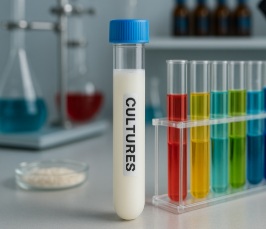
Cultures
(General term used on labels to indicate microbial starter cultures used in fermented foods)
Description
“Cultures” is a generic labeling term referring to selected microorganisms (typically bacteria, yeasts or molds) intentionally added to foods to trigger fermentation, modify flavour, improve texture, or increase food safety.
Commonly used in dairy, meat, vegetable, bakery, and beverage fermentations.
Includes groups such as lactic acid bacteria, bifidobacteria, propionic bacteria, yeasts, and molds, depending on the product type.
The term may represent one or multiple strains and does not necessarily specify their identity unless required by local regulations.

Indicative nutritional values per 100 g
(Values refer to dried culture blends, not fermented foods)
Key constituents
Live microbial cells (species vary by product).
Cellular components: peptidoglycan, membrane phospholipids, enzymes.
Protective agents in dried starters: maltodextrin, inulin, skim milk solids.
Metabolites such as lactic acid (produced during use, not in the dry ingredient).
Production process
Strain selection and characterization (safety, technological properties).
Fermentation in controlled bioreactors.
Harvesting through centrifugation.
Concentration and washing of the biomass.
Stabilisation through freeze-drying or spray-drying.
Blending with suitable carriers.
Packaging in moisture- and oxygen-protective materials.
Production under GMP/HACCP, with:
identity verification,
purity testing,
viability assays,
absence of pathogens.
Physical properties
Aspect: powder (white to off-white), sometimes granular.
Odour: neutral to slightly tangy.
Water activity: low (critical for stability).
Dispersibility: readily dispersible in water or milk.
Sensory and technological properties
Acidification (lowering pH in dairy and vegetable fermentations).
Aroma development (via enzymatic pathways).
Texture creation:
Preservation: competitive inhibition of undesirable microbes.
Colour development in specific fermented meats.
Alcohol and CO₂ production (yeasts in bread, beverages).
Food applications
Dairy products: yoghurt, kefir, fermented milk drinks, cheese.
Meat processing: salami, pepperoni, cured sausages.
Vegetable fermentation: sauerkraut, kimchi, pickles.
Bakery: sourdough breads.
Beverages: kombucha, kefir water, kvass, beer (yeast cultures).
Functional foods with probiotic claims.
Nutrition & health
Some cultures provide probiotic effects, depending on strain and dose:
support for gut microbiota balance
improved lactose digestion
potential immune modulation
In fermented foods, cultures contribute to enhanced digestibility, bioavailability of nutrients, and lower lactose content.
Effects are strain-specific and not guaranteed when cultures are used only for fermentation.
Safe for the general population, with caution for severely immunocompromised individuals.
Portion note
Allergens and intolerances
Cultures themselves are not allergens, but:
Naturally gluten-free, unless processed with gluten-containing carriers.
Storage and shelf-life
Store refrigerated (2–8 °C) unless designated shelf-stable.
Protect from moisture, heat and oxygen.
Shelf-life: typically 12–24 months for freeze-dried cultures.
Viability decreases faster at high temperatures.
Opened packages should be resealed carefully and used quickly.
Safety & regulatory
Subject to regulations for microbial food cultures and, when applicable, probiotics.
Requirements include:
strain identity (genus, species, sometimes strain ID),
absence of pathogens,
demonstration of safe use history,
allergen declaration when carriers are used.
Production must follow GMP/HACCP and strict contamination controls.
Labeling
Typically declared simply as “cultures” or “starter cultures”.
For products with probiotics, species and strain must be listed (e.g., Lactobacillus rhamnosus GG).
Some regulations allow generic listing unless the culture has specific physiological effects.
Additional labeling may include:
storage conditions,
viability guarantee,
allergens from carriers.
Troubleshooting
Slow acidification: low viability, poor temperature control → adjust inoculation and conditions.
Off-flavours: contamination or unsuitable strains → improve hygiene or strain selection.
Gas formation: presence of heterofermentative bacteria when not desired.
Texture defects in dairy: improper incubation, wrong culture blend, proteolysis imbalance.
Viability loss: exposure to heat/moisture → improve storage.
Sustainability & supply chain
Microbial culture production has a relatively low environmental footprint, but energy is required for:
fermentation
freeze-drying
cold storage
Wastewater and biomass residues must be managed properly (monitoring via BOD/COD).
Cultures contribute indirectly to sustainability by reducing food waste through improved preservation.
Main INCI functions (cosmetics)
(as “Lactobacillus Ferment”, “Bifida Ferment Lysate”, etc.)
Skin-conditioning
Microbiome-balancing
Humectant
Barrier-supporting functions
Used in probiotic-inspired skincare, serums, creams and barrier-protection products.
Conclusion
“Cultures” is a broad category encompassing microorganisms that drive fermentation, enhance flavour and texture, and contribute to food safety. They are essential in a wide range of dairy, meat, bakery, vegetable and beverage processes. When carefully selected and properly managed, cultures ensure consistent performance, product stability, and—in some cases—added nutritional or probiotic benefits.
Mini-glossary