

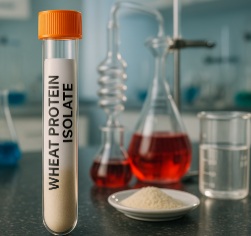
Wheat protein isolate
Description
Wheat protein isolate is a high-purity protein ingredient obtained from wheat flour through the removal of starch and soluble components, leaving a concentrated protein fraction (typically 85–95% protein).
Derived mainly from gluten proteins (gliadins and glutenins), it provides elasticity, structure, and binding functionalities.
Used extensively in bakery, meat analogues, pasta, plant-based applications, and nutrition products.
Neutral to slightly cereal-like in flavour; beige to light cream in colour.

Indicative nutritional values per 100 g
(Typical commercial wheat protein isolate; may vary by processing method)
Key constituents
Gliadins (contribute to extensibility).
Glutenins (contribute to elasticity and strength).
Minor wheat proteins: albumins, globulins.
Residual starch and fiber depending on purification degree.
Small amounts of lipids and minerals from the wheat kernel.
Production process
Milling of wheat to obtain flour.
Dough washing / wet separation to remove starch from the gluten protein matrix.
Centrifugation or filtration to isolate gluten.
Purification to reduce starch, fiber, and non-protein components.
Drying:
Milling to uniform powder.
Packaging in moisture-proof bags.
Quality management under GMP/HACCP, including microbiological tests, moisture, protein content, and gluten strength.
Physical properties
Appearance: fine powder, beige to cream.
Odour: neutral to slightly cereal-like.
Solubility: low in cold water; dispersible but not soluble (due to gluten structure).
Density: typically 0.45–0.60 g/mL (bulk).
Functional properties: viscoelasticity, binding, gelling, water absorption.
Sensory and technological properties
Provides elasticity, chewiness, and structure to doughs.
Acts as a binder in meat and plant-based products.
Enhances water retention and texture stability in baked goods.
Contributes to film formation in certain applications.
Neutral flavour profile allows use in savoury and sweet formulations.
Food applications
Bakery: bread, rolls, tortillas, high-protein baked goods.
Pasta and noodles: improved texture and firmness.
Plant-based meats: texture creator and protein source.
Processed meats: binder in sausages, patties, nuggets.
Protein fortification in bars, shakes, nutrition products.
Batter and coating systems: improved adhesion and crispness.
Dough conditioners and texture improvers.
Nutrition & health
High in plant protein, with a favourable amino acid profile for elasticity and baking performance.
Low in fat and carbohydrates.
Not a complete protein (low lysine content), but useful in combination with legumes.
Safe for general population, except individuals with specific conditions:
May support satiety due to high protein content.
Portion note
In bakery formulations: 1–10% of flour weight depending on desired strength.
In meat or plant-based systems: 2–15%.
In protein-fortified foods: added as needed to reach target protein levels.
Allergens and intolerances
Contains WHEAT and gluten (major allergens).
Unsuitable for individuals with celiac disease or gluten sensitivity.
May cause reactions in wheat-allergic consumers.
Naturally gluten-containing; cannot be used in gluten-free foods.
Storage and shelf-life
Store in cool, dry conditions (<25 °C; low humidity).
Keep sealed to avoid moisture uptake and clumping.
Shelf-life: typically 12–24 months unopened.
Sensitive to:
Safety & regulatory
Must comply with food regulations for wheat derivatives.
Requirements include:
allergen declaration (WHEAT, GLUTEN)
limits on microbial counts
absence of contaminants such as heavy metals and mycotoxins
Manufacturing plants must follow GMP/HACCP.
No genetic modification unless labeled as such (depending on origin).
Labeling
Troubleshooting
Weak dough strength: insufficient hydration or low protein quality → adjust water level or use higher-quality isolate.
Gummy or tough texture: too high concentration → reduce protein percentage.
Poor dispersion: add gradually to water or blend with dry ingredients.
Off-odours: moisture uptake or ageing → ensure airtight storage.
Clumping: high humidity exposure → sieve and control moisture.
Sustainability & supply chain
Sourced from wheat, a widely grown cereal with moderate environmental impact.
Sustainability depends on:
Facilities must treat wastewater and by-products, monitored with BOD/COD.
By-products (starch, bran) are often valorised in other food or feed applications.
Main INCI functions (cosmetics)
(as “Hydrolyzed Wheat Protein”, “Wheat Amino Acids”, etc.)
Film-forming
Hair-conditioning (strengthening and smoothing)
Skin-conditioning
Used in shampoos, conditioners, leave-ins, serums and skincare for improved moisture retention.
Conclusion
Wheat protein isolate is a versatile, high-protein functional ingredient widely used in bakery, plant-based foods, and protein-fortified applications. With strong technological functionality (elasticity, binding, hydration) and a neutral flavour profile, it improves texture and nutritional value. Proper handling and allergen labelling are essential due to its wheat and gluten content.
Mini-glossary
SFA – Saturated fatty acids: present only in trace amounts in wheat.
MUFA – Monounsaturated fatty acids: minimal levels.
PUFA – Polyunsaturated fatty acids: low traces.
TFA – Trans fatty acids: absent.
GMP/HACCP – Systems ensuring hygiene, safety and quality in food manufacturing.
BOD/COD – Indicators of wastewater environmental impact.
CFU – Colony-forming units; used in microbiological quality control.