

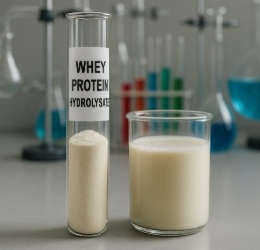
Whey protein hydrolysate
Rating : 7
| Evaluation | N. Experts | Evaluation | N. Experts |
|---|---|---|---|
| 1 | 6 | ||
| 2 | 7 | ||
| 3 | 8 | ||
| 4 | 9 | ||
| 5 | 10 |
Cons:
Allergen (1)0 pts from Al222
| Sign up to vote this object, vote his reviews and to contribute to Tiiips.Evaluate | Where is this found? |
| "Descrizione" about Whey protein hydrolysate by Al222 (23258 pt) | 2025-Nov-19 19:57 |
| Read the full Tiiip | (Send your comment) |
Whey protein hydrolysate (WPH) is a pre-digested whey protein obtained by enzymatically breaking down intact whey proteins into smaller peptides.
It is characterized by rapid absorption, high digestibility, and enhanced bioavailability of amino acids.
Used in sports nutrition, clinical nutrition, infant formulas, and specialized high-performance foods.
Typically produced from WPC or WPI through controlled enzymatic hydrolysis.

(Typical ranges; vary depending on hydrolysis degree)
Energy: 360–400 kcal
Proteins: 70–95 g
Carbohydrates: 1–8 g
Lactose: 0.1–5 g (lower in isolates)
Lipids: 0.5–5 g
SFA (first occurrence): very low
MUFA: traces
PUFA: traces
TFA: absent
Minerals: calcium, phosphorus, potassium, sodium
Moisture: 3–7%
Short peptides (di-peptides, tri-peptides) and oligopeptides
Residual β-lactoglobulin fragments
α-lactalbumin fragments
Immunoglobulin fragments (depending on hydrolysis level)
Lactoferrin fragments (in high-quality WPH)
Free amino acids
Trace minerals and residual lactose depending on purification
Whey collection from cheese manufacturing.
Clarification & pasteurization to remove fat and microbial contaminants.
Concentration via ultrafiltration or microfiltration (starting from WPC/WPI).
Enzymatic hydrolysis:
food-grade proteases break whey proteins into small peptides under controlled time, temperature, and pH.
Enzyme inactivation through controlled thermal treatment.
Filtration and demineralization (optional).
Spray drying to obtain a stable powder.
Quality control (GMP/HACCP): degree of hydrolysis (DH), microbial profile, lactose content, protein purity, bitterness index, solubility.
Appearance: fine, off-white powder; slightly hygroscopic.
Solubility: excellent, dissolves rapidly even in cold water.
Foam behavior: reduced foaming compared to WPC/WPI due to peptide structure.
Viscosity: generally lower than intact whey proteins.
Flavor: more pronounced bitterness in high-hydrolysis products.
Highly soluble and quick to disperse.
Low viscosity, ideal for clear beverages and high-protein liquid applications.
Heat stability improved in some hydrolysates.
Bitterness increases with higher degree of hydrolysis; flavor masking may be needed.
Minimal foaming, beneficial for RTD beverages.
Sports nutrition: fast-acting protein powders, pre- and post-workout formulas.
Medical nutrition: formulas requiring easy digestibility (ICU, elderly care, malabsorption issues).
Infant nutrition: hypoallergenic formulas (extensively hydrolyzed whey proteins).
Functional beverages: clear protein drinks, shots, gels.
Protein bars: enhanced softness and reduced hardness over shelf-life.
Special dietary foods: ketogenic, bariatric, or gastrointestinal-sensitive products.
Fastest-absorbing form of whey protein.
Provides optimal levels of essential amino acids, especially BCAA.
Reduces digestive workload thanks to smaller peptides.
Suitable for applications requiring rapid amino acid delivery (post-exercise).
Extensively hydrolyzed forms may be used in hypoallergenic infant formulas.
Considerations:
not suitable for individuals with cow’s milk protein allergy (but tolerated in some non-IgE cases depending on hydrolysis)
lactose content varies with purification
Sports nutrition: 15–30 g WPH per serving.
Medical and clinical formulas: 10–25 g depending on prescription.
Infant formulas: concentration determined by regulatory guidelines and degree of hydrolysis.
Clear protein drinks: 10–20% protein content by weight.
Contains the mandatory allergen MILK.
Hypoallergenic only when extensively hydrolyzed, and still not suitable for IgE-mediated allergy.
Lactose levels depend on whether the hydrolysate is WPC-based or WPI-based.
Store in cool, dry conditions.
Shelf-life: 18–30 months in sealed packaging.
Sensitive to:
moisture → clumping
heat → peptide degradation or flavor changes
oxidation → off-flavors (especially in higher-fat WPC-based hydrolysates)
Considered safe when produced under GMP/HACCP.
Regulations differ for:
infant nutrition
medical food
sports supplements
Key safety checks:
microbiological profile
degree of hydrolysis
residual lactose
contaminants (heavy metals, residues)
Additional requirements for hypoallergenic infant formulas: validated hydrolysis and clinical tolerance testing.
Declared as:
“whey protein hydrolysate (WPH)”
“hydrolyzed whey protein”
“enzymatically hydrolyzed whey protein”
Allergen declaration: MILK.
Any added ingredients (lecithin, sweeteners, flavors) must be listed.
Bitterness:
high hydrolysis → use flavor masking, sweeteners, or blends.
Poor dispersibility:
use instantized WPH or adjust mixing speed/temperature.
Clumping:
due to moisture; improve packaging or add anti-caking solutions.
Unwanted viscosity changes:
incorrect DH or thermal treatment; adjust enzymatic parameters.
Sedimentation in beverages:
incomplete hydration; allow resting time (1–3 minutes).
Valorizes whey, a cheese-making by-product, reducing waste.
Environmental aspects:
energy use in filtration and spray drying
wastewater with controlled BOD/COD
sourcing from sustainable dairy farms
Highly stable powder → reduced spoilage and logistical waste.
(When used as “Hydrolyzed Whey Protein”, “Hydrolyzed Lactis Proteinum”)
Skin-conditioning and moisturizing agent.
Hair-conditioning and protective film-forming.
Improves hair strength, elasticity, and manageability.
Used in creams, serums, shampoos, masks, conditioners.
Whey protein hydrolysate is a premium ingredient known for its rapid absorption, high digestibility, and superior functionality in sports, clinical, and infant nutrition. Its small peptide profile makes it ideal for fast-acting protein delivery and sensitive digestive conditions. It also provides valuable conditioning benefits in cosmetic formulations. Proper process control and flavor management ensure optimal performance in both liquid and solid applications.
SFA – Saturated fatty acids: present only in small amounts depending on purity.
MUFA – Monounsaturated fatty acids: generally favorable for cardiovascular profiles.
PUFA – Polyunsaturated fatty acids: omega-3 and omega-6 families; minimal in whey ingredients.
TFA – Trans fatty acids: undesirable; absent in whey hydrolysates.
GMP/HACCP – Good Manufacturing Practices / Hazard Analysis and Critical Control Points: safety and quality systems.
BOD/COD – Biological oxygen demand / chemical oxygen demand: indicators of environmental impact for industrial wastewater.
References__________________________________________________________________________
Tang JE, Moore DR, Kujbida GW, Tarnopolsky MA, Phillips SM. Ingestion of whey hydrolysate, casein, or soy protein isolate: effects on mixed muscle protein synthesis at rest and following resistance exercise in young men. J Appl Physiol (1985). 2009 Sep;107(3):987-92. doi: 10.1152/japplphysiol.00076.2009.
Abstract. This study was designed to compare the acute response of mixed muscle protein synthesis (MPS) to rapidly (i.e., whey hydrolysate and soy) and slowly (i.e., micellar casein) digested proteins both at rest and after resistance exercise. Three groups of healthy young men (n = 6 per group) performed a bout of unilateral leg resistance exercise followed by the consumption of a drink containing an equivalent content of essential amino acids (10 g) as either whey hydrolysate, micellar casein, or soy protein isolate. Mixed MPS was determined by a primed constant infusion of l-[ring-(13)C(6)]phenylalanine. Ingestion of whey protein resulted in a larger increase in blood essential amino acid, branched-chain amino acid, and leucine concentrations than either casein or soy (P < 0.05). Mixed MPS at rest (determined in the nonexercised leg) was higher with ingestion of faster proteins (whey = 0.091 +/- 0.015, soy = 0.078 +/- 0.014, casein = 0.047 +/- 0.008%/h); MPS after consumption of whey was approximately 93% greater than casein (P < 0.01) and approximately 18% greater than soy (P = 0.067). A similar result was observed after exercise (whey > soy > casein); MPS following whey consumption was approximately 122% greater than casein (P < 0.01) and 31% greater than soy (P < 0.05). MPS was also greater with soy consumption at rest (64%) and following resistance exercise (69%) compared with casein (both P < 0.01). We conclude that the feeding-induced simulation of MPS in young men is greater after whey hydrolysate or soy protein consumption than casein both at rest and after resistance exercise; moreover, despite both being fast proteins, whey hydrolysate stimulated MPS to a greater degree than soy after resistance exercise. These differences may be related to how quickly the proteins are digested (i.e., fast vs. slow) or possibly to small differences in leucine content of each protein.
Sun Y, Ling C, Liu L, Zhang J, Wang J, Tong X, Hidayat K, Chen M, Chen X, Zhou H, Xu J, Qin L, Zhu W, Yang J. Effects of Whey Protein or Its Hydrolysate Supplements Combined with an Energy-Restricted Diet on Weight Loss: A Randomized Controlled Trial in Older Women. Nutrients. 2022 Oct 28;14(21):4540. doi: 10.3390/nu14214540.
Abstract. An energy-restricted weight-loss approach has limitations when it used in the elderly, especially because of muscle loss. We aimed to assess the effects of whey protein (WP) or WP hydrolysate (WPH) combined with an energy-restricted diet (ERD) on weight reduction and muscle preservation in older women with overweight and obesity. A total of 60 women were randomized to the control (ERD), WP (ERD + 20 g/d WP) or WPH (ERD + 20 g/d WPH) group, using a 1:1:1 allocation ratio. After an 8-week intervention, body composition, gut microbiota, and serum metabolomics changes were compared among the three groups. The reductions in body weight (−1.11 ± 1.11 vs. −2.34 ± 1.35, p < 0.05), BMI (−0.46 ± 0.45 vs. −0.97 ± 0.54, p < 0.05), and body fat (−0.70 ± 0.92 vs. −2.45 ± 1.65, p < 0.01) were higher in the WPH group than in the control group. Body fat (%) was significantly decreased in the two protein groups. Fat-free mass did not significantly change among the three groups. Serum metabolomics showed that the tricarboxylic acid cycle pathway was upregulated in the WPH group. No significant changes in microbiota were observed among the groups. In conclusion, WP or WPH supplementation combined with an energy-restricted diet benefits older women during weight loss. WPH was more effective, possibly due to increased energy metabolism.
Agarkova EY, Kruchinin AG, Glazunova OA, Fedorova TV. Whey Protein Hydrolysate and Pumpkin Pectin as Nutraceutical and Prebiotic Components in a Functional Mousse with Antihypertensive and Bifidogenic Properties. Nutrients. 2019 Dec 3;11(12):2930. doi: 10.3390/nu11122930. PMID: 31816861;
Abstract. Systematical consumption of functional products has a significant positive effect on health and can reduce the risk of diseases. The aim of this study was to investigate the possibility of using whey protein hydrolysate (WPH) and pumpkin pectin as ingredients in a functional mousse, to evaluate the mousse's antioxidant and hypotensive activities in vitro, and to evaluate the effect of the long-term intake of mousse samples on the progression of hypertension in spontaneously hypertensive rats (SHRs) and on the microbiome status in Wistar rats with antibiotic-induced dysbiosis. The experimental mousse's in vitro antioxidant activity (oxygen radical absorbance capacity) increased by 1.2 times. The hypotensive (angiotensin-1-converting enzyme inhibitory) activity increased by 6 times in comparison with a commercial mousse. Moreover, the addition of pectin allowed the elimination of the bitter aftertaste of WPH. In vivo testing confirmed the hypotensive properties of the experimental mousse. The systolic blood pressure in SHRs decreased by 18 mmHg and diastolic blood pressure by 12 mmHg. The experimental mousse also showed a pronounced bifidogenic effect. The Bifidobacterium spp. population increased by 3.7 times in rats orally administered with the experimental mousse. The results of these studies confirm that WPH and pumpkin pectin are prospective ingredients for the development of functional mousses.
Brown MA, Stevenson EJ, Howatson G. Whey protein hydrolysate supplementation accelerates recovery from exercise-induced muscle damage in females. Appl Physiol Nutr Metab. 2018 Apr;43(4):324-330. doi: 10.1139/apnm-2017-0412.
Abstract. A number of different forms of protein and their analogues have been investigated for their efficacy in ameliorating exercise-induced muscle damage (EIMD) and recovery. Preliminary data regarding whey protein hydrolysate (WPH) supplementation are promising. However, its efficacy beyond acute eccentric/resistance exercise bouts or longer term training programmes are limited and all investigations have been conducted in male or mixed-sex groups. This study sought to elucidate whether the benefits of WPH previously reported can be demonstrated in females following repeated-sprint exercise. Twenty physically active females were assigned to consume 2 doses of 70 mL WPH or isoenergetic carbohydrate (CHO) for 4 days post-EIMD. Measures of muscle soreness, limb girth, flexibility, muscle function, and creatine kinase were collected before, immediately after, and 24, 48, and 72 h postexercise. Time effects were observed for all variables (p < 0.05) except limb girth, which is indicative of EIMD. Flexibility improved beyond baseline measures following WPH by 72 h, but had failed to recover in the CHO group (p = 0.011). Reactive strength index was higher throughout recovery in the WPH group compared with CHO (p = 0.016). Reductions in creatine kinase were greater following WPH compared with CHO at 48 h post-EIMD (p = 0.031). The findings suggest that 4-day supplementation of WPH is beneficial for reducing symptoms of EIMD and improving recovery of muscle function in physically active females.
Zhao T, Sun H, Ji S, Yang B, Wang Z, Liu Y, Chen C, Lu B. The Effect of Whey Protein Isolate Hydrolysate on Digestive Properties of Phytosterol. J Agric Food Chem. 2024 Jun 5;72(22):12738-12751. doi: 10.1021/acs.jafc.4c01111.
Abstract. Phytosterol (PS) is a steroid, and its bioavailability can be enhanced by interacting with protein in the C-24 hydroxyl group. The interaction between sterols and amino acid residues in proteins can be enhanced by enzymatic hydrolysis. Phytosterol and whey insulation hydrolysates (WPH1-4) fabricated by the Alcalase enzyme at different enzymatic hydrolysis times were selected as delivery systems to simulate sterol C-24 hydroxyl group interaction with protein. Increasing hydrolysis time can promote the production of β-Lg, which raises the ratio of β-turn in the secondary structure and promotes the formation of interaction between WPH and PS. The correlation coefficient between hydrogen bonds and encapsulation efficiency (EE) and bioaccessibility is 0.91 and 0.88 (P < 0.05), respectively, indicating that hydrogen bonds of two components significantly influenced the combination by concealing the hydrophobic amino acids and some residues, which improved PS EE and bioavailability by 3.03 and 2.84 times after PS was combined with the WPI hydrolysate. These findings are expected to enhance the absorption of PS and other macromolecules by protein enzymatic hydrolysis to broaden their applications for food.
Chen YC, Smith HA, Hengist A, Chrzanowski-Smith OJ, Mikkelsen UR, Carroll HA, Betts JA, Thompson D, Saunders J, Gonzalez JT. Co-ingestion of whey protein hydrolysate with milk minerals rich in calcium potently stimulates glucagon-like peptide-1 secretion: an RCT in healthy adults. Eur J Nutr. 2020 Sep;59(6):2449-2462. doi: 10.1007/s00394-019-02092-4.
Abstract. Purpose: To examine whether calcium type and co-ingestion with protein alter gut hormone availability. Methods: Healthy adults aged 26 ± 7 years (mean ± SD) completed three randomized, double-blind, crossover studies. In all studies, arterialized blood was sampled postprandially over 120 min to determine GLP-1, GIP and PYY responses, alongside appetite ratings, energy expenditure and blood pressure. In study 1 (n = 20), three treatments matched for total calcium content (1058 mg) were compared: calcium citrate (CALCITR); milk minerals rich in calcium (MILK MINERALS); and milk minerals rich in calcium plus co-ingestion of 50 g whey protein hydrolysate (MILK MINERALS + PROTEIN). In study 2 (n = 6), 50 g whey protein hydrolysate (PROTEIN) was compared to MILK MINERALS + PROTEIN. In study 3 (n = 6), MILK MINERALS was compared to the vehicle of ingestion (water plus sucralose; CONTROL). Results: MILK MINERALS + PROTEIN increased GLP-1 incremental area under the curve (iAUC) by ~ ninefold (43.7 ± 11.1 pmol L-1 120 min; p < 0.001) versus both CALCITR and MILK MINERALS, with no difference detected between CALCITR (6.6 ± 3.7 pmol L-1 120 min) and MILK MINERALS (5.3 ± 3.5 pmol L-1 120 min; p > 0.999). MILK MINERALS + PROTEIN produced a GLP-1 iAUC ~ 25% greater than PROTEIN (p = 0.024; mean difference: 9.1 ± 6.9 pmol L-1 120 min), whereas the difference between MILK MINERALS versus CONTROL was small and non-significant (p = 0.098; mean difference: 4.2 ± 5.1 pmol L-1 120 min). Conclusions: When ingested alone, milk minerals rich in calcium do not increase GLP-1 secretion compared to calcium citrate. Co-ingesting high-dose whey protein hydrolysate with milk minerals rich in calcium increases postprandial GLP-1 concentrations to some of the highest physiological levels ever reported. Registered at ClinicalTrials.gov: NCT03232034, NCT03370484, NCT03370497.
| Sign up to vote this object, vote his reviews and to contribute to Tiiips.EvaluateClose | (0 comments) |
Read other Tiiips about this object in __Italiano (1)
Component type:   Natural Main substances:   Last update:   2025-11-19 19:48:03 | Chemical Risk:   |

