

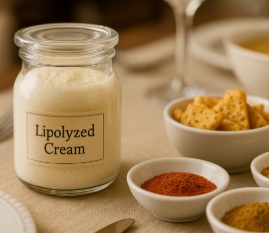
Lipolyzed cream
Rating : 4
| Evaluation | N. Experts | Evaluation | N. Experts |
|---|---|---|---|
| 1 | 6 | ||
| 2 | 7 | ||
| 3 | 8 | ||
| 4 | 9 | ||
| 5 | 10 |
Cons:
Allergen (1)0 pts from Al222
| Sign up to vote this object, vote his reviews and to contribute to Tiiips.Evaluate | Where is this found? |
| "Descrizione" about Lipolyzed cream by Al222 (23254 pt) | 2025-Nov-13 17:07 |
| Read the full Tiiip | (Send your comment) |
Lipolyzed cream
(enzymatically modified cream / enzyme-modified dairy fat, liquid, paste, or spray-dried)
Description
• Dairy ingredient obtained by enzymatic lipolysis of cream (typically 30–60% milk fat) using food-grade lipases to release free fatty acids (FFA) and partial glycerides, intensifying buttery/cheesy notes and improving emulsification.
• Available as liquid/paste (refrigerated or frozen) or spray-dried powder; flavor profile depends on enzyme type (sn-1/3 vs sn-2 specificity), lipolysis degree, temperature, and time.
• Used in flavor systems (butter/cheese/meat snacks), sauces, bakery seasonings, processed cheese, and ready meals.

Indicative nutritional values (per 100 g; typical ranges by format)
• Energy: 520–740 kcal (lower end powders with carriers; higher end fat-rich pastes)
• Fat: 55–85 g — first mention lipids: SFA/MUFA/PUFA (saturated/mono-/polyunsaturated; limit SFA, while MUFA/PUFA generally more favorable)
• Protein: 2–12 g (higher in powders retaining milk solids)
• Carbohydrates: 0–25 g (0–5 g in fat pastes; up to 25 g when carriers like maltodextrin are used)
• Sodium: 20–150 mg (intrinsic; higher if salted)
• Moisture: 1–40% (powders 1–5%; pastes/emulsions higher)
Key constituents
• Free fatty acids (FFA): short- and medium-chain acids (notably butyric, caproic, caprylic, capric) that deliver strong buttery/cheesy notes.
• Mono-/diacylglycerols (natural emulsifiers), residual triacylglycerols.
• Milk fat minor lipids (sterols, tocopherols; traces of MFGM phospholipids if not removed).
• Optional carriers/anti-caking agents in powders (e.g., maltodextrin, silicon dioxide), salt, natural flavors.
Production process
• Standardized cream → pasteurization → enzymatic lipolysis (selected microbial lipase, controlled pH/temperature/time) → monitoring to target FFA/acid value → enzyme inactivation (heat) → phase adjustment (emulsification/standardization) → spray drying (if powder) → packaging under oxygen-barrier conditions (often nitrogen-flushed).
• Typical lipolysis endpoints: acid value (AV) ~ 10–80 mg KOH/g fat (application-dependent).
Physical properties
• Appearance: pale cream to light yellow liquid/paste or free-flowing powder.
• Aroma/flavor: from clean buttery to pungent cheesy as lipolysis increases.
• Oxidation sensitivity: elevated due to FFA; requires low PV (peroxide value) and oxygen control.
Sensory and technological properties
• Strong flavor potentiation (buttery, cooked milk, cheesy, savory).
• FFA and partial glycerides improve emulsification, wetting, and flavor release.
• Enhances Maillard and browning in dry applications when powders contain lactose/carriers.
• High impact at low dose; excessive lipolysis can produce harsh/rancid notes.
Food applications
• Flavors & seasonings: butter/cheese notes for snacks, instant pasta/rice, bouillons.
• Sauces & soups: creamy mouthfeel and top-notes in white/cheese sauces and gravies.
• Bakery: laminated doughs, crackers, biscuit fillings, fillings/toppings.
• Processed cheese & analogs: boosts cheese intensity, allows fat reduction or cost optimization.
• Ready meals & meats: rubs, glazes, and savory systems.
Nutrition and health
• Supplies dairy fat and minor bioactives from milk fat; usage levels are small (typically flavor-level).
• Consider saturated fat contribution in nutrition labeling when used at higher inclusion.
• Not suitable for vegetarian diets (dairy-derived); suitable for ovo-lacto vegetarians if permitted by preference.
Serving note (inclusion guidance)
• Flavor systems/seasonings: ~0.05–0.5% as-is in finished food.
• Sauces/processed cheese/bakery: typically 0.2–1.5% (higher for mild products).
• Titrate to sensory target; combine with diacetyl/cheese flavors as needed.
Allergens and intolerances
• Contains milk (major allergen; labeling required).
• Lactose: negligible in fat pastes; may be present in powders with milk solids/carriers.
• Enzymes are inactivated; the source organism (e.g., microbial lipase) may be declared per local rules when carried over.
Quality and specifications (typical)
• Acid value (AV): 10–80 mg KOH/g fat (target by application).
• Peroxide value (PV): ≤ 1–2 meq O₂/kg fat at packing; p-AnV low.
• FFA (% of fat): 5–25%.
• Moisture: powders ≤ 5%; pastes as specified.
• Microbiology (powders): Salmonella absent/25 g; coliforms low; total count within dairy-powder norms.
• Sensory: clean buttery/cheesy without soapy, oxidized, or sulphury off-notes.
Storage and shelf-life
• Powders: cool, dry, dark (≤ 20–25 °C; RH < 65%); oxygen-barrier packs; 12–18 months unopened.
• Pastes/liquids: refrigerated (≤ 4 °C) for short term (weeks) or frozen (−18 °C) for long term (6–12 months).
• Minimize oxygen and light; consider antioxidants (tocopherols/ascorbyl palmitate) where permitted.
Safety and regulatory
• Produced under GMP/HACCP; lipases must be food-grade and approved.
• In many jurisdictions, marketed as enzyme-modified dairy ingredient (EMDI) or enzyme-modified butterfat (EMBF); may be declared as “flavoring”, “enzymatically modified cream”, or “lipolyzed cream” per local labeling rules.
• Allergen “milk” mandatory; declare added flavors, carriers, and antioxidants where used.
Labeling
• Name examples: “Lipolyzed Cream”, “Enzyme-Modified Cream”, “Enzyme-Modified Dairy Fat”, or “Flavoring” (jurisdiction-dependent).
• Indicate milk allergen, ingredient list (including carriers/additives), net weight, lot/date, origin, storage.
• Optional claims: “natural flavor” only if compliant with local flavor regulations.
Troubleshooting
• Harsh/rancid or soapy notes → over-lipolysis or long storage → select lower AV, add antioxidants, tighten oxygen control.
• Oxidized flavor → high PV/oxygen exposure → improve barrier packaging, nitrogen flush, colder storage.
• Poor dispersion (powder) → fine particles or low instantization → select agglomerated grade; disperse into warm phase with shear.
• Phase separation (paste in sauce) → insufficient emulsifiers/shear → increase shear or add complementary emulsifier/starch.
Sustainability and supply chain
• Enables flavor intensity at low dose, reducing overall dairy fat usage in finished foods.
• Can valorize dairy side streams; implement heat recovery on evaporators/dryers and wastewater treatment with BOD/COD reduction.
• Prefer recyclable/mono-material barrier packaging; rotate stock (FIFO) to reduce waste.
Conclusion
Lipolyzed cream delivers high-impact buttery/cheesy flavor and functional emulsification at low inclusion. Control of enzyme specificity, lipolysis endpoint, and oxidation is critical to achieving a clean, stable profile across sauces, seasonings, bakery, processed cheese, and ready meals.
Mini-glossary
• SFA/MUFA/PUFA — Saturated / monounsaturated / polyunsaturated fatty acids; limit SFA, while MUFA/PUFA generally support a more favorable lipid profile.
• FFA — Free fatty acids; released by lipase action, driving buttery/cheesy flavor but increasing oxidation risk.
• MFGM — Milk fat globule membrane; phospholipid/protein membrane fragments that aid emulsification.
• AV (acid value) — mg KOH needed to neutralize FFA per g fat; a measure of lipolysis degree.
• PV (peroxide value) — Primary lipid-oxidation index (meq O₂/kg fat); lower is fresher.
• GMP/HACCP — Good manufacturing practices / hazard analysis and critical control points; hygiene and safety systems.
• BOD/COD — Biochemical / chemical oxygen demand; indicators of organic load in effluents.
References__________________________________________________________________________
Tomasini, A., Bustillo, G., & Lebeault, J. M. (1995). Production of blue cheese flavour concentrates from different substrates supplemented with lipolyzed cream. International Dairy Journal, 5(3), 247-257.
Abstract. Blue cheese flavour concentrates were prepared from concentrated milk or substitute substrate, with or without added lipolyzed cream, by using a method that is different from the traditional one. The proposed method requires a reduced processing time and avoids a drainage period. The addition of lipolyzed cream, hydrolyzed with a selected lipase, was essential for the production of Blue cheese flavour from the substitute substrate but was not necessary when concentrated milk was used. Excess of free fatty acids inhibited their β-decarboxylation to methyl ketones by Penicillium roqueforti.
Kirane, D. J. A. M. I. L. A., Viera Machado, E. S., Cochet, N., Nonus, M., & Lebeault, J. M. (1995). Blue cheese flavour production on a mixed substrate and lipolyzed cream: stachyose, raffinose, sucrose biodegradation and methyl-ketones formation.
Abstract. Mixed soya/cow milk curds were used to produce blue cheese flavour. A selected strain of Lactobacillus acidophilus was used for reduction of stachyose, raffinose and sucrose. A mixture of 0.30 soyabean extract powder, 0.48 pasteurized whole milk, 0.18 UHT cream with 35% fat, 0.04 calcium caseinate was fermented with lactic acid bacteria and Penicillium roquefortii. After a 4-day maturation period at 27°C and 85% RH, 10% lipolysed cream was added. A typical blue cheese flavour developed after 5 days. High yields (11 mg/g) of methyl ketones were obtained after 150 h of fermentation. The final product contained a low residual level of stachyose, raffinose and sucrose. In addition, no beany flavour was detected. The chemical changes occurring during the fermentation were monitored to optimize fermentation time.
WANG Bei, CAO Yan-ping, XU Shi-ying Volatile Compounds Analysis of Lipolyzed Cream. Journal of Food Science and Technology, 29(4), 19-23.
Abstract:. The solid-phase micro-extraction gas chromatograph olfactometry (SPME-GC/O) and the odour unit value (OUV) were applied in the major characteristic volatile compounds analysis of the lipolyzed cream. The result of SPME-GC/O showed that 18 volatile compounds could be detected both by the sensory panel and the GC-MS. Furthermore, based on the concentration of the volatile compounds of sample and their individual threshold, there were 24 possibly major characteristic volatile compounds evaluated by OUV. The result showed that most of the volatile compounds in sample were similar, while their flavor intensity was different. Combining the results of SPME-GC/O and OUV, the major characteristic volatile compounds of lipolyzed cream were identified as butanoic acid, hexanoic acid, octanoic acid, decanoic acid, and ethyl caproate.
Sundheim, G. (1988). Spontaneous lipolysis in bovine milk: combined effects of cream, skim milk, and lipoprotein lipase activity. Journal of Dairy Science, 71(3), 620-626.
Abstract. Total lipoprotein lipase activity has been studied in bovine milk. Lipase activity per milliliter milk decreased with decreasing yield in late lactation. Individual variation between cows was high, even at given milk yield. Evening samples were always higher in lipoprotein lipase activity than morning samples. This also applied to the degree of cold storage lipolysis (spontaneous lipolysis). However, the amount of liberated FFA per unit lipase was similar in morning and evening samples. Lipolysis in evening milk may be higher due to increased lipase. Methods to quantitate the influence of the skim milk fraction on lipolysis and the susceptibility of milk fat globules to lipolysis have been described previously. A linear multiple regression model that included these two parameters in addition to the total amount of lipoprotein lipase could explain 80 to 87% of cold storage lipolysis. Analysis including only one parameter resulted in low and nonsignificant coefficients. This demonstrated that cold storage lipolysis is a complex problem and that the properties of the fat globules and the skin milk, in addition to the total activity of lipoprotein lipase, are important.
| Sign up to vote this object, vote his reviews and to contribute to Tiiips.EvaluateClose | (0 comments) |
Read other Tiiips about this object in __Italiano (1)
Content:   Last update:   2025-11-13 16:56:29 | Kcal/100g:   740 Family:   Threat factors:   |

