

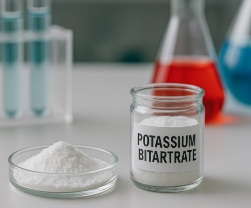
E336 (i)
Rating : 6
| Evaluation | N. Experts | Evaluation | N. Experts |
|---|---|---|---|
| 1 | 6 | ||
| 2 | 7 | ||
| 3 | 8 | ||
| 4 | 9 | ||
| 5 | 10 |
Cons:
To be taken in controlled quantity (1)0 pts from Al222
| Sign up to vote this object, vote his reviews and to contribute to Tiiips.Evaluate | Where is this found? |
| "Descrizione" about E336 (i) by Al222 (23254 pt) | 2025-Nov-07 15:27 |
| Read the full Tiiip | (Send your comment) |
Food additive E336 (i)), Cream of tartar (Potassium bitartrate)
(KC₄H₅O₆; also called potassium hydrogen tartrate / acid potassium tartrate;
Description
• Acid salt of tartaric acid from winemaking: white crystals that naturally precipitate during wine maturation (“wine tartrates”).
• Used as acidulant, acidity regulator, and leavening acid (with bicarbonate); stabilizes egg-white foams, helps prevent sugar crystallization in syrups/caramels, and serves in wine cold stabilization as a seeding crystal.
• Practically insoluble in alcohol; sparingly soluble in water; delivers a clean, neutral acidity without added aroma.

Indicative nutrition values (per 100 g; not intended for direct consumption — typical use is pinches/grams)
• Energy: ~0–10 kcal (negligible)
• Carbohydrate, protein, fat: negligible
• Total potassium: ~20–21 g/100 g (≈ 200–210 mg K per 1 g product)
• Sodium: 0 g
• Note: Technological ingredient, not a nutritional fortifier.
Chemical composition and structure
• Formula: KC₄H₅O₆ (acid salt of 2,3-dihydroxybutanedioic acid).
• Molar mass: ~188.18 g/mol.
• Monobasic nature (one residual acidic function) → acidifying behavior in water.
• Stereochemistry: typically L(+)-tartaric origin (grape/wine derived).
Physical properties
• Appearance: white powder/crystals, odorless, acid taste.
• Water solubility (20 °C): ~0.5–1.0 g/100 mL (rises with temperature).
• pH (1% w/v solution): ~3.5–3.7.
• Bulk density: particle-size dependent; moderately hygroscopic (prone to caking).
• Stability: solid stable at ambient; decomposes on strong heating to tartrate/carbonate products.
Production process
• Enological origin: collection of tartrates (“argol”) from casks/tanks → washing and purification (filtration, decolorization).
• Neutralization/recrystallization: adjust acid/salt balance (from tartaric acid and K bases) → selective recrystallization of bitartrate.
• Drying and milling: set particle size, reduce insolubles, sieve to spec.
• Packed under controlled conditions per GMP/HACCP.
Sensory and technological properties
• Clean acidulant profile with no off-aroma.
• Leavening acid: releases CO₂ with sodium bicarbonate (DIY baking powder).
• Foam stabilizer (egg whites, meringues): chelates ions, lowers pH, strengthens protein network.
• Anti-crystallizing aid in sugarwork (fondant, caramel, toffee).
• Winemaking: promotes tartrate stability during cold conditioning.
Food applications
• Bakery/pastry: meringues, angel food cake, sponge cakes; home baking powders (often 1 part cream of tartar : 2 parts baking soda).
• Sugars/syrups: limits sucrose crystallization in fondants and caramels.
• Beverages & wine: seeding for tartrate precipitation; fine acidity adjustments.
• Savory/culinary: stabilizes whips (e.g., aquafaba), fruits in light acidic syrups.
Nutrition & health
Potassium bitartrate is not meant as a nutrient source, but its high potassium content (~20%) can contribute measurably when used at gram-level doses. Individuals with impaired kidney function, on potassium-sparing diuretics, or at risk of hyperkalemia should limit use and follow clinical advice.
At very high intakes, its acidity may cause gastrointestinal discomfort. In baking, typical amounts are small (pinches/grams per recipe), yielding neutral nutritional impact with clear technological benefits (leavening, foam stability). It contains no gluten or priority allergens; only cross-contact controls apply.
Portion note: In recipes, 0.5–3 g per 100 g flour (pastry) or about 1 part cream of tartar with 2 parts baking soda for a basic instant leavener; for egg white foams: ~1–2 g per 100 g egg white.
Quality and specifications (typical topics)
• Assay: ≥99.0–99.7% KC₄H₅O₆ (food grade).
• Heavy metals (Pb, As, Cd, Hg): within legal limits; total K in spec.
• Moisture/insolubles: low; sulfates/oxalates absent or limited.
• Color/organoleptics: white, no atypical odor/taste.
• Particle size: tailored for baking (fine) vs enology (coarser).
• Microbiology: does not support growth; low APC; pathogens absent.
Storage and shelf-life
• Store cool, dry, and dark (RH <65%) in well-sealed barrier containers.
• Avoid moisture pickup (caking risk) and contact with strong bases/alkalis.
• Typical shelf-life: 24–36 months unopened.
Safety and regulatory
• EU: additive E336(i) (acidifier/acidity regulator), usually at QS (quantum satis) under good manufacturing practice.
• US/other: permitted as GRAS for specified uses.
• Enology: compliant for tartrate stabilization with contaminant limits.
• Produced under GMP/HACCP; lot traceability and SDS available.
Labeling
• Names: “cream of tartar”, “potassium bitartrate”, or “E336(i)”.
• For leavening blends, declare ratios and presence of bicarbonate/anti-caking agents.
• Optionally state enological origin where value-adding; include lot, best-by, and storage conditions.
Troubleshooting
• Weak rise: off-ratio with bicarbonate or moisture uptake → recalibrate stoichiometry, use barrier packs/desiccants.
• Unstable meringues: under-dosage or fat contamination → increase to 1–2% of egg white, degrease tools.
• Sugar crystallization in syrups: dose too low or pH too high → add slightly more or adjust acidity.
• Tartrate haze in wine: insufficient cold time/temperature or supersaturation → extend cold stabilization, refresh seed crystals, check conductivity.
Sustainability and supply chain
• Upcycling of winery tartrates reduces process waste.
• Plant operations: water/energy recovery, wastewater managed toward BOD/COD targets; lightweight, recyclable packaging.
• Supplier qualification, impurity control, and traceability under GMP systems.
INCI functions (cosmetics)
• Potassium Bitartrate: buffer/pH-adjuster, viscosity-controlling, mild abrasive (oral care/scrubs). Usage subject to cosmetic regulations and irritancy assessment.
Conclusion
Food additive E336(i)) is a clean, multifunctional acid that optimizes leavening, foams, and sugarwork in pastry and supports tartrate stability in wine. Consistent performance depends on high purity, appropriate particle size, tight moisture control, and correct stoichiometry with bases.
Mini-glossary
• QS (quantum satis): Regulatory principle allowing “as needed” use to achieve the technological effect under good practice.
• GMP/HACCP: Good manufacturing practice / hazard analysis and critical control points — Preventive hygiene and process-control systems.
• BOD/COD: Biochemical/chemical oxygen demand — Wastewater impact metrics guiding treatment and discharge limits.
• SDS: Safety data sheet — Product safety document with handling, storage, and hazard information.
![]() | ![]() |
Molecular Formula: C4H5KO6
Molecular Weight: 188.18
CAS: 868-14-4
EC Number: 212-769-1
Synonyms:
References____________________________
Oldham, A. M., Mccomber, D. R., & Cox, D. F. (2000). Effect of cream of tartar level and egg white temperature on angel food cake quality. Family and Consumer Sciences Research Journal, 29(2), 111-124.
Abstract. The effects of amount of cream of tartar, time of cream of tartar addition, and egg white temperature were evaluated with angel food cakes. Two replications of each of 12 treatments were used: factorial combinations of three levels of cream of tartar (representing 1/12, 1/8, or 1/4 tsp per egg white), two times of cream of tartar addition (before beating or at foamy stage), and two egg white temperatures (2° or 22°C). Increased cream of tartar decreased pH; increased specific gravity, cake slice area, and tenderness; and caused whiter interior crumb and darker exterior crust. Cakes made with 22°C (vs. 2°C) egg whites had increased exterior yellow color, decreased specific gravity after flour addition, and decreased preference. Cold egg whites did not decrease cake quality, eliminating the need to warm eggs with attending bacterial risk and decreasing preproduction time.
Ng, D. Y. L., Govindasamy, L., Hughes, A., & Lee, H. M. (2025). Hyperkalaemic cardiac arrest due to cream of tartar ingestion. Medical Journal of Australia.
Inoue K, Morikawa T, Takahashi M, Yoshida M, Ogawa K. Obstructive nephropathy induced with DL-potassium hydrogen tartrate in F344 rats J Toxicol Pathol. 2015 Apr;28(2):89-97. doi: 10.1293/tox.2014-0058.
Abstract. We experienced obstructive nephropathy in F344 rats treated with DL-potassium hydrogen tartrate (PHT) in a 13-week oral repeated dose toxicity study. Six-week-old male and female F344/DuCrj rats were fed a diet containing up to 2.0% PHT for 13 weeks. Microscopical findings including irregular dilation of the distal tubule lumen, foreign body giant cells, inflammatory cell infiltration, and regeneration of renal tubules were observed focally or multifocally in the renal cortex and/or medulla in the 0.5% and higher dosage groups of both sexes. The severity of these lesions increased in a dose-dependent manner. In the urinalysis, an increase in protein and white blood cells or the concentration of tartaric acid was detected in the 0.5% PHT and higher dosage groups of both sexes or males, respectively, though conventional blood biochemical analysis did not indicate failure of renal function. These results indicate that the PHT induces obstructive nephropathy in rats. There were no other treatment-related changes in other organs.
Sabboh H, Coxam V, Horcajada MN, Rémésy C, Demigné C. Effects of plant food potassium salts (citrate, galacturonate or tartrate) on acid-base status and digestive fermentations in rats. Br J Nutr. 2007 Jul;98(1):72-7. doi: 10.1017/S0007114507701691
Abstract. Potassium (K) organic anion salts, such as potassium citrate or potassium malate in plant foods, may counteract low-grade metabolic acidosis induced by western diets, but little is known about the effect of other minor plant anions. Effects of K salts (chloride, citrate, galacturonate or tartrate) were thus studied on the mineral balance and digestive fermentations in groups of 6-week-old rats adapted to an acidogenic/5 % inulin diet. In all diet groups, substantial amounts of lactate and succinate were present in the caecum, besides SCFA. SCFA were poorly affected by K salts conditions. The KCl-supplemented diet elicited an accumulation of lactate in the caecum; whereas the lactate caecal pool was low in rats fed the potassium tartrate-supplemented (K TAR) diet. A fraction of tartrate (around 50 %) was recovered in urine of rats fed the K TAR diet. Potassium citrate and potassium galacturonate diets exerted a marked alkalinizing effect on urine pH and promoted a notable citraturia (around 0.5 micro mol/24 h). All the K organic anion salts counteracted Ca and Mg hyperexcretion in urine, especially potassium tartrate as to magnesuria. The present findings indicate that K salts of unabsorbed organic anions exert alkalinizing effects when metabolizable in the large intestine, even if K and finally available anions (likely SCFA) are not simultaneously bioavailable. Whether this observation is also relevant for a fraction of SCFA arising from dietary fibre breakdown (which represents the major organic anions absorbed in the digestive tract in man) deserves further investigation.
| Sign up to vote this object, vote his reviews and to contribute to Tiiips.EvaluateClose | (0 comments) |
Read other Tiiips about this object in __Italiano (1)
Component type:   Chemical Main substances:   Last update:   2025-11-07 11:19:36 | Chemical Risk:   |

