

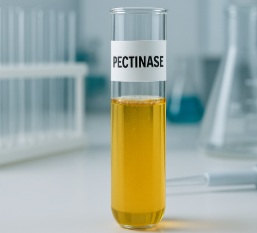
Pectinase
Rating : 8
| Evaluation | N. Experts | Evaluation | N. Experts |
|---|---|---|---|
| 1 | 6 | ||
| 2 | 7 | ||
| 3 | 8 | ||
| 4 | 9 | ||
| 5 | 10 |
0 pts from Al222
| Sign up to vote this object, vote his reviews and to contribute to Tiiips.Evaluate | Where is this found? |
| "Descrizione" about Pectinase by Al222 (24012 pt) | 2025-Nov-06 19:11 |
| Read the full Tiiip | (Send your comment) |
Pectinase
(pectinolytic enzyme systems acting on pectic polysaccharides; typically produced by Aspergillus niger and related microbes)
Description
• Pectinase is a family of enzymes that depolymerise or de-esterify plant pectin (homogalacturonan and rhamnogalacturonan regions), reducing viscosity, breaking haze-causing colloids, and improving mass transfer. Commercial products are usually multienzyme preparations with defined pectinase side-activities and controlled levels of cellulase/hemicellulase.
• Major activities: endo-polygalacturonase (endo-PG), exo-polygalacturonase (exo-PG), pectin lyase (PL), and pectin methylesterase (PME). Preparations for wine/juice are often PME-reduced/PME-free to limit methanol formation.
• Physical forms: stabilised liquids (often with glycerol/sorbitol) and granulated or spray-dried powders (on carriers like maltodextrin). Activity is declared in U/g or process-specific units (e.g., PGU), with assay pH/temperature specified.

Key constituents
• Catalytic proteins: endo-PG, exo-PG, PL, PME; optional side-activities (arabinase, rhamnogalacturonan hydrolase, cellulase/xylanase).
• Stabilisers & carriers: glycerol, sorbitol, salts, maltodextrin; anti-caking agents in powders within legal limits.
• Process water & residuals: trace fermentation media components removed to food-enzyme purity standards.
Production process
• Strain & fermentation: food-grade fungi (commonly Aspergillus niger) grown in submerged fed-batch with pectin/galacturonic inducers; pH, dissolved O₂, and temperature tightly controlled. GMO and non-GMO strains exist; identity preservation upon request.
• Recovery: biomass removal (filtration/centrifugation) → ultrafiltration/diafiltration to concentrate and reduce low-MW impurities → polishing filtration.
• Formulation: set activity and side-activity profile; add stabilisers; adjust pH. Immobilisation (e.g., on alginate/silica) used in niche continuous processes.
• Finishing: liquid fill (aseptic) or spray-dry/granulation; pack in oxygen/light-barrier containers. Manufacturing under GMP/HACCP.
Functional properties
• Substrate scope: works on high-methoxy (HM) and low-methoxy (LM) pectins; efficacy depends on degree of methylation (DM/DE), acetylation, and calcium levels.
• Optima (typical fungal): endo-/exo-PG and PL pH 3.0–5.0, 40–55 °C; PME often pH 4.0–7.0. Activity declines outside the assay window; thermal denaturation generally >55–65 °C depending on formulation.
• Process effects: rapid viscosity drop, improved pressability/filtration, haze removal, enhanced colour/aroma extraction (with macerating enzymes), and lower energy use in clarification.
Food & beverage applications
• Fruit & vegetable juices/nectars: maceration and clarification (pectin breakdown → faster filtration, higher yield, stable clarity).
• Wine & cider: skin maceration to improve colour/phenolics in reds, clarification of musts, and cold-stability via pectin removal; prefer PME-reduced products to minimise methanol.
• Purees & baby foods: controlled viscosity reduction for pumpability/fill; avoid over-hydrolysis to retain body.
• Jam/jelly & pectin manufacture: tailored pectin modification (DM reduction with PME or backbone cut with PG) to tune gel strength.
• Plant-based processing: aids pressing of berries/stone fruit, citrus segment processing, tomato finishing; sometimes combined with cellulase/xylanase for mash liquefaction.
• Other: coffee/tea extract clarification; olive/fruit oil yield improvement (facility-specific).
Non-food applications
• Textile & bio-scouring (with cellulases/hemicellulases) to remove pectic sizing and improve wettability.
• Paper & pulping: pectin reduction in process waters to lower pitch/foam and improve drainage.
• Feed: pectin-rich by-products pre-treatment (niche).
• Lab/research: plant cell wall studies; gentle tissue maceration.
Nutrition & health (use perspective)
• Enzymes act as processing aids and are not nutritional fortifiers. In finished foods they are largely inactivated by heat or removed with pomace/lees.
• Allergenicity from ingestion is unlikely at typical residuals; however, occupational exposure (powder aerosols) can cause sensitisation—engineering controls and PPE are essential.
• Methanol: PME activity demethylates pectin releasing methanol; modern oenological/juice pectinases manage PME to keep methanol well within regulatory limits when used as directed.
Quality and specifications (typical)
• Declared activity (e.g., endo-PG U/g) with assay conditions; side-activity profile (cellulase/xylanase) as applicable.
• Identity/purity: protein fingerprint, absence of antimicrobial activity; heavy metals within limits (e.g., Pb, As); low endotoxins for some applications.
• Microbiology: Salmonella absent/25 g; low APC; yeasts/moulds within spec.
• Physicochemical: density/viscosity (liquids), water activity and particle size (powders), pH, colour.
• Stability: shelf-life at stated storage; retained activity vs time/temperature; freeze–thaw tolerance for liquids.
Use guidelines
• Dose: process-specific; typical ranges 10–200 ppm enzyme concentrate (or 0.01–0.2%), titrated to target time/temperature/pH.
• pH/temperature: operate near the activity optimum; for wine/juice cold processing, extend contact time or use cold-active formulations.
• Synergy: combine with cellulases/hemicellulases for tougher matrices; add β-glucosidase for aroma release in wines.
• Inhibitors/interferences: extreme pH, SO₂/sulphite at high levels, heavy metals (Cu²⁺/Fe³⁺), and thermal holds reduce activity; calcium can hinder backbone access in highly cross-linked LM pectins—adjust with chelators where permitted.
• Kill-step: heat to >70 °C (process-dependent) to ensure deactivation before packaging where required.
Safety and regulatory
• Treated as food enzymes/processing aids in many jurisdictions; compliance with enzyme purity standards (e.g., JECFA) and food-enzyme regulations (e.g., EU 1332/2008) is required.
• US: many pectinase preparations from A. niger are GRAS for specified uses; EU: authorisation/Union list applies by producing organism and TOS (total organic solids).
• GMO disclosure depends on jurisdiction and whether the production organism is genetically modified (the enzyme itself contains no viable GMO).
• Worker safety: dust control for powders; avoid aerosolisation of liquids; SDS available; implement GMP/HACCP.
Environmental & sustainability
• Enzymatic clarification reduces energy, filter-aid use, and waste load; effluents are readily biodegradable.
• Manage cleaning streams toward BOD/COD targets; recover pomace/lees to feed, pectin manufacture, or bioenergy.
• Packaging: choose recyclable/lightweight formats; cold-chain only if specified by the supplier.
Troubleshooting
• Haze persists / filtration slow → pH/temperature off-optimum; dose too low; contact time too short; pectin DM/acetylation high—switch to broader-spectrum blend or raise temperature within product limits.
• Excessive thinning / loss of body → over-dosage or long contact; reduce dose/time or use milder activity profile.
• High methanol in must → PME carryover or long maceration at warm temps; switch to PME-reduced pectinase, lower temperature, shorten contact.
• Colour/aroma extraction weak (red wine) → insufficient macerating side-activities; pair with cellulase/hemicellulase and adjust cap management.
• Enzyme seems inactive → inhibited by SO₂ or metals; verify sulfite level, avoid Cu/Fe contact surfaces, consider chelators if permitted.
INCI functions (cosmetics)
• Pectinase — Enzyme used primarily as a processing aid to clarify plant extracts and reduce pectin-based viscosity in cosmetic raw materials. Direct skin-care use is uncommon; any on-label use should confirm safety at use level and regulatory acceptance.
Conclusion
Pectinase preparations are workhorse processing aids for turning pectin-rich fruits and plant materials into clearer, more filterable, and higher-yield products—while reducing energy and consumables. Success depends on matching the activity spectrum (PG/PL/PME), controlling pH–temperature–time, and managing inhibitors and methanol risk in sensitive applications like wine.
Mini-glossary
• PG (endo/exo-polygalacturonase): Hydrolases that cleave the homogalacturonan backbone (endo = random internal cuts; exo = terminal release).
• PL (pectin lyase): Eliminative cleavage of methyl-esterified pectin without water; effective on high-DM pectin.
• PME (pectin methylesterase): Removes methyl esters from pectin, releasing methanol and enabling Ca²⁺ crosslinking.
• DM/DE (degree of methylation/esterification): Proportion of galacturonic residues esterified; governs gel behaviour and enzyme choice.
• U/g, PGU: Enzyme activity units per gram; always read the supplier’s assay definition.
• GMP/HACCP: Good manufacturing practice / hazard analysis and critical control points — preventive hygiene and process-control systems.
• BOD/COD: Biochemical/chemical oxygen demand — wastewater load metrics guiding treatment and discharge limits.
• CAZyme: Carbohydrate-active enzyme acting on complex polysaccharides.
References__________________________________________________________________________
Khan M, Nakkeeran E, Umesh-Kumar S. Potential application of pectinase in developing functional foods. Annu Rev Food Sci Technol. 2013;4:21-34. doi: 10.1146/annurev-food-030212-182525.
Abstract. The understanding that enzymatic degradation of fruit pectin can clarify juices and improve juice yields resulted in the search for microbial pectinases and application in vegetable- and fruit-processing industries. Identified enzymes were classified on the basis of their catalytic activity to pectin or its derivatives and in terms of industrial use. Discovery of gene sequences that coded the enzymes, protein engineering, and molecular biology tools resulted in defined microbial strains that over-produced the enzymes for cost-effective technologies. Recent perspectives on the use of pectin and its derivatives as dietary fibers suggest enzymatic synthesis of the right oligomers from pectin for use in human nutrition. While summarizing the activities of pectin-degrading enzymes, their industrial applications, and gene sources, this review projects another application for pectinases, which is the use of enzymatically derived pectin moieties in functional food preparation.
Zhao M, Chen J, Pan X, Zabed HM, Arsalan A, Qi X. Advances in Pectinase Engineering for Food Bioprocessing: Novel Sources, Mechanisms, and Optimization Strategies. J Agric Food Chem. 2025 Sep 17;73(37):23078-23097. doi: 10.1021/acs.jafc.5c06547.
Abstract. Pectinases are indispensable biocatalysts for pectin degradation in food and bioprocessing industries, yet natural enzymes often lack tailored functionalities for modern applications. While a previous review discussed pectinases in terms of production and application, this review particularly discusses an integrated framework for robust pectinases. This framework combines enzyme mining, protein engineering, and AI-assisted design to systematically discover, optimize, and customize pectinases. These synergistic strategies, in fact, have been widely explored in recent years to enable precise development of biocatalysts with enhanced industrial traits, moving beyond traditional single-approach-based enzyme improvement. Specifically, we discuss how cutting-edge methodologies, such as data-driven discovery and intelligent protein engineering, accelerate robust pectinase development, while emerging purification and bioprocessing techniques expand their applications in juice/wine production, textile bioscouring, and agricultural waste valorization. By unifying novel microbial sources, mechanistic insights, and engineering advances, these holistic approaches offer transformative potential for biocatalyst development, including pectinases. In this way, this review consolidates recent progress to guide next-generation pectinase development through combinatorial biotechnology, providing actionable insights for advancing sustainable industrial processes.
Mahto RB, Yadav M, Sasmal S, Bhunia B. Optimization of Process Parameters for Production of Pectinase using Bacillus Subtilis MF447840.1. Recent Pat Biotechnol. 2019;13(1):69-73. doi: 10.2174/1872208312666180917094428.
Abstract. Background: Pectinase enzyme has immense industrial prospects in the food and beverage industries. Objective: In our investigation, we find out the optimum process parameters suitable for better pectinase generation by Bacillus subtilis MF447840.1 using submerged fermentation. Method: 2% (OD600 nm = 0.2) of pure Bacillus subtilis MF447840.1 bacterial culture was inoculated in sterile product production media. The production media components used for this study were 1 g/l of pectin, 2 g/l of (NH4)2SO4, 1 g/l of NaCl, 0.25 g/l of K2HPO4, 0.25 g/l of KH2PO4 and 1 g/l of MgSO4 for pectinase generation. We reviewed all recent patents on pectinase production and utilization. The various process parameters were observed by changing one variable time method. Results: The optimum fermentation condition of different parameters was noticed to be 5% inoculums, 25% volume ratio, temperature (37°C), pH (7.4) and agitation rate (120 rpm) following 4 days incubation. Conclusion: Maximum pectinase generation was noticed as 345 ± 12.35 U following 4 days incubation.
Stanek-Wandzel N, Krzyszowska A, Zarębska M, Gębura K, Wasilewski T, Hordyjewicz-Baran Z, Tomaka M. Evaluation of Cellulase, Pectinase, and Hemicellulase Effectiveness in Extraction of Phenolic Compounds from Grape Pomace. Int J Mol Sci. 2024 Dec 18;25(24):13538. doi: 10.3390/ijms252413538.
Abstract. Grape pomace, the solid residue from winemaking, is a rich source of polyphenolic compounds with significant antioxidant properties. However, the efficient extraction of these valuable compounds remains a challenge. This study focuses on optimizing the conditions for the enzyme-assisted extraction of polyphenolic compounds from red grape pomace using cellulase, hemicellulase, and pectinase. The key variables investigated in this study were enzyme concentration, extraction time, and solid/liquid ratio. The results highlight the importance of selecting enzymes based on target compounds, as different enzymes were found to be more effective for specific phenolic fractions. Hemicellulase was most effective for phenolic acids, cellulase for catechins, and pectinase for anthocyanins. Enzyme-assisted extraction significantly increased the yield of phenolic compounds and resulted in higher total phenolic content and antioxidant activity compared to control samples treated with solid/liquid extraction without enzyme addition. These findings confirm that enzyme-assisted extraction is a promising approach for enhancing the recovery of polyphenolic compounds from grape pomace.
Merín MG, Martín MC, Rantsiou K, Cocolin L, de Ambrosini VI. Characterization of pectinase activity for enology from yeasts occurring in Argentine Bonarda grape. Braz J Microbiol. 2015 Jul 1;46(3):815-23. doi: 10.1590/S1517-838246320140160.
Abstract. Pectinolytic enzymes are greatly important in winemaking due to their ability to degrade pectic polymers from grape, contributing to enhance process efficiency and wine quality. This study aimed to analyze the occurrence of pectinolytic yeasts during spontaneous fermentation of Argentine Bonarda grape, to select yeasts that produce extracellular pectinases and to characterize their pectinolytic activity under wine-like conditions. Isolated yeasts were grouped using PCR-DGGE and identified by partial sequencing of 26S rRNA gene. Isolates comprised 7 genera, with Aureobasidium pullulans as the most predominant pectinolytic species, followed by Rhodotorula dairenensis and Cryptococcus saitoi. No pectinolytic activity was detected among ascomycetous yeasts isolated on grapes and during fermentation, suggesting a low occurrence of pectinolytic yeast species in wine fermentation ecosystem. This is the first study reporting R. dairenensis and Cr. saitoi species with pectinolytic activity. R. dairenensis GM-15 produced pectinases that proved to be highly active at grape pH, at 12 °C, and under ethanol and SO2 concentrations usually found in vinifications (pectinase activity around 1.1 U/mL). This strain also produced cellulase activity at 12 °C and pH 3.5, but did not produce β-glucosidase activity under these conditions. The strain showed encouraging enological properties for its potential use in low-temperature winemaking.
| Sign up to vote this object, vote his reviews and to contribute to Tiiips.EvaluateClose | (0 comments) |
Read other Tiiips about this object in __Italiano (1)
Component type:   Chemical Main substances:   Last update:   2025-11-06 18:58:31 | Chemical Risk:   |

