

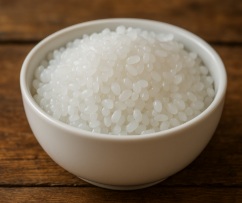
Rice konjac
Rating : 7
| Evaluation | N. Experts | Evaluation | N. Experts |
|---|---|---|---|
| 1 | 6 | ||
| 2 | 7 | ||
| 3 | 8 | ||
| 4 | 9 | ||
| 5 | 10 |
0 pts from Al222
| Sign up to vote this object, vote his reviews and to contribute to Tiiips.Evaluate | Where is this found? |
| "Descrizione" about Rice konjac by Al222 (24830 pt) | 2025-Nov-05 19:31 |
| Read the full Tiiip | (Send your comment) |
Rice Konjac (glucomannan)
Description
Gelled food preparation made from konjac flour (rich in glucomannan) and water, set with calcium ions into rice-like granules.
Sensory profile: neutral taste (after rinsing), white–off-white color, elastic, springy texture; readily absorbs sauces and seasonings.
Positioning: low-calorie rice alternative, gluten-free, suitable for low-carb/keto diets and plant-based formulations.

Caloric value (per 100 g drained product)
~5–20 kcal; digestible carbohydrates <1–3 g, soluble fiber (glucomannan) ~2–4 g, protein <0.5 g, fat <0.5 g, sodium low; calcium varies (from the firming agent).
Key constituents
Glucomannan (β-1,4 glucose–mannose copolymer) as functional soluble fiber.
Water (dominant fraction in finished product).
Calcium hydroxide/calcium lactate as gelling/firming agents (residual levels controlled).
Production process
Slurry make-up: konjac flour + water under high shear.
Gelling/firming: controlled addition of alkali/Ca²⁺ → formation of thermostable gel.
Forming: extrusion/cutting into rice-shaped granules → blanching and cooling.
Packing: in water/slightly alkaline solution, then pasteurized or retorted; barrier pouches or trays.
Controls: drained weight, pH, fiber content, firmness, micro load.
Sensory and technological properties
Flavor uptake: excellent—acts as a vehicle for sauces.
Cooking stability: keeps shape and elasticity; releases no starch (no natural creaminess as in rice).
Water management: can feel watery unless dry-pan heated after rinsing.
Initial odor: from alkaline pack liquor; reduced by rinsing and brief par-boil.
Food applications
Stir-fries & bowls: base for stir-fry, rice bowls, poké-style (after dry-pan step).
“Risotto-style” dishes: needs sauces/binders (e.g., cream/plant cream, reductions) because it doesn’t provide starch binding.
Cold salads: good bite; drain and pat-dry before dressing.
Calorie-/carb-reduction: partial or total rice replacement to lower kcal and net carbs.
Nutrition and health
Soluble fiber (glucomannan): may support satiety, post-prandial glycemia modulation, and cholesterolemia at appropriate daily intakes (follow label conditions for health claims).
Possible GI discomfort (bloating) if fiber intake increases abruptly: introduce gradually and drink water.
Low in **FODMAP**; gluten-free by nature.
Fat profile
Fat is negligible; contributions of **PUFA**, **MUFA**, **SFA**, **TFA**, **MCT** are nutritionally irrelevant here.
Quality and specifications (typical topics)
Net drained weight in spec; slightly alkaline pH; declared fiber content.
Uniform texture/firmness; no off-odors after rinsing.
Microbiology: commercial sterility or validated pasteurization; pathogens absent/25 g.
Contaminants: metals/pesticides compliant; foreign matter absent; Ca(OH)₂ residues within spec.
Storage and shelf life
Ambient (if aseptic/retorted) in a cool, dark place; refrigerate after opening and use within 2–3 days.
Avoid freezing in pack (risk of syneresis/rubbery texture).
Allergens and safety
Not a major allergen; gluten-free.
Safe use: always consume hydrated; chew adequately; avoid very firm mini-gels in sensitive groups (some regions restrict/ban mini-cup konjac gels).
Declare health claims correctly when referencing glucomannan.
Practical use (prep tips)
Rinse 2–3× under running water.
Par-boil 1–2 minutes (optional, with a few drops of lemon/vinegar).
Dry-pan in a nonstick skillet without oil for 2–3 minutes to drive off moisture.
Sauce and finish with proteins/veg and a little oil to improve palatability and adhesion.
INCI functions in cosmetics (where applicable)
For the base ingredient (not the finished “rice”): Glucomannan / Amorphophallus Konjac Root Powder.
Roles: film-forming/thickening in gels/lotions; konjac sponges for gentle cleansing.
Troubleshooting
Persistent pack odor: repeat rinses + brief par-boil with mild acid (lemon/vinegar).
Watery in pan: dry-pan before adding sauces; raise pan temperature slightly and stir.
Sauce not adhering: add emulsified fats (e.g., oil + lecithin or plant cream), reduce free water in the sauce.
Over-rubbery texture: shorten cook time and exposure to alkali; finish in sauce.
Sustainability and supply chain
Konjac has low field inputs and high corm yield; finished product ships water (optimize light packaging and logistics).
In-plant: recover process water, manage effluents toward **BOD/COD** targets, use recyclable packaging, maintain **GMP/HACCP** and robust traceability.
Labelling
Names: “konjac rice”, “konjac shirataki (rice shape)”.
Typical ingredient list: water, konjac flour (glucomannan), firming agent (calcium hydroxide/lactate).
Declare drained weight, nutrition, gluten-free, and use instructions (rinse/dry-pan).
Conclusion
Konjac rice is a very low-calorie rice alternative with high soluble fiber and broad versatility. For best results: rinse, (optionally) par-boil, and dry-pan before saucing; use flavorful sauces and a touch of fat to improve adhesion and eating quality while retaining the nutritional benefits of glucomannan.
Mini-glossary
Glucomannan: soluble fiber (β-1,4 glucose–mannose copolymer) responsible for viscosity and gelation in konjac products.
Syneresis: water release from a gel; mitigated by dry-pan step or thicker sauces.
**FODMAP**: fermentable carbohydrates that can cause bloating; konjac rice is generally low in FODMAPs.
**GMP/HACCP**: good manufacturing practice / hazard analysis and critical control points, preventive food-safety systems.
**BOD/COD**: biochemical/chemical oxygen demand, wastewater metrics guiding treatment and environmental compliance.
References__________________________________________________________________________
Laignier F, Akutsu RCA, Lima BR, Zandonadi RP, Raposo A, Saraiva A, Botelho RBA. Amorphophallus konjac: Sensory Profile of This Novel Alternative Flour on Gluten-Free Bread. Foods. 2022 May 10;11(10):1379. doi: 10.3390/foods11101379.
Abstract. This study aimed to evaluate the sensory profile of gluten-free bread with Amorphophallus konjac (AK) flour in different concentrations. This experimental study is divided into three steps: preparation of the gluten-free bread formulations, sensory analysis, and statistical analysis. The addition of Konjac flour in a gluten-free bread formulation was tested in different proportions, 12.5%, 25%, 37.5%, and 50% of the flour content. The checking all-that-apply (CATA) was conducted with 110 panelists; among these, 43 were consumers of gluten-free bread. Sensory analysis was conducted using a 9-point hedonic scale for color, aroma, texture, flavor, appearance, and overall acceptability. The AK flour influenced the sensory characteristics of gluten-free bread. Bread with characteristics closer to those found in bread with gluten was the one with 12.5% of konjac flour for both the acceptability analysis as the attributes raised through a detailed CATA map. The control sample is located next to features like dry appearance, dry texture and grainy, dark color, and salty. Therefore, 12.5% AK gluten-free bread is closer to the characteristics of the control sample, such as light crust color, light crumb color, soft and moist texture, cohesion, and brightness. The bread with the highest percentage of overall consumer acceptance was 12.5% konjac with 93% and 96% acceptance among consumers and non-consumers of gluten-free bread, respectively.
Drugs and Lactation Database (LactMed®) [Internet]. Bethesda (MD): National Institute of Child Health and Human Development; 2006–. Glucomannan. 2024 Dec 15.
Abstract. Glucomannan is a soluble, highly viscous fiber commonly derived from Amorphophallus konjac root. Glucomannan has no specific lactation-related uses. It is most often used to lower cholesterol, to treat constipation and diabetes, and is contained in products to promote weight loss. No data exist on the safety and efficacy of glucomannan in nursing mothers or infants. However, because glucomannan is not absorbable, it will not reach the breastmilk and is very unlikely to affect the nursing infant. Dietary supplements do not require extensive pre-marketing approval from the U.S. Food and Drug Administration. Manufacturers are responsible to ensure the safety, but do not need to prove the safety and effectiveness of dietary supplements before they are marketed. Dietary supplements may contain multiple ingredients, and differences are often found between labeled and actual ingredients or their amounts. A manufacturer may contract with an independent organization to verify the quality of a product or its ingredients, but that does not certify the safety or effectiveness of a product. Because of the above issues, clinical testing results on one product may not be applicable to other products. More detailed information about dietary supplements is available elsewhere on the LactMed Web site.
Laignier F, Akutsu RCCA, Maldonade IR, Bertoldo Pacheco MT, Silva VSN, Mendonça MA, Zandonadi RP, Raposo A, Botelho RBA. Amorphophallus konjac: A Novel Alternative Flour on Gluten-Free Bread. Foods. 2021 May 27;10(6):1206. doi: 10.3390/foods10061206.
Abstract. The demand for gluten-free products is rising, but their production with similar quality as their gluten counterparts is challenging. This study aimed to develop gluten-free bread samples using different concentrations of Amorphophallus konjac flour (0%, 12.5%, 25%, 37.5%, and 50% of the total flour content) and to evaluate their nutritional and physicochemical properties. Proteins, lipids, carbohydrates, moisture, ash content, fibers, resistant starch, firmness, specific volume, and color were evaluated using official methods. Protein varied from 2.95% to 4.94%, the energy value from 347.93 to 133.55 kcal/100 g, dietary fiber from 8.19 to 17.90%, and resistant starch from 0.67% to 0.75% on wet basis. The addition of konjac flour positively influenced the specific volume. Higher concentrations of konjac flour in the formulations led to lower calories of the bread due to the significant addition of water to the dough. The bread samples with konjac showed high fiber content due to the composition of the flour. They had lower levels of carbohydrates, which can positively influence the glycemic index. Konjac flour provided dough mold, growth, and better texture for gluten-free bread. The best formulations were prepared in concentrations up to 37.5% konjac. The 50% konjac bread showed slightly reduced specific volume and pale color.
Islam F, Labib RK, Zehravi M, Lami MS, Das R, Singh LP, Mandhadi JR, Balan P, Khan J, Khan SL, Nainu F, Nafady MH, Rab SO, Emran TB, Wilairatana P. Genus Amorphophallus: A Comprehensive Overview on Phytochemistry, Ethnomedicinal Uses, and Pharmacological Activities. Plants (Basel). 2023 Nov 23;12(23):3945. doi: 10.3390/plants12233945.
Abstract. The genus Amorphophallus belongs to the family Araceae. Plants belonging to this genus are available worldwide and have been used in traditional medicines since ancient times, mainly in Ayurveda and Unani medical practices. Amorphophallus species are an abundant source of polyphenolic compounds; these are accountable for their pharmacological properties, such as their analgesic, neuroprotective, hepatoprotective, anti-inflammatory, anticonvulsant, antibacterial, antioxidant, anticancer, antiobesity, and immunomodulatory effects, as well as their ability to prevent gastrointestinal disturbance and reduce blood glucose. Moreover, Amorphophallus species contain numerous other classes of chemical compounds, such as alkaloids, steroids, fats and fixed oils, tannins, proteins, and carbohydrates, each of which contributes to the pharmacological effects for the treatment of acute rheumatism, tumors, lung swelling, asthma, vomiting, abdominal pain, and so on. Additionally, Amorphophallus species have been employed in numerous herbal formulations and pharmaceutical applications. There has been no extensive review conducted on the Amorphophallus genus as of yet, despite the fact that several experimental studies are being published regularly discussing these plants' pharmacological properties. So, this review discusses in detail the pharmacological properties of Amorphophallus species. We also discuss phytochemical constituents in the Amorphophallus species and their ethnomedicinal uses and toxicological profiles.
Jiang M, Li H, Shi JS, Xu ZH. Depolymerized konjac glucomannan: preparation and application in health care. J Zhejiang Univ Sci B. 2018 Jul;19(7):505-514. doi: 10.1631/jzus.B1700310.
Abstract. Konjac glucomannan (KGM) is a water-soluble polysaccharide obtained from the roots and tubers of konjac plants. Recently, a degraded product of KGM, depolymerized KGM (DKGM), has attracted attention because of its low viscosity, improved hydrophily, and favorable physiological functions. In this review, we describe the preparation of DKGM and its prebiotic effects. Other health benefits of DKGM, covering antioxidant and immune activity, are also discussed, as well as its safety. DKGM could be a candidate for use as a tool for the treatment of various diseases, including intestinal flora imbalance, and oxidative- and immune-related disorders.
| Sign up to vote this object, vote his reviews and to contribute to Tiiips.EvaluateClose | (0 comments) |
Read other Tiiips about this object in __Italiano (1)
Component type:   Natural Main substances:   Last update:   2025-11-05 19:29:46 | Chemical Risk:   |

