

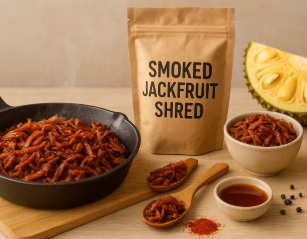
Smoked jackfruit shred
Rating : 5
| Evaluation | N. Experts | Evaluation | N. Experts |
|---|---|---|---|
| 1 | 6 | ||
| 2 | 7 | ||
| 3 | 8 | ||
| 4 | 9 | ||
| 5 | 10 |
0 pts from Al222
| Sign up to vote this object, vote his reviews and to contribute to Tiiips.Evaluate | Where is this found? |
| "Descrizione" about Smoked jackfruit shred by Al222 (23254 pt) | 2025-Nov-04 19:03 |
| Read the full Tiiip | (Send your comment) |
Smoked jackfruit shred
Description
Young green jackfruit (Artocarpus heterophyllus) shredded to long fibers and smoked (via smokehouse or natural smoke flavor), sometimes marinated (salt, acids, spices, light sweeteners) and packed plain or in sauce.
Sensory profile: pulled-meat-like fibers, succulent bite, smoky aroma (phenolic/woody), light caramel and acidic top notes; color from pale tan to deep brown depending on smoke/sauce.

Caloric value (per 100 g)
Plain, drained (no sauce): ~25–45 kcal, carbohydrates 5–9 g, fiber 2–4 g, protein 1–2 g, fat ≤0.5 g, sodium variable (brine).
In BBQ/smoked sauce: kcal and sugars rise with Brix; sodium increases with brine/marinade.
Cooked seeds are typically not included in shred products.
Key constituents
Carbohydrates & fiber: pectins/hemicelluloses (structure, water-binding); starch predominates in unripe pulp, with RS3 — retrograded resistant starch after cooling.
Smoke compounds: phenols, carbonyls and organic acids (drivers of smoky, color, antimicrobial effects).
Minerals/vitamins: mainly potassium; small vitamin C/B residues (process-dependent).
Sodium from brines; optional calcium chloride for firmness.
Production process
Raw prep: Select immature jackfruit, trim, cook/blanch, de-core, and mechanically shred.
Marination (optional): salt, acids (e.g., vinegar/citrus), spices, oil traces; liquid smoke may be included for even coverage.
Smoking:
Hot-smoke on racks with approved hardwoods (e.g., beech/hickory) to target core pasteurisation and desired color/R&R (roast & roast color).
Or oven cook with condensed natural smoke (controlled PAH — polycyclic aromatic hydrocarbons).
Stabilisation & pack: MAP — modified atmosphere packaging, vacuum or retort (pouch/can; plain or sauced); some lines use HPP — high pressure processing for chilled products.
QC controls: drained weight, pH (acidified lines often ≤4.6), Aw/moisture, NaCl, texture (TPA), *color (Lab)**, smoke intensity panel, micro (post-process), and PAH compliance for smoked inputs.
Sensory and technological properties
Fibrous structure gives stringy pull and sauce uptake; good water-holding supports juiciness.
Smoking adds Maillard-like color/aroma precursors and surface dryness that improves sear and bite.
Neutral base pairs well with umami (soy/tamari), acids, sweet-smoky profiles.
Food applications
Pulled-style mains: sandwiches/buns, tacos, pizza toppings, grain bowls.
Meal kits & ready meals: BBQ, chipotle, peri-peri, or teriyaki-smoked variants.
Foodservice: filling for bao, gyros, wraps; plant-forward stews and curry bases.
Nutrition and health
Low energy density in plain formats; fiber aids satiety and glycaemic moderation.
Sodium can be high in brined/sauced items—prefer reduced-salt options or rinse before use.
Potassium is naturally present—consider in CKD dietary planning.
Added sugars vary with sauce; check label.
Fat profile
Very low total fat; residual lipids mainly PUFA — polyunsaturated fatty acids (potentially beneficial when balanced, more oxidation-prone) and MUFA — monounsaturated fatty acids (often neutral/beneficial), with minimal SFA — saturated fatty acids (to moderate overall). TFA — trans fatty acids negligible; MCT — medium-chain triglycerides not significant.
Quality and specifications (typical topics)
Shred length/width specification, foreign-matter free, uniform color (no sooting).
Chem/phys: pH, Aw, moisture, NaCl, °Brix (if sauced), calcium (if firming used).
Microbiology: commercial sterility for retorted goods or defined shelf life for chilled (HPP/MAP) lines; pathogens absent/25 g.
Sensory: target smoke intensity, off-notes (ash/creosote) absent.
Contaminants: PAH within spec for smoked inputs.
Storage and shelf life
Retorted (ambient): typically 18–36 months unopened; refrigerate after opening and use within 2–3 days.
Chilled vacuum/MAP: 0–4 °C, 30–90 days depending on process (shorter without HPP).
Frozen: –18 °C, 6–12 months; expect syneresis upon thaw—bind with sauce.
Allergens and safety
Naturally gluten-free and soy-free unless marinades add soy sauce, wheat-based ingredients, mustard, celery, etc.
Possible latex–fruit cross-reactivity in latex-allergic individuals.
Ensure acidified lines meet pH control and CCP verification under GMP/HACCP.
INCI functions in cosmetics (when applicable)
INCI: Artocarpus Heterophyllus Fruit Extract.
Roles: antioxidant, skin-conditioning, masking (limited, claim/safety substantiation required).
Troubleshooting
Mushy texture: overcooking or high Aw → shorten thermal step, add firming (CaCl₂), improve dewatering.
Harsh/bitter smoke: over-smoke or dirty combustion → switch to clean condensed smoke, reduce exposure, improve airflow.
Watery purge in pack: inadequate binding → increase soluble solids (°Brix) in sauce, add citrus fiber/starch, optimize vacuum.
Uneven flavor penetration: insufficient marination time/tumble → extend contact, reduce shred width, or use vacuum tumble.
Short chilled shelf life: raise acidification, consider HPP, improve MAP gas and hurdle design.
Sustainability and supply chain
Jackfruit trees offer high yield per hectare and climate resilience; shredded formats reduce meat dependency.
Prefer responsibly sourced smoke/condensed natural smoke with emission control and low-PAH specs.
Manage effluents toward BOD/COD targets; operate under GMP/HACCP; use recyclable packaging.
Labelling
Name examples: “smoked jackfruit shred”, “jackfruit in smoked marinade”.
Declare ingredients (e.g., jackfruit, water, salt, natural smoke flavor, vinegar, spices; plus allergens if used), drained weight, and nutrition.
Claims (vegan, low fat, source of fiber) only when criteria are met.
Conclusion
Smoked jackfruit shred delivers a convincing pulled texture with clean smoky flavour and low calories in plain formats. Careful control of shred geometry, smoke type/dose, moisture/Aw, and stabilisation method (retort, MAP, or HPP) ensures juiciness, bite, and safe, consistent shelf performance across retail and foodservice applications.
Mini-glossary
GI — Glycaemic index: Blood-glucose response; lowered by fiber, fat, and cooling (↑ RS3).
RS3 — Retrograded resistant starch: Less-digestible starch formed on cooling; supports glycaemic moderation.
PUFA — Polyunsaturated fatty acids: Potentially beneficial when balanced; more oxidation-prone.
MUFA — Monounsaturated fatty acids: Often neutral/beneficial and relatively stable.
SFA — Saturated fatty acids: Keep moderated overall; minimal here.
TFA — Trans fatty acids: Negligible in non-hydrogenated products.
MCT — Medium-chain triglycerides: Not significant in jackfruit.
PAH — Polycyclic aromatic hydrocarbons: Smoke contaminants controlled via clean combustion/condensed smoke.
MAP — Modified atmosphere packaging: Gas mix to extend chilled shelf life.
HPP — High pressure processing: Cold pasteurisation to extend shelf life of chilled packs.
Aw — Water activity: Governs microbial stability.
GMP/HACCP — Good manufacturing practice / hazard analysis and critical control points: Preventive systems with validated CCPs.
BOD/COD — Biochemical/chemical oxygen demand: Wastewater impact metrics tied to treatment performance.
References__________________________________________________________________________
Gupta A, Marquess AR, Pandey AK, Bishayee A. Jackfruit (Artocarpus heterophyllus Lam.) in health and disease: a critical review. Crit Rev Food Sci Nutr. 2023;63(23):6344-6378. doi: 10.1080/10408398.2022.2031094.
Abstract. Artocarpus heterophyllus Lam. (Family Moraceae), is a tropical tree, native to India and common in Asia, Africa, and several regions in South America. The fruit is commonly known as jackfruit which is one of the largest edible fruits in the world. Jackfruits comprises a wide range of nutrients, including minerals, carbohydrates, volatile compounds, proteins, and vitamins. The fruit, bark, leaves, and roots are endowed with therapeutic attributes and are utilized in the many traditional medicinal systems for the management of various ailments. Fruit and seeds are commonly used to prepare various food items, including sauce, ice creams, jams, jellies, and marmalades. Due to unique texture, jackfruit is becoming a popular meat substitute. Based on preclinical studies, jackfruit exhibits antimicrobial, antioxidant, anti-melanin, antidiabetic, anti-inflammatory, immunomodulatory, antiviral, anthelmintic, wound-healing, and antineoplastic activities. Clinical studies reveal that the leaves possess antidiabetic action in healthy and insulin-independent diabetic individuals. Despite numerous health benefits, regrettably, jackfruit has not been properly utilized in a marketable scale in areas where it is produced. This review delivers an updated, comprehensive, and critical evaluation on the nutritional value, phytochemical profiling, pharmacological attributes and underlying mechanisms of action to explore the full potential of jackfruit in health and disease.
Ranasinghe RASN, Maduwanthi SDT, Marapana RAUJ. Nutritional and Health Benefits of Jackfruit (Artocarpus heterophyllus Lam.): A Review. Int J Food Sci. 2019 Jan 6;2019:4327183. doi: 10.1155/2019/4327183.
Abstract. Artocarpus heterophyllus Lam., which is commonly known as jackfruit is a tropical climacteric fruit, belonging to Moraceae family, is native to Western Ghats of India and common in Asia, Africa, and some regions in South America. It is known to be the largest edible fruit in the world. Jackfruit is rich in nutrients including carbohydrates, proteins, vitamins, minerals, and phytochemicals. Both the seeds and the flesh of jackfruit are consumed as curries and boiled forms, while the flesh in fully ripen stage can be eaten directly as a fruit. Several countries have developed different food products such as jam, jellies, marmalades, and ice creams using pureed jackfruit. The several parts of jack tree including fruits, leaves, and barks have been extensively used in traditional medicine due to its anticarcinogenic, antimicrobial, antifungal, anti-inflammatory, wound healing, and hypoglycemic effects. Despite all these benefits, unfortunately, the fruit is underutilized in commercial scale processing in regions where it is grown. The aim of this review is to disseminate the knowledge on nutritional and health benefits of jackfruit, in order to promote utilization of jackfruit for commercial scale food production.
Li Y, Chen Y, Li C, Wu G, He Y, Tan L, Zhu K. Polysaccharide from Artocarpus heterophyllus Lam. (Jackfruit) Pulp Ameliorates Dextran Sodium Sulfate-Induced Enteritis in Rats. Int J Mol Sci. 2024 Jan 29;25(3):1661. doi: 10.3390/ijms25031661.
Abstract. A polysaccharide from Artocarpus heterophyllus Lam. (jackfruit) pulp (JFP-Ps) is known for its excellent bioactivities. However, its impact on small intestinal barrier function is still largely unexplored. The study aimed to examine the protection effect of JFP-Ps against dextran sodium sulfate-induced enteritis and its underlying mechanism. This research revealed that JFP-Ps mitigated small intestinal tissue damage by reducing the expression of pro-inflammatory cytokines and promoting the expression of the anti-inflammatory cytokine interleukin-10 in the small intestine. JFP-Ps diminished oxidative stress by bolstering the activity of antioxidant enzymes and reducing the concentration of malondialdehyde in the small intestine. In addition, JFP-Ps may restore the mechanical barrier and inhibit intestinal structure damage by augmenting the expression of short-chain fatty acids (SCFAs) receptors (GPR41/43) and up-regulating the expression of tight junction proteins (occludin). In conclusion, JFP-Ps may positively influence intestinal health by relieving oxidative stress in the small intestine, improving mechanical barrier function, activating the SCFA-GPR41/GPR43 axis, and inhibiting TLR4/MAPK pathway activation. The results augment our comprehension of the bioactivities of JFP-Ps, corroborating its great potential as a functional food.
Cheng M, He J, Gu Y, Wu G, Tan L, Li C, Xu F, Zhu K. Changes in Phenolic Compounds and Antioxidant Capacity of Artocarpus heterophyllus Lam. (Jackfruit) Pulp during In Vitro Gastrointestinal Digestion. Antioxidants (Basel). 2023 Dec 23;13(1):37. doi: 10.3390/antiox13010037.
Abstract. An in vitro gastrointestinal digestion model was applied to investigate the effect of digestion on the phenolic compounds and antioxidant capacity of Artocarpus heterophyllus Lam. (jackfruit) pulp. The total phenol content (TPC) was determined using Folin-Ciocalteu method, and the antioxidant activities were evaluated by DPPH and ABTS assays. Phenolic compounds were analyzed using ultra-performance liquid chromatography coupled with electrospray ionization, followed by quadrupole time-of-flight mass spectrometry (UPLC-ESI-Q-TOF-MS/MS). The results showed that TPC was significantly higher after gastric digestion. Thirty phenolic compounds (hydroxybenzoic acids and derivatives, hydroxycinnamic acids and derivatives, and flavonoids) were identified. The antioxidant activities of the digested samples varied with the TPC, and there was a correlation between antioxidant activity and TPC. The present study implies that gastrointestinal digestion may improve TPC and increase the amount of free phenolic compounds, mainly related to changes in pH value and digestive enzymes.
Felli R, Yang TA, Abdullah WNW, Zzaman W. Effects of Incorporation of Jackfruit Rind Powder on Chemical and Functional Properties of Bread. Trop Life Sci Res. 2018 Mar;29(1):113-126. doi: 10.21315/tlsr2018.29.1.8.
Abstract. Nowadays, there is a rising interest towards consuming health beneficial food products. Bread-as one of the most popular food products-could be improved to 'healthy bread' by addition of ingredients high in protein, dietary fiber and low in calorie. Incorporating Jackfruit rind powder (JRP) as a by-product rich in dietary fiber in bread, could not only provide health beneficial bread products, but also lead to develop an environmental friendly technology by solving the problem of waste disposal of residues. In this study, addition of jackfruit rind powder (JRP) as a high dietary fiber and functional ingredient in bread was examined. The results showed that incorporation of JRP in bread improved functional properties of flour such as Oil Holding Capacity (OHC), Water Holding Capacity (WHC) and pasting properties. Addition of 5%, 10% and 15% of JRP in wheat flour caused significantly (p < 0.05) higher insoluble, soluble and total dietary fiber in flour and bread products. Results from proximate composition indicated that all breads substituted with JRP, contained significantly (p < 0.05) higher fiber, moisture and fat. Obtained results confirmed that the JRP has great potential in development of functional foods especially functional bread products.
| Sign up to vote this object, vote his reviews and to contribute to Tiiips.EvaluateClose | (0 comments) |
Read other Tiiips about this object in __Italiano (1)
Component type:   Natural Main substances:   Last update:   2025-11-04 19:01:10 | Chemical Risk:   |

