

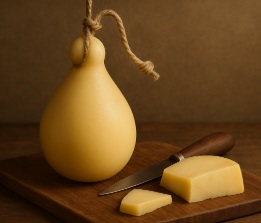
Provolone cheese
Rating : 7
| Evaluation | N. Experts | Evaluation | N. Experts |
|---|---|---|---|
| 1 | 6 | ||
| 2 | 7 | ||
| 3 | 8 | ||
| 4 | 9 | ||
| 5 | 10 |
0 pts from Al222
| Sign up to vote this object, vote his reviews and to contribute to Tiiips.Evaluate | Where is this found? |
| "Descrizione" about Provolone cheese by Al222 (23259 pt) | 2025-Nov-01 20:01 |
| Read the full Tiiip | (Send your comment) |
Provolone cheese (cow’s milk; stretched-curd, short–long ripening)
Description
Stretched-curd (pasta filata) cheese made from cow’s milk with controlled acidification and hot-water stretching; ripened from weeks (dolce/mild) to many months (piccante/sharp).
Main types: provolone dolce (calf rennet; milder flavor, more elastic paste) and provolone piccante (kid/lamb rennets; greater lipolysis → more pronounced, piquant flavor).
Traditional shapes: salami (cylindrical), pear/gourd, melon; smoked variants exist. Paste is straw-colored, with absent/minute eyes.

Caloric value (per 100 g)
~350–400 kcal; fat ~27–32 g, protein ~24–27 g, carbohydrate ~0–2 g (very low lactose), salt ~1.8–2.8 g, moisture ~36–42% (varies with ripening).
Key constituents
Proteins: casein network (calcium–phosphate bridges); traces of whey proteins.
Milk fat (triacylglycerols) with fat-soluble vitamins A, D, E, K.
Minerals: high calcium and phosphorus; sodium from brining.
Aroma compounds from proteolysis/lipolysis (more marked in piccante).
Typical analytics: pH ~5.1–5.4, % moisture, % fat (on dry matter ≥~48–50%), % salt, water activity (aw).
Production process
Standardized milk (raw or pasteurized) → inoculation with lactic starter cultures (Italian label: Fermenti Lattici) → rennet (calf for dolce; kid/lamb blends for piccante) → coagulation and fine cut → curd maturation to stretching pH → hot-water stretching and shaping.
Cooling and brining → optional smoking → netting/tying for typical shapes → ripening under controlled T/RH with permitted rind treatments (oils, waxes, paraffin) depending on style.
Managed under GMP/HACCP with CCP on pH trajectory, brine time/salt uptake, hygiene, and pack/tying integrity.
Sensory and technological properties
Texture: elastic and supple in dolce; progressively firmer/crumbly and sometimes pungent in piccante.
Melt: good meltability with moderate oiling-off when moisture and calcium are balanced; older cheeses melt cleanly but are less stretchy.
Flavor: dairy-buttery, nutty; smoked styles add sweet phenolic notes.
Food uses
Table/slicing, toast/burgers/sandwiches, gratins/oven cooking, pizza blends, skewers and grill, antipasti (piccante with honey/mostarda).
In soups/sauces, add off-boil to limit graininess.
Nutrition and health
High in protein and calcium; energy-dense with meaningful sodium and saturated fat → favor portion control.
Lactose typically low (<0.5 g/100 g) but not always zero.
Smoked versions: manage exposure to keep PAH within limits.
Lipid profile
Typical cow-milk cheese pattern: ~60–70% SFA (saturated fatty acids; high intakes may raise LDL), ~25–33% MUFA (monounsaturated fatty acids, mainly oleic; generally favorable/neutral for blood lipids), ~2–5% PUFA (polyunsaturated fatty acids, linoleic/ALA; beneficial when balanced).
Small natural ruminant TFA (e.g., CLA) and minor MCT (medium-chain triglycerides) occur in milk fat.
Practical lever: moderate portions and balance with foods richer in unsaturated fats.
Quality and specifications (typical topics)
pH 5.1–5.4, style-appropriate moisture/salt; fat in dry matter ≥~48–50%.
Structure: compact paste, minimal/mechanical openness; absence of bitterness and defect odors.
Microbiology: low counts; Listeria/Salmonella absent/25 g; control of yeasts/molds and coliforms.
Packaging: barrier films, suitable wax/paraffin; intact seals/netting.
Storage and shelf-life
0–4 °C. Unopened: 1–4 months (short ripening) up to >6 months (long).
After opening: 7–14 days well wrapped and dry; limit oxygen/humidity to prevent mold and weeping.
Freezing feasible for portions/grated (expect slight texture change).
Allergens and safety
Contains milk (major allergen).
Raw-milk versions (where permitted) require strict hygiene and verified ripening; robust environmental monitoring for Listeria in ready-to-eat products.
INCI functions in cosmetics
Provolone is not a standard INCI ingredient. Related materials: Lactis (Milk) Protein, Milk Fat/Lactis Lipida, Sodium Caseinate (emollient/skin-conditioning roles in specific formulations).
Troubleshooting
Oiling-off in melt: excessive heat or cheese too dry → lower temperature/time; blend with higher-moisture cheeses; optimize salt/calcium balance.
Grainy sauces: too low pH or boiling → add off-boil, use suitable starches/emulsifiers.
Bitterness on aging: excessive proteolysis/lipolysis → review rennet type/dose, time/temperature of ripening, and salt.
Surface molds: insufficient barrier/gas exchange → improve packaging and controls; apply permitted rind treatments where appropriate.
Sustainability and supply chain
Dairy supply has notable GHG and water footprints; mitigate via feed/energy efficiency, manure methane capture, recyclable packaging, and optimized cold chain.
Plants: effluent treatment to BOD/COD targets; full traceability under GMP/HACCP.
Conclusion
Provolone pairs culinary versatility with good melting and rich aromatics. Tight control of pH/salt/moisture, ripening, and heating conditions yields cheeses that are safe, stable, and sensorially consistent.
Mini-glossary
SFA — Saturated fatty acids: high intakes can raise LDL; favor replacement with unsaturated fats.
MUFA — Monounsaturated fatty acids (e.g., oleic): generally favorable/neutral for blood lipids.
PUFA — Polyunsaturated fatty acids (e.g., linoleic/ALA): beneficial when balanced; more prone to oxidation.
TFA — Trans fatty acids: small natural amounts in dairy (CLA); avoid industrial TFA.
MCT — Medium-chain triglycerides (C6–C12): minor fraction of milk fat.
GMP/HACCP — Good Manufacturing Practice / Hazard Analysis and Critical Control Points: hygiene/preventive safety systems with defined CCP.
CCP — Critical control point: step where a control prevents/reduces a hazard (e.g., pH, salting, sealing).
BOD/COD — Biochemical/Chemical oxygen demand: wastewater impact indicators for dairies.
aw — Water activity: “free” water availability; lower aw improves stability.
References__________________________________________________________________________
Paggio F, Ritota M, Di Costanzo MG, Barzaghi S, Monti L, Ulrici A, Manzi P. Effects of time and temperature of storage on chemical and nutritional characteristics of raw milk for Provolone Valpadana PDO cheesemaking: a multivariate approach. J Dairy Res. 2023 May;90(2):191-199. doi: 10.1017/S0022029923000341.
Abstract. We evaluated the possibility of increasing the storage temperature of raw milk for Provolone Valpadana cheesemaking, to identify the most suitable conditions of time and temperature for a pre-maturation process. We used Principal Component Analysis (PCA) to analyze the overall effects of different storage conditions on chemical, nutritional and technological characteristics of the raw milk. Four different thermal storage cycles, two at fixed temperature/time (6 and 12°C for 60 h) and two with two-phase thermal cycle (10 and 12°C for 15 h, followed by refrigeration at 4°C for 45 h) were studied. Although a moderate heterogeneity among raw milks from the 11 producers of Provolone Valpadana cheese was observed, PCA revealed the critical aspects of the extreme storage conditions (60 h of refrigeration). Some samples resulted in anomalous behaviors, probably related to unexpected fermentation phenomena occurring with increasing storage temperature. The acidification and the increase in the contents of lactic acid, soluble calcium, and degree of retinol isomerization observed in the anomalous samples can compromise the technological functionality of milk. Conversely, the storage with a two-phase thermal cycle did not lead to variations in any measured characteristic, suggesting that mild refrigeration conditions (10 or 12°C for 15 h followed by 4°C for 45 h) could be a good compromise in favoring milk pre-maturation without altering its quality characteristics.
Giraffa G, Gatti M, Rossetti L, Senini L, Neviani E. Molecular diversity within Lactobacillus helveticus as revealed by genotypic characterization. Appl Environ Microbiol. 2000 Apr;66(4):1259-65. doi: 10.1128/AEM.66.4.1259-1265.2000.
Abstract. Lactobacillus helveticus is a homofermentative thermophilic lactic acid bacterium that is used in the manufacture of Swiss type and long-ripened Italian cheeses, such as Emmental, Grana, and Provolone cheeses. Substantial differences in several technologically important characteristics are found among L. helveticus strains isolated from natural dairy starter cultures. In the present study we investigated the genotypic diversity of 74 strains isolated from different dairy cultures used for manufacturing Grana and Provolone cheeses and six collection strains. A restriction fragment length polymorphism analysis of both total genomic DNA and the 16S rRNA gene (ribotyping) was used as genotypic fingerprinting. A multivariate statistical analysis of the data enabled us to identify significant genotypic heterogeneity in L. helveticus. We found that genotypic fingerprinting could be used to distinguish strains; in particular, it was possible to associate the presence of specific strain genotypes with dairy ecosystem sources (e.g., Grana or Provolone cheese). Our data contribute to the description of microbial heterogeneity in L. helveticus and provide a more solid basis for understanding the functional and ecological significance of the presence of different L. helveticus biotypes in natural dairy starter cultures.
Gatti M, Trivisano C, Fabrizi E, Neviani E, Gardini F. Biodiversity among Lactobacillus helveticus strains isolated from different natural whey starter cultures as revealed by classification trees. Appl Environ Microbiol. 2004 Jan;70(1):182-90. doi: 10.1128/AEM.70.1.182-190.2004. PMID: 14711641;
Abstract. Lactobacillus helveticus is a homofermentative thermophilic lactic acid bacterium used extensively for manufacturing Swiss type and aged Italian cheese. In this study, the phenotypic and genotypic diversity of strains isolated from different natural dairy starter cultures used for Grana Padano, Parmigiano Reggiano, and Provolone cheeses was investigated by a classification tree technique. A data set was used that consists of 119 L. helveticus strains, each of which was studied for its physiological characters, as well as surface protein profiles and hybridization with a species-specific DNA probe. The methodology employed in this work allowed the strains to be grouped into terminal nodes without difficult and subjective interpretation. In particular, good discrimination was obtained between L. helveticus strains isolated, respectively, from Grana Padano and from Provolone natural whey starter cultures. The method used in this work allowed identification of the main characteristics that permit discrimination of biotypes. In order to understand what kind of genes could code for phenotypes of technological relevance, evidence that specific DNA sequences are present only in particular biotypes may be of great interest.
Sampalean NI, de-Magistris T, Rama D. Investigating Italian Consumer Preferences for Different Characteristics of Provolone Valpadana Using the Conjoint Analysis Approach. Foods. 2020 Nov 25;9(12):1730. doi: 10.3390/foods9121730. PMID: 33255550;
Abstract. The objective of this paper was twofold. First, we estimated consumer preferences for an Italian cheese (Provolone Valpadana) with respect to several attributes and levels, such as price, origin certification, production system, 'free from' labelling, and brand. Second, we identified consumer clusters with similar preferences for various cheese characteristics. Preferences were estimated using the conjoint analysis method. Then, a cluster analysis was used to classify consumers into different (three) clusters followed by a market simulation. In all three clusters, the attribute most preferred by Italian consumers was the brand of the cheese: consumers preferred to purchase Provolone cheese having the lowest price, produced by Auricchio, bearing a European Union (EU) quality certification, produced organically, and non-lactose-free. The results of our study provide helpful information to food companies for better segmenting their market and targeting their consumers, as well as effectively promoting their products using brands, certifications as organic and lactose-free. This study contributes to the literature on consumer preference for the EU labelling scheme (voluntary and mandatory). To our knowledge, this is the first study to investigate this combination of multiple labels displayed on the front of Italian cheese packaging.
| Sign up to vote this object, vote his reviews and to contribute to Tiiips.EvaluateClose | (0 comments) |
Read other Tiiips about this object in __Italiano (1)
Component type:   Natural Main substances:   Last update:   2025-11-01 19:52:07 | Chemical Risk:   |

