

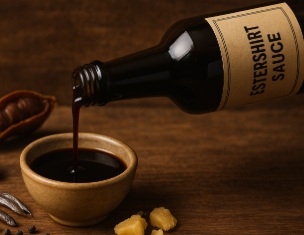
Worcestershire sauce
Description
• Fermented and matured liquid condiment of British origin with a complex sweet–sour–umami profile. Classic formula: malt vinegar and/or distilled vinegar, molasses/sugar, salt, fermented anchovies, tamarind, onion, garlic, spices (e.g., clove, pepper, chili) and natural flavors.
• Amber–brown color, low viscosity, high impact even at small doses.
• Variants exist that are gluten-free (using distilled vinegars) and fish-free (vegetarian/vegan), but the traditional style contains anchovies.

Caloric value (per 100 g)
• Typical: ~60–90 kcal/100 g (mainly from sugars/molasses).
• Indicative macros: carbohydrate ~13–22 g (sugars ~10–18 g), protein ~0.5–1.5 g, fat ~0–0.5 g; sodium often high (~1.0–1.8 g/100 g).
• Serving (5–10 ml): modest energy, sodium can be relevant.
Key constituents
• Organic acids (acetic predominant; tartaric from tamarind) → typical pH ~2.6–3.4.
• Sugars from molasses; minerals (e.g., potassium).
• Nitrogenous compounds and nucleotides from fermented anchovies (source of umami).
• Polyphenols/tannins from spices and tamarind; spice volatiles (eugenol from clove, warm pungent notes).
• Typical analytical markers: °Brix/TSS, titratable acidity, pH, sodium/NaCl, color (L, a, b*)**, viscosity (e.g., Brookfield).
Production process
• Infusion/maceration of spices, tamarind, onion/garlic in vinegar; fermentation/maturation with anchovies in an acid–salty medium.
• Cooking/extraction and aging in tanks (months to >1 year) to integrate flavors.
• Fine filtration, standardization (salt/sugars/acidity), optional pasteurization, and hot-fill/aseptic packing (glass or compatible plastics).
• Controls under GMP/HACCP.
Sensory and technological properties
• Umami-forward (anchovies, nucleotides), with a balanced acid–sweet backbone (vinegars + molasses) and warm spice notes.
• Functionality: gentle acidifier, robust flavor enhancer, and promoter of browning/Maillard during cooking; excels as an aroma booster in meat and vegetable systems.
• Compatibility: low viscosity and high dispersibility; potential haze/precipitation in dairy or high-protein matrices due to polyphenol–protein interactions.
Food uses
• Marinades and glazes for meats and fish; burgers, meatballs, BBQ sauces, stews, gravies, and tomato sauces.
• Cocktails (e.g., Bloody Mary), dressings (e.g., Caesar), deviled eggs, roasted vegetables and legumes.
• Typical inclusion: 0.5–5.0% in sauces/marinades; to taste as a tabletop condiment.
Nutrition and health
• Low calories per serving; sodium can be significant—consider in low-salt diets.
• Trace protein and omega-3 from anchovies are nutritionally negligible at use levels.
• Residual alcohol from vinegars is negligible; sulfites may be present depending on vinegar—check labels.
Lipid profile
• Total fat in finished product: negligible; contributions of SFA (saturated fatty acids), MUFA (monounsaturated fatty acids), and PUFA (polyunsaturated fatty acids) are insignificant at typical dosages.
Quality and specifications (typical topics)
• °Brix/TSS, pH/titratable acidity, NaCl/sodium, color (L*, a*, b*), and viscosity (e.g., Brookfield).
• Microbiology: pathogen-free; low total count/yeasts/molds due to combined pH and salt hurdles.
• Lot-to-lot sensory consistency; contaminants (metals/pesticides) within specification.
Storage and shelf-life
• Store cool and dark, container tightly closed; avoid prolonged light/oxygen exposure.
• Typical shelf-life 18–36 months unopened; after opening, refrigerate and use within 4–8 weeks.
• Avoid temperature cycling; apply FIFO.
Allergens and safety
• Fish (anchovies): major EU allergen → mandatory label declaration.
• Gluten: possible if malt vinegar (barley) is used; gluten-free versions rely on distilled vinegars.
• Possible sulfites (from certain vinegars) → declare when present; acidic pH may corrode unsuitable closures—use compatible materials.
INCI functions in cosmetics
• Rare cosmetic use; potentially listed as Flavor/Aroma in oral-care or novelty products. Individual ingredients (e.g., Tamarindus indica extract) are more common.
Troubleshooting
• Haze/precipitate: polyphenols/tannins → finer clarification/filtration; consider mild chelation if compatible.
• Excess browning/cooked notes: heat abuse in process/storage → lower time/temperature; improve O₂ barrier.
• Container swelling: contamination → reinforce pasteurization and hygiene; check aw and closures.
• Instability in emulsions: acidity/salts → adjust aqueous phase, add starch/xanthan, pre-emulsify oils.
Sustainability and supply chain
• Valorize spice and vegetable by-products; manage effluents to BOD/COD targets.
• Recyclable packaging and acid-resistant closures; energy efficiency in cooking and hot-fill.
• Full ingredient traceability (fish, vinegars, spices); supplier audits under GMP/HACCP.
Conclusion
Worcestershire sauce is a high-complexity flavor amplifier combining acidity, sweetness, umami, and spice. Careful ingredient selection, controlled maturation, protection from heat/oxygen, and correct allergen labeling ensure stable, repeatable performance across applications.
Mini-glossary
• °Brix — Percentage of TSS (total soluble solids); guides concentration and perceived sweetness.
• TSS — Total soluble solids: sugars/acids/salts; correlates with density and yield.
• pH — Acidity/alkalinity index; governs taste, shelf-life, and protein interactions.
• aw — Water activity: lower values improve microbial stability.
• SFA — Saturated fatty acids: excess may raise LDL; negligible here.
• MUFA — Monounsaturated fatty acids (e.g., oleic): generally favorable/neutral for lipids; negligible here.
• PUFA — Polyunsaturated fatty acids (n-6/n-3): beneficial when balanced; negligible here.
• GMP — Good Manufacturing Practice: hygiene and process-control standards.
• HACCP — Hazard Analysis and Critical Control Points: preventive safety system with defined CCP.
• BOD/COD — Biochemical/Chemical Oxygen Demand: wastewater impact indicators.
• CFU — Colony forming units: viable cell counts for microbiology monitoring.
• FIFO — First in, first out: stock rotation prioritizing older lots.
References__________________________________________________________________________
Fukaya, T., Furuta, Y., Ishiguro, Y., Horitsu, H., & Takamizawa, K. (1996). Continuous Fermentation of Worcestershire Sauce by Trickle Bed Bioreactor Using Comb‐Shaped Ceramic Carriers. Journal of food science, 61(1), 223-225.
Abstract. A two-step fermentation process using Saccharomyces cerevisiae OC-2 (wine yeast) was studied. The first step, to multiply and immobilize yeast cells, was carried out by batch method (7 days) in a trickle bed bioreac-tor. In a second step, the substrate was continuously fermented by immobilized and free yeast cells in the same bioreactor. Continuous fermentation resulted in retention of 3% (W/V) of ethanol, 50 mg/L of isoamyl alcohol and 6 mg/L of β-phenethyl alcohol (the major aromatic components of fermented Worcestershire sauce). Maximum ethanol productivity was retained at 4.1–4.2 g/L/hr under continuous operation with immobilized yeasts, 3.2-fold higher than with the batch system.
SATOH, T., & MIYAO, S. (1984). The Effect of Acid and Osmotic Pressure on the Gas Formation by the Yeast of Worcester Sauce. Nippon Shokuhin Kogyo Gakkaishi, 31(3), 187-191.
Murphy, K. (1967). Bilateral renal calculi and aminoaciduria after excessive intake of Worcestershire sauce. The Lancet, 290(7512), 401-403.
Abstract. Two patients with bilateral renal calculi were found to have aminoaciduria and a history of long-continued and excessive intake of Worcestershire sauce. No other cause of kidney stones was found. As Worcestershire sauce contains a number of potentially nephrotoxic ingredients it is suggested that these agents have caused the aminoaciduria and the kidney stones.
FUKAYA, T., SAKAMOTO, H., TAKAMIZAWA, K., & HORITSU, H. (1993). Preservation of fermented mixture of vegetables and fruits juices and production of an Worcestershire sauce using these fermented juices. journal of the japanese society for cold preservation of food, 19(2), 68-73.