

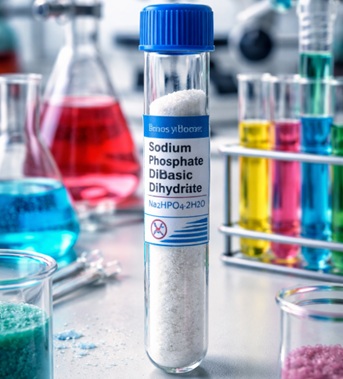
Sodium phosphate dibasic dihydrate
Rating : 7
| Evaluation | N. Experts | Evaluation | N. Experts |
|---|---|---|---|
| 1 | 6 | ||
| 2 | 7 | ||
| 3 | 8 | ||
| 4 | 9 | ||
| 5 | 10 |
0 pts from Al222
| Sign up to vote this object, vote his reviews and to contribute to Tiiips.Evaluate | Where is this found? |
| "Descrizione" about Sodium phosphate dibasic dihydrate by Al222 (23259 pt) | 2025-Sep-09 15:47 |
| Read the full Tiiip | (Send your comment) |
Sodium phosphate dibasic dihydrate
Disodium hydrogen phosphate dihydrate – Na₂HPO₄·2H₂O
Synonyms: disodium hydrogen phosphate; disodium phosphate; E339(ii) (food use)
INCI / Functions: pH buffer (pH adjuster), aqueous phase stabilizer, processing aid in oral care
Definition
Sodium phosphate dibasic dihydrate is the alkaline disodium salt of phosphoric acid in its dihydrate form. It is a white, odorless, highly water-soluble crystalline solid that yields a slightly alkaline solution. In cosmetics, oral care, foods, and pharmaceuticals it is used to create and maintain stable pH in the near-neutral to mildly alkaline range, typically paired with sodium phosphate monobasic (NaH₂PO₄) as a classic phosphate buffer.
Calories (energy value)
0 kcal per 100 g (inorganic salt; no metabolizable energy).
Identification and specifications
Formula: Na₂HPO₄·2H₂O | Molar mass: 177.99 g/mol | CAS: 10028-24-7 | EC: 231-448-7
Appearance: white crystals/powder | Odor: none
Water solubility (25 °C): high (tens of g/L; dissolves rapidly) | Insoluble in ethanol
Typical pH (1–2% aq.): ~8.7–9.2
Bulk density (powder): ~1.5 g/cm³ | Hygroscopicity: moderate
Stability: loses crystal water on heating; avoid moisture/CO₂ uptake (pH drift risk)
Phosphoric system pKa (25 °C): pKa₁ ≈ 2.15; pKa₂ ≈ 7.20; pKa₃ ≈ 12.35
→ NaH₂PO₄/Na₂HPO₄ buffers most effectively around pH 6.2–8.2.
Functional role and “chelating” clarification
Primary function is buffering: it stabilizes formulation pH against moderate acid/base inputs. Interaction with Ca²⁺/Mg²⁺ is not true chelation; in hard-water or alkaline conditions phosphate can precipitate calcium salts (e.g., calcium phosphate). For metal control, pair with sodium citrate or EDTA rather than relying on disodium phosphate.
Formulation compatibility
Surfactants: excellent with anionics, amphoterics, many nonionics; assess high-level cationics case-by-case.
Polymers/gellants: broadly compatible with neutralized carbomers, natural gums, acrylates (mind the final pH window).
Pigments/minerals: stabilizes the aqueous phase; watch Ca²⁺–rich systems (haze/precipitation risk).
pH-sensitive actives: holds tight pH windows for enzymes, fluorides (oral care), and color-critical systems.
Use guidelines (indicative)
Cosmetics (leave-on/rinse-off): 0.05–0.50% for fine pH trim and day-to-day stability.
Oral care (toothpastes/mouthwashes): 0.2–2.0% with NaH₂PO₄ targeting pH 6.0–7.5 alongside fluorides.
Food (E339(ii)): levels per category-specific regulations.
Buffer preparation: dissolve acidic and basic salts separately, combine under stirring; tune pH using small additions of the acidic (NaH₂PO₄) or basic (Na₂HPO₄) component. Verify after thermal equilibration.
Practical phosphate buffer recipes (purified water, 25 °C, indicative)
pH ≈ 6.5: ~80–85% NaH₂PO₄ + 15–20% Na₂HPO₄ (mass of anhydrous equivalents)
pH ≈ 7.0: ~60–65% NaH₂PO₄ + 35–40% Na₂HPO₄
pH ≈ 7.4: ~45–50% NaH₂PO₄ + 50–55% Na₂HPO₄
pH ≈ 8.0: ~25–30% NaH₂PO₄ + 70–75% Na₂HPO₄
(Ionic strength and total concentration slightly shift pH—always confirm at the bench.)
Typical applications
Gentle cleansers, shampoos, body washes: robust pH control and consistent performance in hard water.
Gels and lotions: viscosity and active stability in the aqueous phase.
Oral care: buffering with fluorides/antitartar systems; supports oral comfort (physiological pH).
Water-based make-up: pH stability for color/dispersion.
Food: acidity regulator/stabilizer; emulsifying salt in processed/processed cheese.
Grades, quality, and specifications
Available in technical, food (E339(ii)), and pharmaceutical grades. Common specs include assay, heavy metals (Pb, As, Cd) at very low levels, loss on drying (crystal water), solution pH, insolubles, and microbiological limits for food/pharma.
Safety, regulatory, and environmental notes
Irritation: low at use levels; powder/concentrate may irritate eyes/skin/airways.
Allergenicity: not a contact allergen.
EU Cosmetics (Reg. 1223/2009): no specific restrictions; use under GMP and appropriate pH targets.
IFRA: not applicable (non-fragrance).
Food: additive E339(ii); observe category-specific maximums and conditions.
Environmental: phosphates may contribute to eutrophication; manage use and discharge responsibly.
Storage: airtight, cool, dry place; avoid moisture and CO₂ uptake; keep away from strong acids (neutralization).
Formulation troubleshooting
White haze/precipitate with hard water or calcium salts: lower pH, reduce phosphate level, add citrate/EDTA at low dose, or use DI water.
pH drift over 24–48 h: check buffer capacity (total molarity), temperature, and dissolved CO₂; re-trim with small acidic/basic component additions.
Active interactions: verify compatibility with enzymes, aluminum salts (antiperspirants), and high-level cationics; optimize order of addition.
Conclusion
Sodium phosphate dibasic dihydrate is a workhorse pH-buffering salt for water-based formulations: versatile, predictable, economical. Used correctly in tandem with sodium phosphate monobasic, it delivers chemical–physical stability, consistent performance, and wide excipient compatibility in cosmetics and oral care. It is not a substitute for true chelators; where metal control is required, complement with sodium citrate or EDTA. Careful control of pH, water hardness, concentration, and storage conditions ensures stable, safe, and compliant products.
References__________________________________________________________________________
Buck CL, Wallman KE, Dawson B, Guelfi KJ. Sodium phosphate as an ergogenic aid. Sports Med. 2013 Jun;43(6):425-35. doi: 10.1007/s40279-013-0042-0.
Abstract. Legal nutritional ergogenic aids can offer athletes an additional avenue to enhance their performance beyond what they can achieve through training. Consequently, the investigation of new nutritional ergogenic aids is constantly being undertaken. One emerging nutritional supplement that has shown some positive benefits for sporting performance is sodium phosphate. For ergogenic purposes, sodium phosphate is supplemented orally in capsule form, at a dose of 3-5 g/day for a period of between 3 and 6 days. A number of exercise performance-enhancing alterations have been reported to occur with sodium phosphate supplementation, which include an increased aerobic capacity, increased peak power output, increased anaerobic threshold and improved myocardial and cardiovascular responses to exercise. A range of mechanisms have been posited to account for these ergogenic effects. These include enhancements in 2,3-Diphosphoglycerate (2,3-DPG) concentrations, myocardial efficiency, buffering capacity and adenosine triphosphate/phosphocreatine synthesis. Whilst there is evidence to support the ergogenic benefits of sodium phosphate, many studies researching this substance differ in terms of the administered dose and dosing protocol, the washout period employed and the fitness level of the participants recruited. Additionally, the effect of gender has received very little attention in the literature. Therefore, the purpose of this review is to critically examine the use of sodium phosphate as an ergogenic aid, with a focus on identifying relevant further research.
Curran MP, Plosker GL. Oral sodium phosphate solution: a review of its use as a colorectal cleanser. Drugs. 2004;64(15):1697-714. doi: 10.2165/00003495-200464150-00009.
Abstract. Oral sodium phosphate solution (Fleet Phospho-soda, Casen-Fleet Fosfosoda is a low-volume, hyperosmotic agent used as part of a colorectal-cleansing preparation for surgery, x-ray or endoscopic examination. The efficacy and tolerability of oral sodium phosphate solution was generally similar to, or significantly better than, that of polyethylene glycol (PEG) or other colorectal cleansing regimens in patients preparing for colonoscopy, colorectal surgery or other colorectal-related procedures. Generally, oral sodium phosphate solution was significantly more acceptable to patients than PEG or other regimens. The use of this solution should be considered in most patients (with the exception of those with contraindications) requiring colorectal cleansing. PHARMACOLOGICAL PROPERTIES: After the first and second 45 mL dose of oral sodium phosphate solution, the mean time to onset of bowel activity was 1.7 and 0.7 hours and the mean duration of activity was 4.6 and 2.9 hours. Bowel activity ceased within 4 hours of administration of the second dose in 83% of patients. Elevations in serum phosphorus and falls in serum total and ionised calcium from baseline occurred during the 24 hours after administration of oral sodium phosphate solution in seven healthy volunteers. These changes were not associated with significant changes in clinical assessments. The decrease in serum potassium levels after administration of oral sodium phosphate solution was negatively correlated with baseline intracellular potassium levels. Therapeutic use: A regimen that administered the first dose of sodium phosphate on the previous evening and a second dose on the morning of the procedure (10-12 hours apart) was significantly more effective than PEG-based regimens for colorectal cleansing in preparation for colonoscopy, sigmoidoscopy or colorectal surgery. A regimen that administered both doses of oral sodium phosphate on the day prior to the procedure offered no colorectal cleansing advantage over PEG-based regimens and was significantly less effective than an oral sodium phosphate solution regimen that administered one dose on the previous evening and a second dose on the morning of the procedure. Oral sodium phosphate solution was generally as effective as other colorectal cleansing solutions (including magnesium citrate-containing regimens with sodium picosulfate). The direct costs of a diagnostic colonic examination with oral sodium phosphate solution were less than those with PEG (US465 dollars vs US503 dollars per patient; 1995 values), according to data from a US study. Oral sodium phosphate solution was significantly more effective than a commercially available tablet formulation as a colorectal cleanser prior to colonoscopy (data from one study only). Tolerability: Oral sodium phosphate solution administered as two 45 mL doses (generally 10-12 hours apart) was well tolerated in well designed trials in which adults with major comorbid conditions were excluded. Sodium phosphate-associated adverse events were mostly gastrointestinal (including abdominal pain/cramping, abdominal fullness and/or bloating, anal or perianal irritation or soreness, nausea, vomiting or hunger pains), although dizziness, weakness/fatigue, thirst, chest pain, chills, headache and sleep loss were also reported. Faecal incontinence was commonly reported in the elderly. Three doses (administered 10 minutes apart) of 15 mL of oral sodium phosphate solution, each diluted in 250 mL of clear fluid was associated with less vomiting than one 45 mL dose of the solution diluted in 250 mL of clear fluid (data from one study). In patients without major comorbid conditions, oral sodium phosphate has been associated with transient and clinically inconsequential changes in intravascular volume and electrolyte disturbances. Serious electrolyte disturbances have been associated with oral sodium phosphate administration in patients in whom sodium phosphate is contraindicated or should be use with caution (the elderly and those with bowel obstructions, small intestinal disorders, poor gut motilderly and those with bowel obstructions, small intestinal disorders, poor gut motility, renal insufficiency, cardiovascular disease or taking concomitant medication) or in patients ingesting more than the recommended dosage. Changes in the colonic mucosa have been reported in patients treated with oral sodium phosphate solution; however, the exact role of this agent in the appearance of these changes has not been fully clarified. The tolerability profile of oral sodium phosphate solution was similar to, or significantly better than, that of PEG or other colorectal cleansing regimens. Oral sodium phosphate solution was generally significantly more acceptable than PEG or other colorectal cleansing regimens. Oral sodium phosphate solution had similar tolerability, but was considered to be more acceptable than commercially available oral sodium phosphate tablets prior to colonoscopy (data from one study).
Cheng J, Tao K, Shuai X, Gao J. Sodium phosphate versus polyethylene glycol for colonoscopy bowel preparation: an updated meta-analysis of randomized controlled trials. Surg Endosc. 2016 Sep;30(9):4033-41. doi: 10.1007/s00464-015-4716-6.
Abstract. Background: Adequate bowel cleansing is of great importance for a high-quality colonoscopy examination. Nevertheless, whether sodium phosphate or polyethylene glycol is a gold standard agent for bowel preparation is still under debate. In consideration of the clinical needs, we thus performed an updated meta-analysis of randomized controlled trials concerning the comparison between both regimens. The efficacy, safety and acceptability of each regimen are major indicators to measure and appraise. Methods: By searching PubMed, EMBASE, Web of Science and Cochrane Library databases, 15 original trials published from 2000 to 2014 were included as eligible studies. We carried out data extraction and subsequent pooling analysis for each indicator in a standard manner. Sensitivity analysis was performed by elimination of low-quality trials, while a funnel plot and Egger's test were employed to analyze the publication bias across studies. Results: Our pooling analysis revealed that patients undergoing sodium phosphate as a cleansing agent displayed better acceptability, compliance, cleansing scores, preparation taste, polyp detection rate and less adverse effects including nausea, vomiting and abdominal pain (P < 0.05). In terms of procedure time, adequate preparation rate and electrolyte concentration, there was no significant difference between both regimens (P > 0.05). The pooling analysis offered stable conclusions which were verified by our sensitivity analysis. There was no publication bias across studies as a symmetric funnel plot was demonstrated and the result of Egger's test was P = 0.56. Conclusions: Regarding preparation efficacy, safety and acceptability, sodium phosphate was a better agent than polyethylene glycol for colonoscopy bowel cleansing, with its advantages of higher efficacy, better tolerability and acceptability as well as comparable safety.
Hoffmanová I, Kraml P, Anděl M. Renal risk associated with sodium phosphate medication: safe in healthy individuals, potentially dangerous in others. Expert Opin Drug Saf. 2015 Jul;14(7):1097-110. doi: 10.1517/14740338.2015.1044970.
Abstract. Introduction: Sodium phosphate purgatives are used for bowel preparation before endoscopic or radiologic examination and occasionally for treatment of severe obstipation. Generally, they are well tolerated and effective; however, safety concerns exist regarding serious renal injury and electrolyte disturbances after administration of these drugs. Areas covered: The review presents complications associated with the use of agents containing sodium phosphate with regard to electrolyte disorders and renal impairment, namely acute phosphate nephropathy (APhN). This paper discusses the pathophysiology, histopathological findings, clinical symptoms, diagnosis and treatment of APhN. Additionally, it examines the epidemiology of adverse renal events and the safety of using sodium phosphate preparations prior to colonoscopy. Expert opinion: Because of safety concerns, sodium phosphate purgatives are not recommended for routine bowel cleansing. Despite some serious and even fatal adverse events associated with these drugs when used with at-risk patients, available data suggest that administration of sodium phosphate purgatives is relatively safe in nonrisk individuals(i.e., in adequately hydrated, otherwise healthy adults, younger than 55 years with evidence of normal renal function).
| Sign up to vote this object, vote his reviews and to contribute to Tiiips.EvaluateClose | (0 comments) |
Read other Tiiips about this object in __Italiano (1)
Component type:   Chemical Main substances:   Last update:   2025-09-09 15:24:12 | Chemical Risk:   |
