

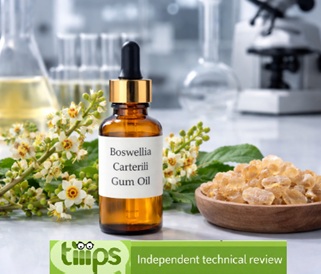
Boswellia carterii gum oil: properties, uses, pros, cons, safety
Boswellia carterii gum oil (frankincense)
Boswellia carterii gum oil is an essential oil obtained from the gum-resin (“frankincense/olibanum”) of Boswellia (traditionally referred to as Boswellia carterii; often treated in botanical literature as a synonym of Boswellia sacra), family Burseraceae. In cosmetics it is used primarily as a perfuming ingredient and, in some formulas, as a sensory support in leave-on and rinse-off products. The composition is dominated by volatile constituents (monoterpenes and, partly, sesquiterpenes) typical of essential oils.

Chemical Composition and Structure:
Chemical Constituents:
Boswellic Acids: Contribute to anti-inflammatory and soothing effects.
Essential Oils: Includes components such as alpha-pinene, limonene, and incensole that provide the characteristic frankincense scent.
Terpenes: Such as beta-caryophyllene and alpha-thujene, which are important for the oil’s fragrance and effects.
Structure: Volatile oil with a complex mixture of terpenes and sesquiterpenes.
Physical Properties:
Appearance: A clear to slightly yellowish liquid.
Odor: Strong, warm, and woody frankincense aroma.
Solubility: Generally soluble in organic solvents and can be blended with other essential oils and carrier oils.
Consistency: Lightweight, with an oily texture.
Production Process:
Resin Collection: Resin is harvested from the Boswellia carterii tree through careful tapping.
Steam Distillation: The collected resin is subjected to steam distillation to extract the essential oil.
Filtration: The oil is filtered to remove impurities and to obtain a pure, high-quality product.
Quality Control: Ensuring the oil meets quality and safety standards.
Main uses
Food.
It is not a typical food ingredient. In flavor/aroma contexts, resin derivatives (e.g., “olibanum” as an aromatic/resinous material) may be used, with classifications and specifications depending on the market and grade. Any food-use evaluation must refer to applicable standards and the supplier’s documentation.
Cosmetics.
Primarily used as a perfuming agent (aromatic raw material) in fragrances and finished formulas. It may be included in serums, face/body oils, emulsions, and bath products to deliver a warm resinous note, with a sensory/olfactive role more than a functional “active” role. Used in serums, facial oils, and moisturizers for its anti-inflammatory, calming, and rejuvenating properties.
Personal Care: Incorporated into body lotions, bath products, and haircare items for its nourishing and fragrant qualities.
Aromatherapy: Utilized in diffusers and massage oils for its relaxing and grounding effects.
INCI Functions
Perfuming. Unlike fragrance, which can also contain slightly less pleasant or characteristic odours, the term perfume indicates only very pleasant fragrances. Used for perfumes and aromatic raw materials.
Identification data and specifications
| Characteristic | Value |
|---|
| INCI name | Boswellia carterii gum oil |
| Botanical source | Boswellia (trad. Boswellia carterii; often synonym of Boswellia sacra), family Burseraceae |
| Preparation type | essential oil from gum-resin (frankincense/olibanum) |
| CAS number | 89957-98-2 (sometimes also reported as 8016-36-2 for closely related resin materials/derivatives) |
| EC number | 289-620-2 |
| Molecular formula | not applicable (mixture) |
| Molecular weight | not applicable (mixture) |
| Main use | perfuming agent in cosmetics and perfumery |
| Variability note | composition varies with origin, distillation, and storage |
Physico-chemical properties (indicative)
| Characteristic | Indicative value | Note |
|---|
| Physical state | liquid | typical of an essential oil |
| Color | colorless to straw-yellow | depends on batch and oxidation |
| Odor | resinous, balsamic, woody | variable intensity |
| Water solubility | insoluble / very low | typical of terpenes |
| Solubility in organic solvents | good | miscible with many organic solvents and carrier oils |
| Volatility | medium to high | driven by monoterpenes |
| Oxidative stability | sensitive | terpene components can oxidize, generating more sensitizing species |
Functional role and mechanism of action (practical)
In cosmetic formulas, the main contribution is olfactive: the terpene mixture evaporates progressively, releasing the characteristic frankincense note. From a formulation standpoint, it behaves as a lipophilic raw material that can interact with the matrix (oils, solvents, emulsified systems), secondarily influencing sensoriality and dry-down perception.
Formulation compatibility
Generally compatible with anhydrous systems and with the oil phase of emulsions. Typical critical points include: compatibility with complex fragrance accords (note balance), oxidative stability (need to control oxygen/light/temperature), and use limits driven by cosmetic regulation and applicable fragrance standards. In surfactant-based systems (shower gels/shampoos), solubilizers or suitable fragrance systems may be required to prevent haze or phase separation.
Use guidelines
Set dosage based on desired olfactive intensity, product category (leave-on/rinse-off), and compliance constraints (e.g., applicable IFRA standards for the fragrance). Store in suitable containers, minimizing exposure to light and air to limit oxidation and olfactive drift.
Quality, grades, and specifications
Quality is driven by botanical/geographical authenticity, distillation method, GC profile (compositional “fingerprint”), absence of adulteration, and controls on contaminants/oxidation. Batch-to-batch consistency can be challenging for natural materials; for industrial use it is useful to define minimum specifications (marker components, color, odor, oxidation indices).
Safety, regulation, and environment
Generally regarded as safe for use in cosmetics and personal care products when used according to recommendations. Individuals with sensitive skin or allergies to essential oils should be cautious.
As with many terpene-rich essential oils, it may have irritation or sensitization potential, especially when oxidized. Practical regulatory management includes quality control, use within typical formulation ranges, compliance with fragrance standards, and correct labeling of fragrance allergens when present above applicable thresholds (e.g., limonene and linalool, if relevant in the batch profile).
Allergen.
Not a single “allergen” category per se, but it may contain fragrance allergens (notably terpenes) which, at certain concentrations and/or when oxidized, can increase sensitization risk.
Contraindications (brief).
Use caution in individuals with highly reactive skin or a history of sensitization to fragrances/essential oils. Avoid overdosage in leave-on products and carefully manage oxidative stability and batch quality.
Formulation troubleshooting
Olfactive instability (note changes over time).
Action: improve barrier packaging, reduce headspace, use compatible antioxidants, and optimize storage conditions.
Haze or phase separation in cleansers.
Action: add a suitable solubilizer or rebalance the fragrance system; check cloud point behavior.
Perceived irritation in the finished product.
Action: reduce dosage, adjust the fragrance, verify batch oxidation and the presence of allergens/oxidized components.
Conclusion
Boswellia carterii gum oil is a gum-resin essential oil used mainly as a perfuming ingredient in cosmetics and perfumery. Natural variability in composition and sensitivity to oxidation are the key technical drivers for quality, stability, and sensitization risk management. Effective formulation relies on proper grade qualification, stability control, and compliance with applicable fragrance standards.
Mini-glossary
INCI. International nomenclature of cosmetic ingredients; standardized naming for cosmetic ingredients. Benefit: consistent labeling and traceability.
GC (gas chromatography). Analytical technique used to profile volatile components in essential oils. Benefit: authenticity control, consistency monitoring, and adulteration detection.
IFRA. International fragrance association; voluntary standards for safe use of fragrance ingredients. Benefit: risk management (irritation/sensitization) by product category.
Fragrance allergens. Odorant molecules which, above certain thresholds and/or when oxidized, can increase sensitization risk. Benefit: supports compliant formulation and labeling.