

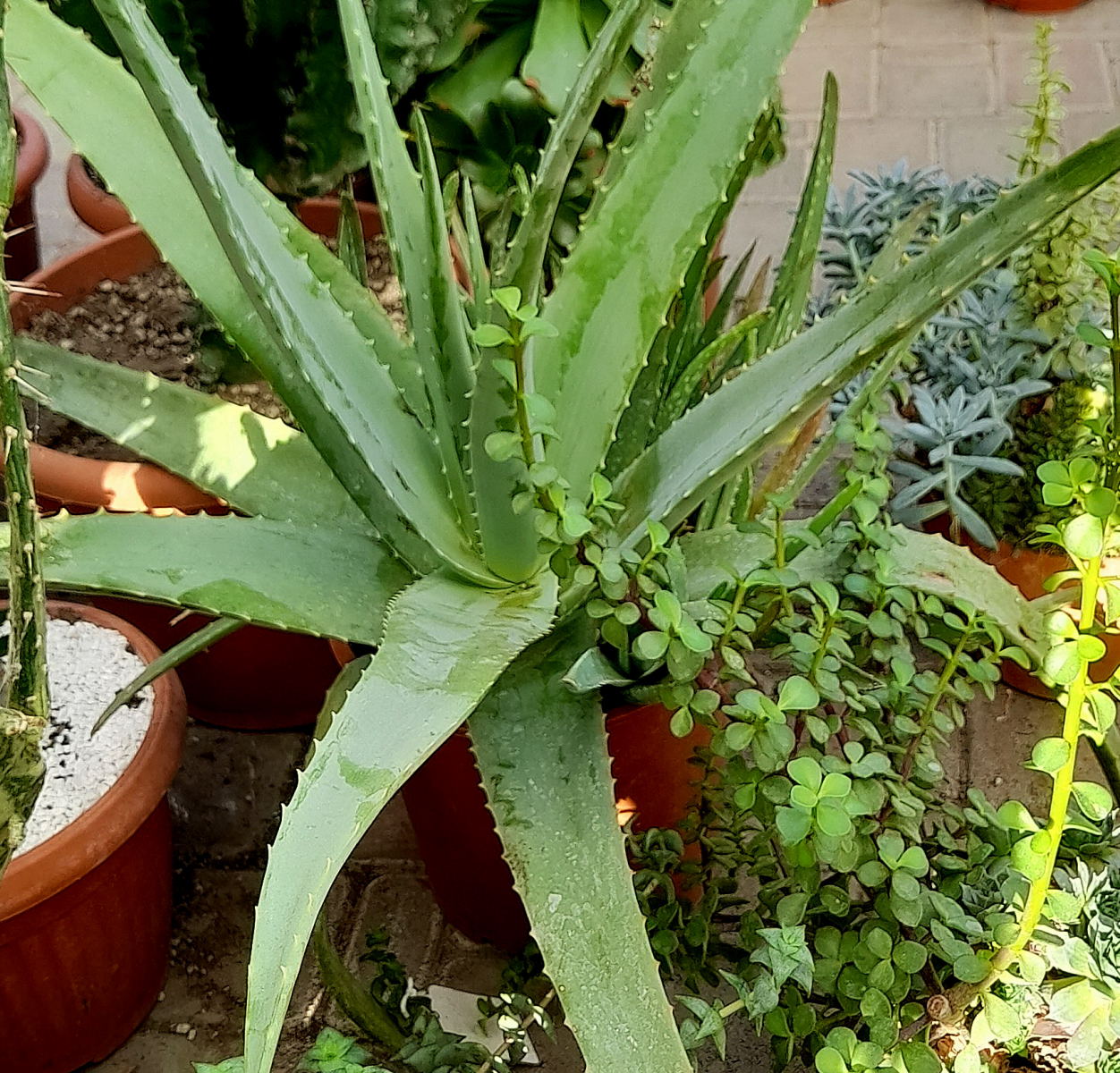
Aloe Barbadensis Leaf Juice Powder is a product of natural origin obtained from the plant Aloe barbadensis, Liliaceae botanical family.
The name describes the structure of the molecule:
- "Aloe Barbadensis"is the scientific name for the plant commonly known as aloe vera.
- "Leaf Juice Powder" indicates that the product is a powder made by drying the juice extracted from the leaves of the plant. The powder contains various compounds like vitamins, enzymes, minerals, and amino acids that are beneficial for the skin.
Description of raw materials used in production and their functions.
- Aloe Barbadensis leaves. These leaves come from the aloe vera plant, renowned for its soothing and moisturizing properties. The juice derived from its leaves is abundant with vitamins, minerals, amino acids, and enzymes.
- Drying agents. Used to convert the liquid juice into a powder form for longer preservation and ease of use.
Step-by-step summary of industrial extraction process.
- Leaf harvesting. Aloe Barbadensis leaves are harvested from the plant.
- Juice extraction. The juice is extracted from the leaves through a pressing process.
- Filtration. The extracted juice is filtered to remove impurities and solid particles.
- Drying. The filtered juice is then dried, typically through freeze drying or spray drying, turning it into a fine powder.

What it is for and where
Medical
The use of herbs is a well-established method for treating certain diseases, but herbs can trigger side effects and can interact with other herbs, supplements or medications. For these reasons, one should only proceed with caution when taking them with the assistance of a doctor (1). In any case, it is important to set quantities and frequency of intake that only a doctor can prescribe.
Latex and gels are made from the plant with a long history of topical and local therapy, as a treatment for burns, wounds, skin irritation and constipation, and in Ayurvedic medicine it is used against skin diseases, however ingestion has been associated with several physical ailments (2).
It abounds in anthraquinones, plant enzymes and useful tricyclic aromatic secondary metabolites, including aloe emodin and chrysophanol (3).
It contains antioxidant vitamins (A, C, E, B12), niacin, riboflavin and folic acid and, used as a laxative stimulant, anthelmintic. It also contains potassium, calcium, magnesium, copper, zinc, chromium, iron and magnesium lactate (4) as well as polysaccharides (glucomannans), amino acids, fatty acids (lupeol and campesterol), lipids, plant sterols, tannins and enzymes (amylase, catalase and peroxidase) used as herbal medicines.
Aloe vera improved epithelialisation and granulation tissue of burn wounds in patients with superficial second degree burns (5) and significantly increased skin elasticity index (6) and collagen levels (7).
Cosmetics
Skin conditioning agent. It is the mainstay of topical skin treatment as it has the function of restoring, increasing or improving skin tolerance to external factors, including melanocyte tolerance. The most important function of the conditioning agent is to prevent skin dehydration, but the subject is rather complex and involves emollients and humectants that can be added in the formulation.
CAS 85507-69-3 94349-62-9
EC number 287-390-8 305-181-2
Commercial Applications
Cosmetics and Personal Care. Aloe Barbadensis Leaf Juice Powder is widely used in skin care products such as lotions, creams, and balms for its moisturizing, soothing, and healing properties.
Hair Products. It's found in shampoos, conditioners, and hair treatments because of its moisturizing and soothing properties.
Dietary Supplements. Some people consume Aloe Vera as a dietary supplement in powdered form for its health benefits.
Traditional Medicine
Historically, Aloe Barbadensis Leaf Juice Powder has been used for treating minor burns, abrasions, cuts, and to alleviate symptoms of skin conditions like eczema and psoriasis.
References_____________________________________________________________________
(1) Aloe - University of Maryland - Medical Center
http://umm.edu/health/medical/altmed/herb/aloe
(2) Boudreau M, Beland F (2006) An evaluation of the biological and toxicological properties of Aloe barbadensis (miller), Aloe vera. J Environ Sci Heal C 24: 103–154
(3) Enhancement of Anti-Inflammatory Activity of Aloe vera Adventitious Root Extracts through the Alteration of Primary and Secondary Metabolites via Salicylic Acid Elicitation
Yun Sun Lee, Hyun Kyoung Ju, Yeon Jeong Kim, Tae-Gyu Lim, Md Romij Uddin, Yeon Bok Kim, Jin Hong Baek, Sung Won Kwon, Ki Won Lee, Hak Soo Seo, Sang Un Park, Tae-Jin Yang
PLoS One. 2013; 8(12): e82479. Published online 2013 Dec 16. doi: 10.1371/journal.pone.0082479
(4) Shelton M. Aloe vera, its chemical and therapeutic properties. Int J Dermatol. 1991;30:679–683. doi: 10.1111/j.1365-4362.1991.tb02607.x
(5) Irani PS, Varaie S. Comparison of the Effect of Aloe Vera Gel and Nitrofurazone 2% on Epithelialization and Granulation Tissue Formation Regarding Superficial Second-Degree Burns. Iran J Med Sci. 2016 May;41(3 Suppl):S3.
(6) Tanaka M, Yamamoto Y, Misawa E, Nabeshima K, Saito M, Yamauchi K, Abe F, Furukawa F. Aloe sterol supplementation improves skin elasticity in Japanese men with sunlight-exposed skin: a 12-week double-blind, randomized controlled trial. Clin Cosmet Investig Dermatol. 2016 Nov 10;9:435-442. doi: 10.2147/CCID.S118947. Erratum in: Clin Cosmet Investig Dermatol. 2016 Dec 16;10 :1.
(7) Tanaka M, Yamamoto Y, Misawa E, Nabeshima K, Saito M, Yamauchi K, Abe F, Furukawa F. Effects of Aloe Sterol Supplementation on Skin Elasticity, Hydration, and Collagen Score: A 12-Week Double-Blind, Randomized, Controlled Trial. Skin Pharmacol Physiol. 2016;29(6):309-317. doi: 10.1159/000454718.