

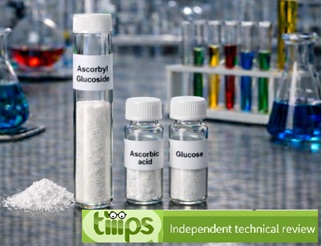
Ascorbyl Glucoside
Rating : 7
| Evaluation | N. Experts | Evaluation | N. Experts |
|---|---|---|---|
| 1 | 6 | ||
| 2 | 7 | ||
| 3 | 8 | ||
| 4 | 9 | ||
| 5 | 10 |
10 pts from Carnob
| Sign up to vote this object, vote his reviews and to contribute to Tiiips.Evaluate | Where is this found? |
| "Descrizione" about Ascorbyl Glucoside Review Consensus 10 by Carnob (1998 pt) | 2026-Jan-13 18:47 |
| Read the full Tiiip | (Send your comment) |
Ascorbyl Glucoside: properties, uses, pros, cons, safety
Ascorbyl Glucoside – a stabilized derivative of vitamin C (ascorbic acid) linked to a glucose unit, used in cosmetics as an antioxidant and to support skin radiance
Synonyms: ascorbic acid 2-O-glucoside, 2-O-alpha-D-glucopyranosyl-L-ascorbic acid, AA-2G, vitamin C glucoside (technical usage)
INCI / Functions: antioxidant
Ascorbyl glucoside is a glycoside of ascorbic acid: in practice, a form of vitamin C in which a glucose molecule is bound to the ascorbate structure. This modification typically makes the ingredient more stable than free ascorbic acid, especially in water-based formulations, reducing oxidation tendency and helping preserve performance over the product’s shelf life.

In topical application, the cosmetic rationale is that of a functional “precursor”: under compatible conditions, skin enzymes may contribute to conversion toward ascorbic acid, supporting benefits consistent with cosmetic vitamin C use (protection from oxidative stress and improved perceived radiance and evenness). Real-world outcomes depend on matrix design, pH, preservative system, packaging, and use conditions.
The name describes the structure of the molecule
Description of raw materials used in production
Step-by-step summary of industrial chemical synthesis process
Cosmetics.
Its primary use is in face and body products as an antioxidant to support cosmetic protection from oxidative stress and contribute to a more radiant and even-looking complexion. It is often selected when a more formulation-friendly vitamin C derivative is desired versus free ascorbic acid, especially in aqueous serums and creams.
In tone-evening and radiance-focused formulations, it is frequently paired with support systems (chelators, secondary antioxidants, airless packaging) and compatible actives to build a balanced “radiance” routine. Choosing ascorbyl glucoside versus other derivatives (e.g., ascorbyl phosphates or lipophilic esters) is typically driven by solubility, target pH, sensorial goals, and the required stability profile.
Antioxidant agent. Ingredient that counteracts oxidative stress and prevents cell damage. Free radicals, pathological inflammatory processes, reactive nitrogen species and reactive oxygen species are responsible for the ageing process and many diseases caused by oxidation.
Anti-aging Products. Due to its antioxidant properties, it can help prevent free radical damage and reduce the appearance of wrinkles.
Serums and Creams. Incorporated into various formulations for its ability to boost collagen production and enhance skin elasticity.
Sun Care Products. Can be used in sunscreens for its antioxidant properties, which aid in protecting the skin from sun damage.
Pharmaceutical.
May be considered in dermatological/dermocosmetic formulations as an antioxidant, subject to grade specifications, impurities, stability, and dossier requirements.
Industrial use.
Primarily linked to the cosmetic supply chain (raw material for finished products); it may appear in technical products where its stability and aqueous-handling characteristics are beneficial.
Medicine
Ascorbyl Glucoside has been used in effective topical formulation to promote healing of corneal epithelial wounds (1), ameliorates solar lentigos (2).
| Identifier | Value |
|---|---|
| INCI name | Ascorbyl Glucoside |
| Formula | C12H18O11 |
| Molecular weight | 338.26 g/mol |
| CAS number | 129499-78-1 |
| EC/EINECS number | 425-980-0 |
| Typical commercial appearance | white to off-white powder (grade-dependent) |
| Solubility | water-soluble (typically) |
| Property | Value | Note |
|---|---|---|
| Water solubility | good | facilitates use in serums/gels/O/W creams |
| Oxidative stability | higher than ascorbic acid | depends on pH, metals, oxygen, light, and packaging |
| Melting point (indicative) | ~158–163 °C | commonly reported range in technical profiles |
| Sensitivity to metals | relevant | potential oxidation catalysis: chelator management is useful |
| Function | What it does in formula | Technical note |
|---|---|---|
| Antioxidant | helps limit oxidative phenomena in the product and on skin | supports “radiance” routines and cosmetic protection from oxidative stress |
| Support for radiance/evenness | contributes to improved perception of a more even-looking complexion | results depend on concentration, vehicle, and consistent use |
| Formulation manageability | more manageable than free vitamin C | does not eliminate the need for protection from light/oxygen |
Ascorbyl glucoside is typically compatible with aqueous bases and O/W systems and is often chosen specifically for better manageability in these matrices. The most relevant technical points are:
pH and stability. Even if more stable than free vitamin C, stability still depends on pH and the formulation environment. Good practice is to work within a pH range that supports both derivative stability and finished-product tolerability, avoiding conditions that accelerate oxidation or hydrolysis.
Metals and oxidation. Trace iron/copper can catalyze oxidative degradation. Using chelators and maintaining good process hygiene (water quality, tanks, tools) materially improves repeatability.
Packaging. Protection from oxygen and light (airless, opaque bottles, reduced headspace) is often decisive for maintaining color/odor and perceived activity.
Interactions with actives. In multi-active formulas, it is prudent to check compatibility with strongly oxidizing systems or matrices that significantly shift pH or ionic strength. Verify via accelerated stability, thermal cycling, and monitoring of color/odor/viscosity.
| Application | Typical range | Technical note |
|---|---|---|
| Face serums (leave-on) | 1–5% | commonly used level for “radiance” products; validate stability and sensoriality |
| Face/neck creams (leave-on) | 0.5–5% | pay attention to pH, chelators, and packaging |
| Rinse-off masks | 0.5–2% | useful when an antioxidant contribution is desired in rinse-off formats |
| Facial cleansers (rinse-off) | 0.1–1% | benefit is limited by contact time; evaluate cost/efficacy |
| QC parameter | What to check |
|---|---|
| Identity | INCI, CAS/EC alignment and documentation (SDS/CoA) |
| Assay | active content and supplier specification |
| Impurities | impurity profile and metals (Fe/Cu) relevant for stability |
| Moisture | impacts powder flow and storage stability |
| Color/odor | early indicators of degradation or contamination |
| In-formula stability | drift in color, pH, and performance under stress testing |
In cosmetics, ascorbyl glucoside is assessed as an ingredient with antioxidant function and, based on available safety evaluations, is suitable for use in cosmetics at concentrations and product categories consistent with common practice, subject to the safety assessment of the finished product (use scenario, application area, target population).
Practical issues are more often related to: individual irritation in sensitive users, formulation interactions that lead to instability (with potential increase of degradation by-products), and correct quality/storage management to prevent visible oxidation (yellowing/browning).
In manufacturing, applying GMP (Good manufacturing practice; first occurrence) reduces variability, contamination, and specification drift; benefit: improved repeatability and process control. In supply chains requiring preventive controls, HACCP (Hazard analysis and critical control points; first occurrence) is a methodological reference; benefit: preventive risk management at critical points.
| Problem | Possible cause | Recommended intervention |
|---|---|---|
| Yellowing/browning over time | oxidation (oxygen, light, metals) | more protective packaging, chelators, supporting antioxidants, reduced headspace |
| Loss of clarity in aqueous serums | incompatibility with solubilizers/polymers or off-target pH | adjust pH, verify polymers, reduce salts, run hot/cold stress tests |
| “Metallic” odor or off-note | metal contamination or advanced oxidation | control water/equipment, chelation, supplier qualification |
| No perceived performance | dose too low, suboptimal matrix, unrealistic expectations | adjust concentration, improve stability/pH, position cosmetic claim appropriately |
| Instability in multi-active systems | chemical incompatibility (pH, oxidants, ionic systems) | separate steps/phases, revise addition order, simplify the formula |
Ascorbyl glucoside is a water-soluble and relatively stable vitamin C derivative used in cosmetics as an antioxidant and to support radiance and even-looking skin tone. Formulation success depends mainly on pH control, metal management, protection from light/oxygen, and stability testing on the finished product.
INCI: standard nomenclature for cosmetic ingredient labeling.
Antioxidant: substance that helps reduce oxidative reactions (in the product and/or on the skin surface).
Chelator: ingredient that complexes metals (e.g., Fe/Cu), reducing oxidative catalysis.
GMP: Good manufacturing practice; benefit: reduces variability and operational risk.
HACCP: Hazard analysis and critical control points; benefit: strengthens prevention and control in regulated supply chains.
References_____________________________________________________________________
(1) Jaber M, Jaber B, Hamed S, AlKhatib HS. Preparation and evaluation of ascorbyl glucoside and ascorbic acid solid in oil nanodispersions for corneal epithelial wound healing. Int J Pharm. 2022 Nov 5;627:122227. doi: 10.1016/j.ijpharm.2022.122227. Epub 2022 Sep 23. PMID: 36155791.
(2) Takada M, Numano K, Nakano M, Yamamoto A, Imokawa G. Treatment with Ascorbyl Glucoside-Arginine Complex Ameliorates Solar Lentigos. Int J Mol Sci. 2024 Dec 15;25(24):13453. doi: 10.3390/ijms252413453.
Abstract. Little is known about the anti-pigmenting effects of skin-whitening agents on solar lentigos (SLs). To characterize the anti-pigmenting effects of a newly designed derivative ascorbyl glucoside-arginine complex (AGAC) on SLs, lotions with or without 28% AGAC were applied twice daily for 24 weeks in a double-blind half-face study of 27 Japanese females with SLs. The pigmentation scores and skin colors of previously selected SLs on the right and left sides of the faces of the subjects were evaluated using a photo-scale, a color difference meter and a Mexameter. Treatment with the test lotion elicited a significant decrease in pigmentation scores at 24 weeks compared to week 0, with a significant decrease in pigmentation scores at 24 weeks compared to the placebo lotion. In the test lotion-treated SLs, the lightness (L) and melanin index (MI) values that reflect the pigmentation level significantly increased and decreased, respectively, at 12 and 24 weeks of treatment compared to week 0. Comparisons of increased L values or decreased MI values between the test and placebo lotion-treated SLs demonstrated that the test lotion-treated SLs had significantly higher increased L or decreased MI values than the placebo lotion-treated SLs both at 12 and 24 weeks of treatment. The sum of our results strongly indicates that AGAC is distinctly effective in ameliorating the hyperpigmentation levels of SLs at a level visibly recognizable by the subjects, without any hypo-pigmenting effects or skin problems.
| Sign up to vote this object, vote his reviews and to contribute to Tiiips.EvaluateClose | (0 comments) |
Read other Tiiips about this object in __Italiano (1)
Component type:   Chemical Main substances:   Last update:   2023-09-01 18:11:36 | Chemical Risk:   |

