

Balsam of Peru: properties, uses, pros, cons, safety, alternatives
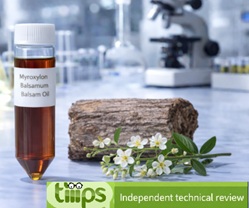
Balsam of Peru is a resin obtained from the Balsam Peru tree that grows in El Salvador Myroxylon balsamum (L.) var. pereirae, Leguminosae. This resin, composed of about 250 constituents, repairs cracks in the tree. The same plant is used to make a cosmetic product called Tolu Balm or Tolu Balsam with almost similar characteristics but different INCI names.
It appears as a yellow liquid.

What it is used for and where
Food
Balsam of Peru is added as a flavouring agent in both food and beverages, but it is a stimulant to the cardiovascular system and increases blood pressure depending on the amount added.
Cosmetics
It is used on all continents for different purposes, but the most popular use is perfuming in cosmetic products. It is a restricted ingredient as a Relevant Item in the Annexes of the European Cosmetics Regulation 1223/2009 or not subject to restrictions. It depends on the composition.
The following products are on the market, with and without restrictions, bearing in mind that the cosmetic safety rating expressed may differ from study to study, composition to composition. As can be seen from the table below, only 4 out of 9 ingredients have no cosmetic restrictions, but even for these, the safety considerations I outline below apply.
| INCI | CAS | EC number | Restriction | Name | Function |
| MYROXYLON BALSAMUM BALSAM EXTRACT | 9000-64-0 | 232-550-4 |
| Balsam Tolu
| Perfuming
|
| MYROXYLON BALSAMUM RESIN | 9000-64-0 | 232-550-4 |
| Balsam Tolu
| Film former Fragrance Hair conditioning |
| MYROXYLON BALSAMUM BALSAM OIL | 9000-64-0 | 232-550-4 | II/1136 | Peru Balsam
| Perfuming
|
| MYROXYLON PEREIRAE OIL/EXTRACT |
|
|
|
| Perfuming
|
| MYROXYLON PEREIRAE RESIN EXTRACT |
|
|
|
| Flavouring Fragrance Skin conditioning
|
| MYROXYLON BALSAMUM PEREIRAE BALSAM EXTRACT | 8007-00-9 | 232-352-8 | III/154 | Peru Balsam
| Flavouring
|
| MYROXYLON BALSAMUM PEREIRAE BALSAM OIL | 8007-00-9 | 232-352-8 | III/154 | Peru Balsam
| Flavouring
|
| MYROXYLON PEREIRAE OIL | 8007-00-9 | 232-352-8 | II/1136 |
| Flavouring
|
| MYROXYLON PEREIRAE RESIN | 8007-00-9 | 232-352-8 | II/1136 | Peru Balsam
| Film former Fragrance Hair conditioning
|
Safety
It is considered an allergen even though not all of the main allergens have yet been identified because in addition to benzoic acid, cinnamate, eugenol, at least 10 others are unidentifiable. However, the allergic contact dermatitis it causes (1) is known to be among the most frequent sensitisers that can cause periocular contact dermatitis (2).
Alternatives
| Option (INCI) | Product type | Key advantages |
|---|
| Vanilla Planifolia Fruit Extract | Aromatic extract | Sweet balsamic/vanillic facet for warm accords; often easier to manage than balsams rich in allergens, while still needing quality control (odor/color). |
| Styrax Benzoin Resin Extract | Benzoin resin extract/resinoid | Similar balsamic-vanillic accord with good roundness and fixative effect; manage naturally occurring allergens and supplier specs. |
| Copaifera Officinalis (Balsam Copaiba) Resin | Resin/oleoresin | Cleaner balsamic-woody facet, often used as a resinous alternative; allergen profile is typically different from Myroxylon. |
| Vanillin / Ethyl Vanillin | Aroma materials | Sweet, rounding note with good repeatability and stability; useful to replace part of the warm balsamic signature while reducing extract variability. |
Medical
It is used to treat wounds and burns, but positive patch tests, especially in elderly people, have confirmed that this ingredient is responsible for dermatitis (3).
References_____________________________________________________________________
(1) Nanda, A. and Wasan, A., 2016. Allergic contact dermatitis to balsam of Peru. Annals of Allergy, Asthma & Immunology, 117(2), pp.208-209.
(2) Temesvári E, Pónyai G, Németh I, Hidvégi B, Sas A, Kárpáti S. Periocular dermatitis: a report of 401 patients. J Eur Acad Dermatol Venereol. 2009 Feb;23(2):124-8. doi: 10.1111/j.1468-3083.2008.02949.x.
Abstract. Background: Periocular contact dermatitis may appear as contact conjunctivitis, contact allergic and/or irritative eyelid and periorbital dermatitis, or a combination of these symptoms. The clinical symptoms may be induced by several environmental and therapeutic contact allergens. Objectives: The aim of the present study was to map the eliciting contact allergens in 401 patients with periocular dermatitis (PD) by patch testing with environmental and ophthalmic contact allergens. Methods: Following the methodics of international requirements, 401 patients were tested with contact allergens of the standard environmental series, 133 of 401 patients with the Brial ophthalmic basic and supplementary series as well. Results: Contact hypersensitivity was detected in 34.4% of the patients. Highest prevalence was seen in cases of PD without other symptoms (51.18%), in patients of PD associated with ophthalmic complaints (OC; 30.4%), and PD associated with atopic dermatitis (AD; 27.9%). In the subgroup of PD associated with seborrhoea (S) and rosacea (R), contact hypersensitivity was confirmed in 17.6%. Most frequent sensitisers were nickel sulphate (in 8.9% of the tested 401 patients), fragrance mix I (4.5%), balsam of Peru (4.0%), paraphenylendiamine (PPD) (3.7%), and thiomersal (3.5%). By testing ophthalmic allergens, contact hypersensitivity was observed in nine patients (6.7% of the tested 133 patients). The most common confirmed ophthalmic allergens were cocamidopropyl betaine, idoxuridine, phenylephrine hydrochloride, Na chromoglycinate, and papaine. Limitations: Patients with symptoms of PD were tested from 1996 to 2006. Conclusions: The occurence of contact hypersensitivity in PD patients was in present study 34.4%. A relatively high occurrence was seen in cases of PD without other symptoms, in PD + OC and in PD + AD patients. The predominance of environmental contact allergens was remarkable: most frequent sensitizers were nickel sulphate, fragrance mix I, balsam of Peru, thiomersal, and PPD. The prevalence of contact hypersensitivity to ophthalmic allergens did not exceed l.5%.
(3) Avalos‐Peralta, P., Garcia‐Bravo, B. and Camacho, F.M., 2005. Sensitivity to Myroxylon pereirae resin (balsam of Peru). A study of 50 cases. Contact dermatitis, 52(6), pp.304-306.