

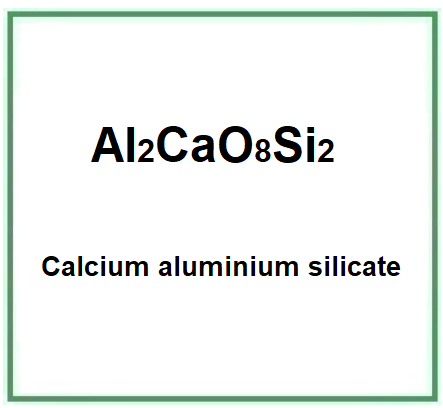
E556
Rating : 5
| Evaluation | N. Experts | Evaluation | N. Experts |
|---|---|---|---|
| 1 | 6 | ||
| 2 | 7 | ||
| 3 | 8 | ||
| 4 | 9 | ||
| 5 | 10 |
10 pts from Frank123
| Sign up to vote this object, vote his reviews and to contribute to Tiiips.Evaluate | Where is this found? |
| "Descrizione" about E556 Review Consensus 10 by Frank123 (11988 pt) | 2026-Jan-21 17:15 |
| Read the full Tiiip | (Send your comment) |
E556: properties, uses, pros, cons, safety
E556 or Calcium aluminium silicate is an inorganic aluminosilicate based on calcium and aluminium, used both as a functional powder in cosmetics and, historically, as a food anti-caking additive identified as E556. In practice, it is a mineral material whose performance depends primarily on particle-size distribution, particle morphology, porosity/specific surface area, and purity.

Synonyms: calcium aluminosilicate; calcium and aluminium silicate (descriptive); anorthite (common mineralogical framing).
INCI / functions: in cosmetics it is used as an inorganic ingredient with typical class functions such as bulking, absorbent, opacifying, anti-caking and, in some contexts, abrasive (depending on particle size/morphology and supplier specification).
Definition
Calcium aluminium silicate belongs to the aluminosilicate family containing calcium. It is not a biological “active”: it acts mainly as a physical modifier of the formula. It can improve powder slip and silkiness, contribute to optical performance (opacity/soft-focus), and, thanks to its particulate structure, help manage absorption of oils/surface sebum.
As an inorganic material, it generally shows high chemical stability under cosmetic conditions and, where relevant, in dry matrices. Practical issues are more often linked to respirable dust, mineral contaminants, and particle variability than to classic “chemical instability.”
Main uses
Food.
It is known as E556 with an anti-caking function to improve flow and storage of powdered or granular foods. Within the EU framework, however, the regulatory note is essential: use as E556 is no longer authorised in the European Union from 1 February 2014 (authorisation ceased on 31 January 2014). In practice, this means the association “E556 = anti-caking” remains correct as a function, but food use in the EU is constrained by the current authorisation status and any historical transitional provisions.
Cosmetics.
Mainly used in make-up (loose/pressed powders, compact foundations, eyeshadows) and in some “matt finish” skincare as a functional powder to improve slip, silkiness, opacity, and sensory stability. In anhydrous or low-water systems it can also support compactability and reduce caking in-pack.
Industrial use.
Mineral material for technical blends and formulations; suitability depends on purity, contaminant control, and the required particle-size curve.
Nutritional use note and bioactive compounds
Not applicable: it is an inorganic, non-nutritional material and is not associated with food-relevant bioactive compounds. Performance is physical-functional (particles), not biochemical.
Identification data and specifications
| Characteristic | Value |
|---|---|
| common name | calcium aluminium silicate |
| english name | calcium aluminum silicate / calcium aluminosilicate |
| synonyms (descriptive) | calcium and aluminium silicate; anorthite (mineralogical context) |
| CAS number | 37342-39-5 |
| EC/EINECS number | 253-476-9 |
| molecular formula | CaAl₂Si₂O₈ |
| molecular weight | 278.21 g/mol |
| food identifier | E556 (anti-caking function; EU status: authorisation ceased on 31 January 2014) |
| typical commercial form | mineral powder, grade-dependent (treated or untreated; varying particle size) |
| energy value (practical note) | not applicable in cosmetics |
Physico-chemical properties (indicative)
| Characteristic | Value | Note |
|---|---|---|
| chemical nature | calcium aluminosilicate (inorganic) | mineral/particulate material |
| water solubility | negligible | typically insoluble |
| chemical stability | high under standard conditions | contaminants are more critical than degradation |
| density (indicative) | typically ~2.6–2.8 g/cm³ | depends on mineral phase and grade |
| melting/softening point | high | not relevant for cosmetic processing |
| critical performance parameters | particle size, morphology, specific surface area, purity | drive slip, opacity, and sensoriality |
Functional role and practical mechanism of action
In cosmetics it works via a particulate effect: it improves pay-off and spreadability, supports a drier touch, and can promote light diffusion for a smoothing optical effect. In food applications (historical E556 use), the practical effect is reducing clumping and improving powder flow during packaging, transport, and use.
Real-world performance is strongly grade-dependent: finer/more porous materials tend to increase absorption and mattifying effect, while other particle characteristics can prioritize slip and optical finish.
Formulation compatibility
In cosmetics it is generally compatible with many bases, especially anhydrous or low-water systems. In emulsions it requires proper wetting and suspension management. The most frequent incompatibilities are physical: settling in low-viscosity systems, agglomeration if wetting is poor, and rheology shifts if it interacts with unsuitable structuring systems.
In dry foods (historical E556 scenario), compatibility is linked to correct dispersion and particle-size selection to avoid undesired appearance/sensory impact, in addition to compliance with the applicable authorisation status.
Use guidelines (indicative)
In cosmetics, grade selection should be driven by the sensory target and product type (loose powder, pressed powder, stick, emulsion). In development it is useful to define: desired particle-size curve, mattifying requirement, compatibility with pigments and oils, and resistance to mechanical stress (pressing, transport). For powdery formats, it is also appropriate to assess dustiness and manage the risk of accidental inhalation for specific product types.
In food, any use considerations must start from the current authorisation framework in the relevant jurisdiction and any applicable technical specifications for food-grade material.
Quality, grades, and specifications
Key controls include: particle-size distribution, impurities and trace metals per relevant specifications, and application tests (slip, opacity, oil absorption, compactability). Any surface treatments must be declared and managed as an integral part of the specification.
Safety, regulatory, and environment
In cosmetic use, safety is typically linked to purity/contaminants and the risk of inhalation of respirable fractions in loose powders or aerosolizable products. On skin, inorganic silicates are generally low-reactivity materials, but the safety assessment should consider the use scenario and particle size. At the process level, dust containment and ventilation are relevant for operator protection.
In EU food use, the decisive point is regulatory: E556 is associated with an authorisation that ceased on 31 January 2014. In practice, any food use should be checked against the current legislation and updated lists.
It should also be considered that the risk of cumulative intake of aluminium, which can pose a danger to human health, cannot be excluded as this ingredient can be found in widely consumed food products (1).
Implementation of GMP (good manufacturing practice; benefit: reduces variability and contamination) remains relevant to maintain consistent particulate quality and impurity profile.
Formulation troubleshooting
Settling or separation in fluid systems.
Typical cause: insufficient wetting or high particle density. Action: optimize wetting/dispersing aids and the continuous-phase structure.
Agglomeration and visible “speckling” on application.
Typical cause: incomplete dispersion or moisture/caking of the powder. Action: improve pre-dispersion and moisture control.
Conclusion
Calcium aluminium silicate is an inorganic ingredient used mainly as a functional powder in cosmetics to modulate texture, opacity, and slip. It is also historically known in food as E556 with an anti-caking function, but within the EU context the key temporal clarification is that authorisation ceased on 31 January 2014. The most important technical management areas are grade qualification (particle size, purity, performance) and, for powdery products, appropriate evaluation of dustiness and the real use scenario.
Mini-glossary
Aluminosilicate: an inorganic material based on aluminium, silicon, and oxygen, often with cations such as calcium.
Particle-size distribution: the distribution of particle sizes; it influences sensoriality, opacity, and suspension stability.
Anti-caking: a function that reduces caking/clumping and improves the flow of powders and granules.
GMP: good manufacturing practice; benefit: improves quality control and reduces contamination/variability.
![]() | ![]() |
References_____________________________________________________________________
(1) Wong, W.W., Chung, S.W., Kwong, K.P., Yin Ho, Y. and Xiao, Y., 2010. Dietary exposure to aluminium of the Hong Kong population. Food Additives and Contaminants, 27(4), pp.457-463.
Abstract. A total of 256 individual food samples were collected in Hong Kong for aluminium testing. Most of food samples were analysed in ready-to-eat form. High aluminium levels were found in steamed bread/bun/cake (mean: 100-320 mg kg(-1)), some bakery products such as muffin, pancake/waffle, coconut tart and cake (mean: 250, 160, 120 and 91 mg kg(-1), respectively), and jellyfish (ready-to-eat form) (mean: 1200 mg kg(-1)). The results demonstrated that aluminium-containing food additives have been widely used in these food products. The average dietary exposure to aluminium for a 60 kg adult was estimated to be 0.60 mg kg(-1) bw week(-1), which amounted to 60% of the new PTWI established by JECFA. The main dietary source was "steamed bread/bun/cake", which contributed to 60% of the total exposure, followed by "bakery products" and "jellyfish", which contributed to 23 and 10% of the total exposure, respectively. However, the estimation did not include the intake of aluminium from natural food sources, food contact materials or other sources (e.g. drinking water). Although the results indicated that aluminium it is unlikely to cause adverse health effect for the general population, the risk to some populations who regularly consume foods with aluminium-containing food additives cannot be ruled out.
Bratakos, S.M., Lazou, A.E., Bratakos, M.S. and Lazos, E.S., 2012. Aluminium in food and daily dietary intake estimate in Greece. Food Additives and Contaminants: Part B, 5(1), pp.33-44.
Abstract. Aluminium content of foods, as well as dietary aluminium intake of the Greek adult population, was determined using graphite furnace atomic absorption spectroscopy after microwave sample digestion and food consumption data. Al content ranged from 0.02 to 741.2 mg kg⁻¹, with spices, high-spice foods, cereal products, vegetables and pulses found to be high in Al. Differences in aluminium content were found between different food classes from Greece and those from some other countries. Aluminium intake of Greeks is 3.7 mg/day based on DAFNE Food Availability Databank, which uses data from the Household Budget Surveys. On the other hand, according to the per capita food consumption data collected by both national and international organisations, Al intake is 6.4 mg day⁻¹. Greek adult population has an Al intake lower than the Provisional Tolerable Weekly Intake of 7 mg kg⁻¹ body weight established by EFSA. Cereals and vegetables are the main Al contributors, providing 72.4% of daily intake.
| Sign up to vote this object, vote his reviews and to contribute to Tiiips.EvaluateClose | (0 comments) |
Read other Tiiips about this object in __Italiano (1)
Component type:   Chemical Main substances:   Last update:   2023-04-21 12:22:58 | Chemical Risk:   |

