

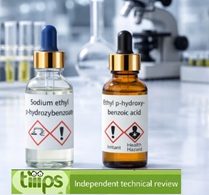
Etil-p-idrossibenzoato di sodio
Rating : 5
| Evaluation | N. Experts | Evaluation | N. Experts |
|---|---|---|---|
| 1 | 6 | ||
| 2 | 7 | ||
| 3 | 8 | ||
| 4 | 9 | ||
| 5 | 10 |
Cons:
Possible risk. Click ingredient (1)10 pts from Whiz35
| Sign up to vote this object, vote his reviews and to contribute to Tiiips.Evaluate | Where is this found? |
| "Descrizione" about Etil-p-idrossibenzoato di sodio Review Consensus 10 by Whiz35 (12050 pt) | 2026-Jan-28 11:18 |
| Read the full Tiiip | (Send your comment) |
Sodium ethyl p-hydroxybenzoate: properties, uses, pros, cons, safety, alternatives
Sodium ethyl p-hydroxybenzoate (commonly called sodium ethylparaben) belongs to the paraben family and is used as a preservative thanks to antimicrobial activity (particularly against yeasts and molds, with performance dependent on ph, matrix, and the overall preservation system). Compared with the neutral ester (ethylparaben, E214), the sodium salt is typically selected when improved handling in the aqueous phase is needed.

Definition
Sodium ethyl p-hydroxybenzoate is a defined substance: the sodium salt of ethyl p-hydroxybenzoate (ethylparaben). From a practical formulation standpoint, preservative performance depends on the amount of “available” preservative in the active phase, ph, interactions with other ingredients, microbial challenge level, packaging, and storage conditions.
Main uses
Food.
E215 has been listed as a preservative additive with use restricted to specific food categories and maximum permitted levels set by applicable regulations. In modern practice, paraben use in foods can be less common than other preservative systems, depending on market, consumer perception, and supply-chain preferences.
Preservative. Any product containing organic, inorganic compounds, water, needs to be preserved from microbial contamination. Preservatives act against the development of harmful microorganisms and against oxidation of the product.
Identification data and specifications
| Characteristic | Value |
|---|---|
| Name / E-number | E215 (sodium ethyl p-hydroxybenzoate) |
| Common name | sodium ethylparaben |
| Synonyms | sodium ethyl 4-hydroxybenzoate; sodium ethyl p-hydroxybenzoate |
| Molecular formula | C9H9NaO3 |
| Molecular weight | 188.16 g/mol |
| CAS number | 35285-68-8 |
| EC number (EINECS) | 252-487-6 |
| Functional class | preservative |
| ADI note | ADI (acceptable daily intake) historically reported as a group value for methyl and ethyl parabens and their sodium salts: 0–10 mg/kg body weight (interpretation depends on the authority and the update considered) |
Physico-chemical properties (indicative)
| Characteristic | Indicative value | Note |
|---|---|---|
| Chemical nature | sodium salt of a p-hydroxybenzoate ester | paraben in salt form |
| Physical state | solid | typically powder/crystals |
| Water solubility | higher than ethylparaben | salt form generally improves aqueous handling |
| Solubility in organic solvents | good in several polar solvents | system-dependent |
| Stability | generally good under controlled conditions | performance depends on ph and matrix |
| Antimicrobial spectrum | variable | typically stronger on yeasts/molds; matrix-dependent |
Alternatives
| Option | Product type | Key advantages |
|---|---|---|
| E202 (potassium sorbate) | Antimicrobial preservative (sorbate) | Long history of use; strong activity vs yeasts and molds; performs best at acidic pH and often in synergy with other preservatives. |
| E211 (sodium benzoate) | Antimicrobial preservative (benzoate) | Long history of use; effective in acidic beverages/sauces; best performance at low pH, often combined for broader coverage. |
| E282 (calcium propionate) | Anti-mold preservative (propionate) | Widely used for mold control in bakery; suitable for less-acidic matrices than benzoates/sorbates; good when the main target is mold. |
For more information: PARABENS
Safety
Parabens are preservative chemical compounds that have been the subject of attention in the scientific literature as possible endocrine disruptors (particularly propylparaben and butylparaben), i.e. with the possibility of damaging the hormone-producing glands in our bodies, particularly in the breasts. The 2004 study by Darbre et al. showed that parabens remain in our bodies as intact esters (2). Following this study, some of the scientific literature in 2005 and 2006 cast doubt on Darbre's conclusions and claimed they were limited. However, both the US FDA and the European SCCP authorised in 2006 the use of a single paraben in cosmetic products at a concentration of 0.4% and the use of total parabens at a concentration of 0.8%. However, there is no shortage of studies that consider the restrictions unnecessary: M. G. Kirchhof et al. in 2013 found that parabens are among the safest and most well-tolerated preservatives and that current data do not support drastic regulations or personal exposure restrictions. Darbre in 2014 published a further study in which he showed how parabens can cause DNA damage.
Parabens are components discussed and on whose safety many doubts have been raised, especially for the damage they would produce to the aquatic environment where they are discharged after use (1).
Parabens can contribute to obesity (2).


References_______________________________________________________________________
(1) Terasaki M, Abe R, Makino M, Tatarazako N. Chronic toxicity of parabens and their chlorinated by-products in Ceriodaphnia dubia. Environ Toxicol. 2013 Dec 27. doi: 10.1002/tox.21944. [Epub ahead of print]
Popa DS, Bolfa P, Kiss B, Vlase L, Păltinean R, Pop A, Cătoi C, Crişan G, Loghin F.
Influence of Genista tinctoria L. or methylparaben on subchronic toxicity of bisphenol A in rats. Biomed Environ Sci. 2014 Feb;27(2):85-96. doi: 10.3967/bes2014.021.
(2) Hu P, Chen X, Whitener RJ, Boder ET, Jones JO, Porollo A, Chen J, Zhao L. Effects of parabens on adipocyte differentiation. Toxicol Sci. 2013 Jan;131(1):56-70. doi: 10.1093/toxsci/kfs262. Epub 2012 Sep 5.
Darbre, P. D., & Harvey, P. W. (2014). Parabens can enable hallmarks and characteristics of cancer in human breast epithelial cells: a review of the literature with reference to new exposure data and regulatory status. Journal of Applied Toxicology, 34(9), 925-938.
Abstract. A framework for understanding the complexity of cancer development was established by Hanahan and Weinberg in their definition of the hallmarks of cancer. In this review, we consider the evidence that parabens can enable development in human breast epithelial cells of four of six of the basic hallmarks, one of two of the emerging hallmarks and one of two of the enabling characteristics. In Hallmark 1, parabens have been measured as present in 99% of human breast tissue samples, possess oestrogenic activity and can stimulate sustained proliferation of human breast cancer cells at concentrations measurable in the breast. In Hallmark 2, parabens can inhibit the suppression of breast cancer cell growth by hydroxytamoxifen, and through binding to the oestrogen-related receptor gamma may prevent its deactivation by growth inhibitors. In Hallmark 3, in the 10 nm–1 μm range, parabens give a dose-dependent evasion of apoptosis in high-risk donor breast epithelial cells. In Hallmark 4, long-term exposure (>20 weeks) to parabens leads to increased migratory and invasive activity in human breast cancer cells, properties that are linked to the metastatic process. As an emerging hallmark methylparaben has been shown in human breast epithelial cells to increase mTOR, a key regulator of energy metabolism. As an enabling characteristic parabens can cause DNA damage at high concentrations in the short term but more work is needed to investigate long-term, low-dose mixtures. The ability of parabens to enable multiple cancer hallmarks in human breast epithelial cells provides grounds for regulatory review of the implications of the presence of parabens in human breast tissue. Copyright © 2014 John Wiley & Sons, Ltd.
Hager E, Chen J, Zhao L. Minireview: Parabens Exposure and Breast Cancer. Int J Environ Res Public Health. 2022 Feb 8;19(3):1873. doi: 10.3390/ijerph19031873.
Abstract. There is increasing recognition that environmental exposure to chemicals, such as endocrine-disruptive chemicals (EDCs), contributes to the development of breast cancer. Parabens are a group of EDCs commonly found in personal care products, foods, and pharmaceuticals. Systemic exposure to parabens has been confirmed by the ubiquitous detection of parabens in human blood and urine samples. Although evidence from in vivo and epidemiological studies linking parabens exposure to breast cancer is limited, the current evidence suggests that parabens may negatively interfere with some endocrine and intracrine targets relevant to breast carcinogenesis. So far, most studies have focused on a single paraben's effects and the direct modulating effects on estrogen receptors or the androgen receptor in vitro. Recent studies have revealed that parabens can modulate local estrogen-converting enzymes, 17β-hydroxysteroid dehydrogenase 1 and 2 and increase local estrogen levels. Also, parabens can crosstalk with the human epidermal growth factor receptor 2 (HER2) pathway and work with ER signaling to increase pro-oncogenic c-Myc expression in ER+/HER2+ breast cancer cells. Future studies investigating paraben mixtures and their crosstalk with other EDCs or signaling pathways both in vitro and in vivo in the context of breast cancer development are warranted.
Petric Z, Ružić J, Žuntar I. The controversies of parabens - an overview nowadays. Acta Pharm. 2021 Mar 1;71(1):17-32. doi: 10.2478/acph-2021-0001.
Abstract. Effects of paraben toxicity, i.e., endocrine-disruption properties, are in the focus of researchers for decades, but still - they are a hot subject of debate. Parabens are aliphatic esters of p-hydroxybenzoic acid, which are widely used as antimicrobial agents for the preservation of cosmetics, pharmaceuticals and foods. Mostly used parabens are methyl-, ethyl-, propyl- and butylparaben. Although the toxicity of parabens is reported in animals and in in vitro studies, it cannot be taken for granted when discussing hazards for human health due to an unrealistic exposure -safety profile. Many studies have demonstrated that parabens are non-teratogenic, non-mutagenic, non-carcinogenic and the real evidence for their toxicity in humans has not been established. For now, methyl-, ethyl- and propylparaben are considered safe for use in cosmetics and pharmaceuticals within the recommended range of doses. Regarding alternatives for parabens, a variety of approaches have been proposed, but every substitute would need to be tested rigorously for toxicity and safety.
Byford JR, Shaw LE, Drew MG, Pope GS, Sauer MJ, Darbre PD. Oestrogenic activity of parabens in MCF7 human breast cancer cells. J Steroid Biochem Mol Biol. 2002 Jan;80(1):49-60. doi: 10.1016/s0960-
Abstract. Parabens (4-hydroxybenzoic acid esters) have been recently reported to have oestrogenic activity in yeast cells and animal models. Since the human population is exposed to parabens through their widespread use as preservatives in foods, pharmaceuticals and cosmetics, we have investigated here whether oestrogenic activity of these compounds can also be detected in oestrogen-sensitive human cells. We report on the oestrogenic effects of four parabens (methylparaben, ethylparaben, n-propylparaben, n-butylparaben) in oestrogen-dependent MCF7 human breast cancer cells. Competitive inhibition of [3H]oestradiol binding to MCF7 cell oestrogen receptors could be detected at 1,000,000-fold molar excess of n-butylparaben (86%), n-propylparaben (77%), ethyl-paraben (54%) and methylparaben (21%). At concentrations of 10(-6)M and above, parabens were are able to increase expression of both transfected (ERE-CAT reporter gene) and endogenous (pS2) oestrogen-regulated genes in these cells. They could also increase proliferation of the cells in monolayer culture, which could be inhibited by the antiestrogen ICI 182,780, indicating that the effects were mediated through the oestrogen receptor. However, no antagonist activity of parabens could be detected on regulation of cell proliferation by 17 beta-oestradiol at 10(-10)M. Molecular modelling has indicated the mode by which paraben molecules can bind into the ligand binding pocket of the crystal structure of the ligand binding domain (LBD) of the oestrogen receptor alpha (ERalpha) in place of 17beta-oestradiol; it has furthermore shown that two paraben molecules can bind simultaneously in a mode in which their phenolic hydroxyl groups bind similarly to those of the meso-hexoestrol molecule. Future work will need to address the extent to which parabens can accumulate in hormonally sensitive tissues and also the extent to which their weak oestrogenic activity can add to the more general environmental oestrogen problem.
Darbre PD, Aljarrah A, Miller WR, Coldham NG, Sauer MJ, Pope GS. Concentrations of parabens in human breast tumours. J Appl Toxicol. 2004 Jan-Feb;24(1):5-13. doi: 10.1002/jat.958. PMID: 14745841.
Nowak K, Ratajczak-Wrona W, Górska M, Jabłońska E. Parabens and their effects on the endocrine system. Mol Cell Endocrinol. 2018 Oct 15;474:238-251. doi: 10.1016/j.mce.2018.03.014. Epub 2018 Mar 27. PMID: 29596967.
Wei F, Mortimer M, Cheng H, Sang N, Guo LH. Parabens as chemicals of emerging concern in the environment and humans: A review. Sci Total Environ. 2021 Jul 15;778:146150. doi: 10.1016/j.scitotenv.2021.146150. Epub 2021 Feb 27. PMID: 34030374.
Charles AK, Darbre PD. Combinations of parabens at concentrations measured in human breast tissue can increase proliferation of MCF-7 human breast cancer cells. J Appl Toxicol. 2013 May;33(5):390-8. doi: 10.1002/jat.2850. Epub 2013 Jan 31. PMID: 23364952
Darbre PD, Harvey PW. Paraben esters: review of recent studies of endocrine toxicity, absorption, esterase and human exposure, and discussion of potential human health risks. J Appl Toxicol. 2008 Jul;28(5):561-78. doi: 10.1002/jat.1358. PMID: 18484575.
| Sign up to vote this object, vote his reviews and to contribute to Tiiips.EvaluateClose | (0 comments) |
Read other Tiiips about this object in __Italiano (1)
Component type:   Chemical Main substances:   Last update:   2026-01-28 10:29:18 | Chemical Risk:   |

