

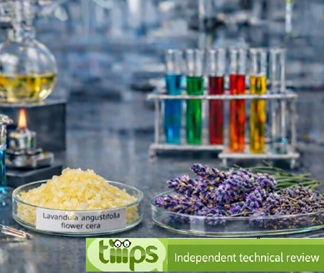
Lavandula angustifolia flower cera: properties, uses, pros, cons, safety
(Lavandula angustifolia; Lamiaceae)
Lavandula angustifolia flower cera is a plant wax obtained from lavender flowers. In cosmetics it is used mainly as a skin conditioning ingredient with an emollient role, contributing to texture, pay-off, and sensorial performance in lipophilic systems (and in some rich emulsions).

Definition
Lavandula angustifolia flower cera falls into the category of botanical materials with variable composition (a practical “UVCB” approach): it is not a single molecule, but a waxy fraction whose performance and quality depend on botanical origin, cultivation/harvesting conditions, and above all on the supplier’s process and specifications. Operationally it is handled as a structuring and sensorial raw material, with controls on batch-to-batch consistency, thermal behavior (softening/melting), color/odor, and impurities.
Main uses
Cosmetics.
Typical use in balms, sticks, body butters, rich creams, and anhydrous bases, where it can improve emollience, consistency, slip, and a “surface protective film” feel. In emulsions it may be used as an oil-phase co-structurant, with attention to physical stability and compatibility with the emulsifier system.
INCI functions
Skin conditioning agent. It is the mainstay of topical skin treatment by restoring, increasing or improving skin tolerance to external factors, including melanocyte tolerance. The most important function of the conditioning agent is to prevent skin dehydration, but the subject is rather complex and involves emollients and humectants.
Skin conditioning agent - Emollient. Emollients have the characteristic of enhancing the skin barrier through a source of exogenous lipids that adhere to the skin, improving barrier properties by filling gaps in intercorneocyte clusters to improve hydration while protecting against inflammation. In practice, they have the ability to create a barrier that prevents transepidermal water loss. Emollients are described as degreasing or refreshing additives that improve the lipid content of the upper layers of the skin by preventing degreasing and drying of the skin. The problem with emollients is that many have a strong lipophilic character and are identified as occlusive ingredients; they are oily and fatty materials that remain on the skin surface and reduce transepidermal water loss. In cosmetics, emollients and moisturisers are often considered synonymous with humectants and occlusives.
Medicine.
Not a therapeutic active. In traditional medical medicine it is used as a medical plant in the treatment of inflammation, depression and stress, due to its sedative and anxiolytic action, thrombotic and antimicrobial properties.
Cultivation
Lavender (Lavandula angustifolia) is cultivated in temperate areas; for a wax ingredient derived from flowers, upstream variability (origin and seasonality) can be reflected in organoleptic profile and physical behavior. In industrial practice, standardization is achieved through supplier-defined specifications and analytical/organoleptic controls.
For more information: LAVENDER
Key constituents
The “wax” fraction is generally made up of components typical of plant waxes (long-chain lipid fractions) and may retain trace aromatic components consistent with lavender, depending on the process. For formulators, the most relevant parameters are: softening/melting point, consistency, residual odor, color, and impurities.
Nutritional use note and bioactive compounds
Not relevant within the cosmetic scope. Technical interest is mainly technological/sensorial (structure and emollience), not nutritional.
Identification data and specifications
| Characteristic | Value |
|---|
| INCI name | Lavandula angustifolia flower cera |
| INCI functions | skin conditioning, skin conditioning – emollient |
| CAS number | 90063-37-9 |
| EC/EINECS number | 289-995-2 |
| Molecular formula | not applicable (mixture/variable-composition ingredient) |
| Molecular weight | not applicable as a single value (mixture) |
| Typical commercial form | wax/waxy solid, grade-dependent (color/odor/consistency) |
| Practical quality note | specifications on thermal behavior, odor/color, impurities, and batch-to-batch repeatability per supplier |
Physico-chemical properties (indicative)
| Characteristic | Value | Note |
|---|
| Material nature | plant wax (complex mixture) | variable composition |
| Water solubility | negligible | typical wax behavior |
| Solubility in oil phase | high | compatible with anhydrous bases and oil phases |
| Thermal behavior | softening/melting is grade-dependent | to be defined in supplier specifications |
| Oxidative stability | variable | barrier packaging and an antioxidant strategy may help when needed |
| Critical parameters | consistency, odor, color, impurities | drive repeatability and sensorial acceptability |
Functional role and practical mechanism of action
In formula, Lavandula angustifolia flower cera acts mainly as an emollient and skin conditioning agent, contributing to comfort feel and a surface film. In anhydrous systems or high-oil phases it can also provide a structuring function, modulating hardness, slip, and pay-off.
Formulation compatibility
It is generally compatible with oils, esters, butters, and other waxes. The most common watchpoints are:
management of residual odor (relevant in lightly fragranced formulas or delicate accords)
color impact in pale formulas or make-up
rheology balance (too much wax can increase hardness or reduce spreadability)
physical stability in emulsions (crystallization/instability if not properly integrated into the oil phase)
Use guidelines (indicative)
Use levels are strongly dependent on the objective (emollience vs structure) and the base profile. It is advisable to validate via accelerated stability (hot/cold), sensorial evaluation, and packaging compatibility, setting tolerances for odor/color and thermal behavior of the selected grade.
Quality, grades, and specifications
Variability among suppliers can be significant. Robust control requires: a technical sheet with physical parameters (consistency and thermal behavior), organoleptic criteria, limits for impurities/contaminants, and microbiological requirements where relevant. Batch-to-batch repeatability is often the main driver for finished-product sensorial consistency.
Safety, regulatory, and environment
Safety assessment must be performed on the finished product, considering concentration, use area, and target population. As a waxy botanical material, practical considerations include individual tolerability (reactive skin), impurity control, and oxidative stability (to reduce organoleptic drift). A GMP framework (good manufacturing practice; benefit: reduces variability and contamination) across the supply chain supports quality and traceability.
Formulation troubleshooting
Wax too “hard” or drag during application.
Action: retune the total wax fraction, balance with more slip-providing esters/oils, and verify the grade’s thermal behavior.
Odor/color drift over time.
Action: improve the barrier against light/oxygen (packaging), evaluate compatible antioxidants, and select a grade with more stable organoleptic specifications.
Conclusion
Lavandula angustifolia flower cera is a lavender-flower plant wax whose primary function is skin conditioning – emollient, useful to improve structure and sensoriality in lipophilic bases and rich formulas. For reliable use, key points are: grade control (odor/color/thermal behavior), validation of physical stability, and batch-to-batch quality management, supported by finished-product safety assessment.
Mini-glossary
UVCB: substances of unknown or variable composition, complex reaction products, or biological materials.
Emollient: an ingredient that softens and smooths the skin, improving comfort and reducing dryness perception.
Softening/melting: the thermal range in which a wax shifts from rigid to more plastic, affecting pay-off and stability.
GMP: good manufacturing practice; benefit: improves quality control and reduces contamination/variability.