

Polyester-39: properties, uses, pros, cons, safety
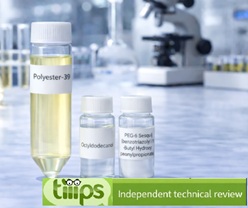
Polyester-39 is a synthetic polymer obtained by condensation from Dilinoleic Acid, PEG-6 Sesqui(benzotriazolyl t-Butyl Hydroxyphenylpropionate), and Octyldodecanol. In cosmetic formulation it typically sits among “performance polymers” with a film-forming behavior and a potential contribution to light stability, because one reagent contains a benzotriazole fragment (a chemistry often associated with photostabilization/UV-absorbing functions in materials and, depending on the supplier grade, in cosmetics).
Polyesters are synthetic polycondensation polymers that are generally derived from dicarboxylic organic acids and diols and contain an ester functional group on the main polymer chain.

Definition
Polyester-39 is derived from a condensation reaction in which:
Dilinoleic Acid contributes to the lipid “backbone” component (unsaturated C18 chains), impacting compatibility with oil phases and sensoriality;
Octyldodecanol acts as a long-chain fatty alcohol, increasing lipophilicity and film slip;
PEG-6 Sesqui(benzotriazolyl t-Butyl Hydroxyphenylpropionate) introduces PEG segments and an aromatic benzotriazole fragment, which can provide a contribution to light resistance (photostability) and film robustness in certain bases.
Regulatory/claim note (PEG/EO).
From a regulatory and claims perspective, using a PEG reagent in the process means the material is not automatically “PEG-free / EO-free”, unless:
there is an explicit supplier declaration,
there is analytical evidence demonstrating the absence of detectable EO/PEG residues according to agreed methods and limits (specifications and COA).
Main uses
Cosmetics
Typical use in oily or anhydrous systems and in emulsions with a structured oil phase when seeking:
support for a more uniform film (a more “ordered” finish, partial transfer reduction in a formula-dependent way);
a possible contribution to light stability or photostability of sensitive components (depending on the actual chemistry of the grade and the formulation strategy);
improved sensoriality (slip, glide, a more silky feel), especially in combination with compatible emollients.
INCI functions
Film-forming agent. It produces a continuous ultra-thin film with an optimal balance of cohesion, adhesion and stickiness on the skin or hair to counteract or limit damage from external phenomena such as chemicals, UV rays and pollution.
Light stabilizer / photostabilizer: a possible function, to be confirmed in supplier documentation (grade-specific).
Industrial use
Primarily cosmetic (personal care) as a functional polymer to modulate surface properties (film, sensoriality, resistance to light-driven degradation) in compatible matrices.
Identification data and specifications
| Characteristic | Value | Note |
|---|
| INCI name | Polyester-39 | Cosmetic denomination |
| Origin | synthetic | Synthetic polymer |
| Production method (provided) | condensation | With the reagents listed below |
| Listed reagents | Dilinoleic Acid; PEG-6 Sesqui(benzotriazolyl t-Butyl Hydroxyphenylpropionate); Octyldodecanol | Useful for QC, claims, and traceability |
| Main function | film forming | Central performance in formula |
| Claim note | not automatically PEG-free / EO-free | Requires supplier evidence and/or testing |
| CAS number | to be verified in SDS/supplier documentation | Often not unique across grades |
| EC number (EINECS) | to be verified in SDS/supplier documentation | Depends on classification |
Chemical-physical properties (indicative)
| Characteristic | Indicative value | Note |
|---|
| Physical state | viscous liquid / carrier-based resin | Depends on commercial grade |
| Color | colorless to pale yellow | Batch-dependent |
| Odor | mild / characteristic | Usually not dominant in the finished product |
| Water solubility | very low | Expected due to lipophilic component |
| Compatibility with oil phase | generally good | Verify with specific esters/silicones/oils |
| Emulsion behavior | may influence texture and film | Depends on emulsifiers and process |
| Stability | generally good | Criticalities more often linked to compatibility and management of light/oxygen in the formula |
Functional role and mechanism of action
The action is mainly physical: the polymer helps create a continuous film that can improve uniformity and sensoriality. The presence of a benzotriazole fragment may, in some grades, help reduce light impact on photosensitive components (e.g., changes in color/odor or degradation of certain raw materials), but actual effectiveness must be verified with photostability testing on the finished product.
Formulation compatibility
Performance depends mainly on:
composition and polarity of the oil phase (esters, oils, hydrocarbons, optional silicones);
level and type of surfactants/emulsifiers (if in an emulsion);
process (order of addition, temperature, shear, and homogenization time).
For “PEG-free/EO-free” claims, beyond formulation compatibility, alignment with supplier specifications and the target market’s requirements is necessary.
Production process
A scheme consistent with condensation between an acid (Dilinoleic Acid) and alcohol/functionalized components (Octyldodecanol and PEG-containing portions of the benzotriazole reagent), forming ester-type linkages and building a lipophilic polymeric structure, which may be carrier-based or standardized for cosmetic use (viscosity/solids/color).
Critical point for claims: the presence of a PEG reagent in the process requires documentary control and, if needed, analytical verification of residues.
Pros and cons
Pros
Supports film formation and deposit uniformity, with potential finish improvement.
Can improve slip and glide in compatible oily systems.
Potential contribution to light stability of the product (to be demonstrated on the specific formula and grade).
Cons
Not automatically compatible with PEG-free / EO-free claims: supplier evidence and/or testing is required.
Non-universal compatibility: may cause texture drift or instability if the oil phase and emulsifier system are not balanced.
Environmental aspects: as a synthetic polymer, biodegradability and environmental profile depend on structure and market requirements.
Safety, regulatory, and environmental aspects
In cosmetics, high-molecular-weight polymers generally show low dermal bioavailability, but safety assessment must refer to the finished product (use level, area of use, frequency, and format).
Allergen.
It is not typically a classic “fragrance allergen”; reactions are more often linked to the overall formula and individual sensitivity.
Contraindications (brief).
For spray/aerosol formats, consider incidental inhalation exposure depending on aerosol profile and the presence of film-forming components.
Formulation troubleshooting
Emulsion instability or phase separation.
Action: rebalance oil phase and emulsifiers; optimize process (temperature, shear, order of addition); evaluate electrolyte compatibility.
PEG-free claim is contestable.
Action: request a formal supplier statement; define methods/limits; run residue checks according to an agreed specification.
Insufficient photostability in the finished product.
Action: run comparative light/UV tests; evaluate synergies with antioxidants and packaging; optimize dose and positioning of the polymer in the correct phase.
Conclusion
Polyester-39 is a condensation polymer based on lipophilic components and a reagent containing a PEG segment and a benzotriazole fragment. In formulation it can deliver film-forming and sensory benefits and, in some contexts, support light stability of the finished product. From a claims standpoint, it is not automatically “PEG-free/EO-free”: supplier documentation and, if required, analytical evidence are needed.