

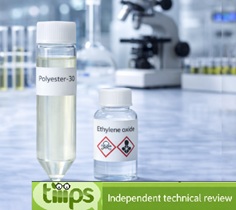
Polyester-30: properties, uses, pros, cons, safety, alternatives
Polyester-30 is a synthetic polymer from the “polyester” family used in cosmetics mainly to provide hair conditioning and to improve sensorial performance in hair formulations. In practical formulation work it can behave as a film-forming “performance polymer,” contributing to slip, friction reduction, and—in some systems—more uniform deposition on the hair fiber.

Significant substances used in the production method:
Adipic Acid, sulfonated isophthalic acid, hexamethylene diamine, Glycol PEG-33.
Polyester-30 is a functionalized polyester (a polymer based on ester bonds) whose chemical architecture and performance profile depend on the commercial grade and the manufacturer’s design strategy. In practical terms, it is used as a “resin”/functional polymer to modulate:
deposition and sensoriality on hair,
formation of a cosmetic film (more or less perceptible),
compatibility and stability in the presence of other conditioners/polymers.
More precisely:
Polyester-30 is a synthetic polyester modified with polyoxyethylene (PEG) chains.
Ethoxylation is implicit in its structure: during synthesis, ethylene oxide units are introduced to provide hydrophilicity and water solubility.
For this reason, it is classified as a non-ionic ethoxylated polymer.
Practical implications
The ethoxylated component enables Polyester-30 to function as a film-forming agent, stabilizer, and viscosity control agent in cosmetic formulations (especially gels and styling products).
From a formulation standpoint, it behaves similarly to other PEG-modified polyesters, even though “PEG” does not explicitly appear in the INCI name.
Main uses
Cosmetics
Primary use in haircare products (rinse-off and leave-on depending on the base) when conditioning and improved manageability are desired: conditioners, masks, smoothing treatments, anti-frizz products, and some “soft hold” styling products (depending on the formulation concept and grade).
INCI functions
Hair conditioning agent. A large number of ingredients with specific purposes can co-exist in a hair shampoo: cleansers, conditioners, thickeners, mattifying agents, sequestering agents, fragrances, preservatives, special additives. However, the indispensable ingredients are the cleansers and conditioners as they are necessary and sufficient for hair cleansing and manageability. The others act as commercial and non-essential auxiliaries such as: appearance, fragrance, colouring, etc. Hair conditioning agents have the task of increasing shine, manageability and volume, and reducing static electricity, especially after treatments such as colouring, ironing, waving, drying and brushing. They are, in practice, dispersing agents that may contain cationic surfactants, thickeners, emollients, polymers. The typology of hair conditioners includes: intensive conditioners, instant conditioners, thickening conditioners, drying conditioners.
Industrial use
Primarily cosmetic (personal care), as a performance polymer to modify surface and sensorial properties in compatible matrices.
Identification data and specifications
| Characteristic | Value | Note |
|---|
| INCI name | Polyester-30 | Cosmetic denomination |
| Origin | synthetic | Man-made polymer |
| Class | functionalized polyester | Architecture depends on manufacturer |
| Main function | hair conditioning | Cosmetic use function |
| CAS number | to be verified in SDS/supplier documentation | May vary by grade/composition |
| EC number (EINECS) | to be verified in SDS/supplier documentation | Depends on material classification |
| Molecular formula | not applicable (polymer) | Polymeric structure |
| Molecular weight | not applicable (polymer) | Distribution, not a single value |
Chemical-physical properties (indicative)
| Characteristic | Indicative value | Note |
|---|
| Physical state | resinous solid or component in a carrier | Depends on commercial grade |
| Color | light to slightly amber | Batch/carrier-dependent |
| Odor | mild / characteristic | Usually not dominant in the finished product |
| Water solubility | low / variable | Depends on functionalization and carrier |
| Solubility in cosmetic solvents | variable, often better in hydroalcoholic systems or specific carriers | Verify by grade |
| Film effect | possible | Depends on dose, base, and synergies |
| Chemical stability | generally good | Criticalities are more often tied to compatibility and build-up |
Functional role and mechanism of action
The action is mainly physical: the polymer can deposit on hair and contribute to a film that reduces friction between fibers, improving slip and combability. In some systems, it may also help improve the uniformity of distribution of other conditioning agents and enhance the perception of “more orderly” hair.
Formulation compatibility
Performance is strongly dependent on:
carrier and solvent system (water, alcohols, glycols, dedicated carriers),
presence of surfactants and electrolyte level,
synergies or competition with quaternary conditioners, silicones, and other film-forming polymers.
In practice, it is advisable to validate: hot/cold stability, thermal cycles, centrifugation, and performance on real hair types (fine vs coarse, treated vs natural).
Pros and cons
Pros
Provides conditioning and improved combability.
Possible cosmetic film effect useful for smoothing and anti-frizz (when properly balanced).
Can enhance a silky sensorial profile and tactile feel on hair.
Cons
Risk of build-up and weighing-down on fine hair or with repeated use if the system deposits too much.
Non-universal compatibility: may require appropriate carriers/solubilization to avoid haze, separation, or uncontrolled deposition.
Environmental aspect: like many synthetic polymers, biodegradability may be limited; assessment depends on structure and the brand’s regulatory/claim framework.
Alternatives
| Option (INCI) | Product type | Key advantages |
|---|
| Acrylates Copolymer | Synthetic film former | Strong film formation, improves wear and rub resistance; widely used in long-wear makeup and sunscreens. |
| VP/VA Copolymer | Synthetic film former | Boosts adhesion and hold, common in sprays/styling and some makeup; good performance-to-cost balance. |
| Polyurethane-1 | High-performance synthetic film former | More elastic, durable film; useful for water and transfer resistance; often used in mascara/eyeliner and long-wear products. |
| Trimethylsiloxysilicate | Silicone film former | Very high wear with strong water/transfer resistance; useful in sunscreens and no-transfer makeup. |
| Pullulan | Natural-origin film former (polysaccharide) | Lightweight film with smoothing/tightening feel; good option to reduce synthetic polymers (typically more limited water resistance). |
Safety, regulatory, and environmental aspects
In cosmetics, high-molecular-weight polymers generally show low dermal bioavailability; safety assessment remains tied to the finished product (use level, use pattern, application area).
Allergen.
It is not typically a classic allergen. Any reactions are more often related to the overall formula and individual sensitivity.
Contraindications (brief).
On very reactive skin or in high-deposition leave-on products, evaluate dose and tolerability. On fine hair, consider the risk of weighing-down.
Formulation troubleshooting
Hair feels heavy or loss of volume.
Action: reduce dosage; rebalance the conditioning package; consider a less-depositing grade or a different carrier.
Haze or separation.
Action: optimize solubilization/carrier; review surfactants and electrolytes; adjust order of addition and shear.
Insufficient conditioning effect.
Action: increase level gradually; verify compatibility with quats/silicones; test synergies with other film-forming polymers.
Conclusion
Polyester-30 is a synthetic polymer used mainly as a hair conditioning agent, with potential film-forming and sensorial contribution. Its practical value lies in improved combability, slip, and smoothing; the quality of the result depends on solubilization, the formulation base, and deposition control to avoid build-up.
Mini-glossary
Polyester (in cosmetics). A polymer containing ester bonds, often used as a resin or performance polymer to modulate film and sensoriality.
Cosmetic film. A continuous layer deposited on a surface (e.g., hair) that can reduce friction and improve appearance.
Build-up. Progressive accumulation of material on the fiber with potential loss of volume or a weighed-down feel.