

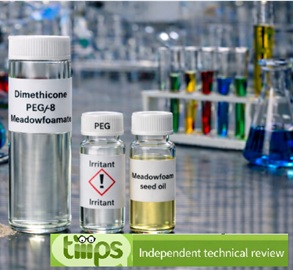
Dimethicone Peg-8 Meadowfoamate
Rating : 5
| Evaluation | N. Experts | Evaluation | N. Experts |
|---|---|---|---|
| 1 | 6 | ||
| 2 | 7 | ||
| 3 | 8 | ||
| 4 | 9 | ||
| 5 | 10 |
Cons:
Ethoxylated chemical compound (1)0 pts from admin
| Sign up to vote this object, vote his reviews and to contribute to Tiiips.Evaluate | Where is this found? |
| "Descrizione" about Dimethicone Peg-8 Meadowfoamate by admin (19534 pt) | 2026-Jan-15 09:54 |
| Read the full Tiiip | (Send your comment) |
Dimethicone PEG-8 Meadowfoamate: properties, uses, pros, cons, safety, alternatives
Dimethicone PEG-8 Meadowfoamate – silicone functionalized with PEG-8 and a “meadowfoamate” fraction (esters from meadowfoam fatty acids), designed to provide slip, conditioning, and sensorial enhancement in hair and skin formulas, with good suitability for aqueous/clear systems
Synonyms: PEG-8 dimethicone meadowfoamate (alternative spelling), Fancorsil® LIM-1 (reference trade name), Dimethicone PEG-8 Meadowfoamate (extended form)
INCI / functions: hair conditioning, skin conditioning, skin conditioning – emollient

Dimethicone PEG-8 Meadowfoamate is a “hybrid” material that combines three functional elements: a silicone component (dimethicone, responsible for slip and a light film), a PEG-8 component (increasing affinity with the aqueous phase and facilitating handling in water- and surfactant-containing systems), and a “meadowfoamate” component, linked to lipid chains derived from fatty acids of Limnanthes alba (meadowfoam), contributing to a more pronounced emollient and conditioning profile.
In practical terms, it sits among the more “water-friendly” silicone polyethers: it can deliver a silky feel without the heavy effect typical of more hydrophobic silicones, and it supports fuller, cosmetically rich textures. In haircare it is frequently used to improve combability, shine, and a more “disciplined” fiber feel; in skincare/bodycare it primarily improves slip, spreading, and post-application comfort.
An important point is that, as a polymeric/complex material, real performance depends on the commercial grade (active content, purity, viscosity) and on the formulation matrix (pH, ionic strength, surfactants, solvents, and fragrance).
Dimethicone ((polydimethylsiloxane) is a chemical compound, a high molecular weight polymer derived from silicone, a chemically inert mixture of linear methylated siloxane polymers. The term 'dimeth' denotes two methyl groups bonded to the silicone molecule that provide the formation of dimethicone. It possesses a pronounced viscoelasticity characteristic and is hydrophobic, thus adding shine and slipperiness when applied to hair or skin. It forms a kind of barrier that prevents exogenous substances from entering the stratum corneum and at the same time prevents water loss. It is also UV-resistant, non-greasy and cost-effective. At low concentrations it is considered by the US FDA (Food and Drug Administration) to be a skin protector with a good degree of safety.
It is therefore considered safe when formulated to be non-irritating in cosmetic products as, given its high molecular weight, it is poorly absorbed by the skin or scalp.
https://www.tiiips.com/m/tiiips/home?action=viewObject&oID=26173
And now let us talk about PEGs.
Since the PEG (Polyethylene glycol) family is very numerous and can be found in cosmetic, industrial, pharmaceutical, medical and other products, we need to make an introductory statement on the subject, which is rather complex from a safety point of view because these products not only come into contact with the skin, but, as in the case of medical products, are ingested.
PEGs (polyethylene glycol) polymerise condensed ethylene oxide and water and are referred to as polyethylene glycols, but are actually complex chemical components, polymers bonded together. For example, plastic is polyethylene and has a hard consistency, while polyethylene combined with glycol forms a liquid. PEGylation is produced not only as etherification, but also as transesterification, which is the transformation of an alcohol by an ester.
The number appearing after the abbreviation PEG represents the molecular weight and the higher this number is, the less it penetrates the skin.
Food.
Not a food ingredient and not intended for ingestion.
Cosmetics.
In haircare, it is used as a sensorial and conditioning additive in shampoos, conditioners, masks, styling products, and “2-in-1” formulas, aiming to increase slip during application and improve manageability after rinsing or on dry hair. The silicone + PEG + lipid fraction profile makes it useful when a “clean” conditioning feel and more uniform shine are desired, by reducing fiber-to-fiber friction. In some systems it may also contribute to a more creamy perceived foam (a formulation effect), without materially penalizing foam generation when properly balanced within the surfactant package.
In skincare and bodycare (creams, lotions, bath/spa products), it is mainly used to improve touch (lubricity), spreading, and a softer final feel, while maintaining a light, “breathable” silicone-like film. In make-up/color cosmetics, it can act as a slip and shine-enhancing agent, supporting glide and film uniformity.
INCI Functions
Hair conditioning agent. A large number of ingredients with specific purposes can co-exist in a hair shampoo: cleansers, conditioners, thickeners, mattifying agents, sequestering agents, fragrances, preservatives, special additives. However, the indispensable ingredients are the cleansers and conditioners as they are necessary and sufficient for hair cleansing and manageability. The others act as commercial and non-essential auxiliaries such as: appearance, fragrance, colouring, etc. Hair conditioning agents have the task of increasing shine, manageability and volume, and reducing static electricity, especially after treatments such as colouring, ironing, waving, drying and brushing. They are, in practice, dispersing agents that may contain cationic surfactants, thickeners, emollients, polymers. The typology of hair conditioners includes: intensive conditioners, instant conditioners, thickening conditioners, drying conditioners.
Skin conditioning agent. It is the mainstay of topical skin treatment by restoring, increasing or improving skin tolerance to external factors, including melanocyte tolerance. The most important function of the conditioning agent is to prevent skin dehydration, but the subject is rather complex and involves emollients and humectants.
Skin conditioning agent - Emollient. Emollients have the characteristic of enhancing the skin barrier through a source of exogenous lipids that adhere to the skin, improving barrier properties by filling gaps in intercorneocyte clusters to improve hydration while protecting against inflammation. In practice, they have the ability to create a barrier that prevents transepidermal water loss. Emollients are described as degreasing or refreshing additives that improve the lipid content of the upper layers of the skin by preventing degreasing and drying of the skin. The problem with emollients is that many have a strong lipophilic character and are identified as occlusive ingredients; they are oily and fatty materials that remain on the skin surface and reduce transepidermal water loss. In cosmetics, emollients and moisturisers are often considered synonymous with humectants and occlusives.
| Identifier | Value |
|---|---|
| INCI name | Dimethicone PEG-8 Meadowfoamate |
| Chemical description (technical) | partial ester of PEG-8 dimethicone with meadowfoam-derived fatty acids |
| CAS number | 157479-51-1 |
| EC/EINECS number | not unique or not consistently reported for this polymeric/“family” type (database- and grade-dependent) |
| Physical state (typical) | liquid (grade-dependent) |
| Typical commercial appearance | liquid from off-white to yellow, clear or slightly opalescent (grade-dependent) |
| Property | Value | Note |
|---|---|---|
| Nature | functionalized silicone polyether | silicone + PEG-8 + lipid fraction |
| Water solubility | good (often “soluble” at low % in screening; grade-dependent) | useful for aqueous/clear systems |
| Relative density (indicative) | ~1.05–1.10 (at 20 °C, for commercial grades) | typical technical data range |
| Acid value (indicative) | ≤ ~8 mg KOH/g | typical QC control parameter |
| Solvent compatibility (indicative) | good with various cosmetic solvents; often compatible/dispersible in oils | verify against specific fragrances and oils |
| Use level (indicative) | 0.1–10% | depends on claim and formulation architecture |
| Function | What it does in formula | Technical note |
|---|---|---|
| Hair conditioning | improves slip, combability, and a silky feel | light film + reduced fiber-to-fiber friction |
| Skin conditioning | improves comfort and after-feel | softer sensoriality, reduced drag |
| Emollient | increases softness and a nourished perception | contribution of the meadowfoamate lipid fraction |
| Texture enhancer | adds body and glide to the cosmetic film | useful in color cosmetics and hair styling as well |
| Support for “clear” systems | facilitates aqueous formulas with good aesthetics | always validate with pH, electrolytes, and fragrance |
Its behavior is generally favorable in aqueous systems and many cosmetic emulsions. In practice, the PEG-8 component helps integration into the aqueous phase and can reduce typical issues associated with hydrophobic silicones (separation, oil ring, difficulty clarifying). This makes it attractive for cleansers and shampoos where a richer sensorial profile is desired without requiring complex silicone microemulsion structures.
In surfactant systems, compatibility depends on the overall package: in highly “salted” systems or those thickened aggressively via electrolytes, it is important to verify the clarity window and thermal-stress stability. Highly lipophilic fragrances can also change clarity or viscosity, so a targeted solubilization strategy is often helpful.
In emulsions (creams/lotions), it can be introduced either in the aqueous phase or the oil phase depending on the grade and system structure; the most common objective is to optimize spreading and reduce drag. In make-up it can improve glide and film uniformity; in those cases, compatibility with pigments, fillers, and film formers should be verified to avoid excessive slip or reduced adhesion.
From a quality/safety standpoint, since it contains a PEG fraction, it is good practice to control supplier quality and specifications for potential process-related impurities associated with PEG derivatives (a QC topic, not a marketing claim).
| Application | Typical range | Technical note |
|---|---|---|
| Shampoos and haircare cleansers | 0.2–3.0% | sensoriality and creamy feel; verify clarity and viscosity |
| Conditioners and masks | 0.5–5.0% | slip and combability; balance with other conditioners |
| Lightweight hair styling / leave-on | 0.2–2.0% | build-up risk depends on the full system and hair type |
| Face/body creams and lotions | 0.2–3.0% | improved spreading and after-feel |
| Color cosmetics (lip/face) | 0.2–5.0% | glide and shine; test with pigments and film formers |
| QC parameter | What to check |
|---|---|
| Identity | INCI alignment and grade documentation (SDS/CoA) |
| Appearance and color | lot-to-lot consistency; absence of off-notes |
| Acid value | indicator of material control and stability |
| Density/viscosity (supplier method) | repeatability and processing impact |
| Clarity in water (at target %) | suitability for “clear” systems |
| Odor | sensorial compatibility, especially with delicate fragrances |
| PEG-related impurities (supplier specs) | quality control and internal compliance |
In cosmetics, safety framing is based on finished-product assessment (use scenario, application area, frequency, target population). For materials of this type, the most common concerns are local (individual tolerability, irritation under improper use or aggressive formulation combinations) rather than systemic, particularly given typical rinse-off use or low leave-on levels.
Because it includes a PEG fraction, it is good practice to qualify suppliers and specifications also with respect to possible residuals typical of PEG chemistry (industrial QC). In manufacturing, applying GMP (Good manufacturing practice; first occurrence) improves control and repeatability; benefit: reduces variability and operational risk. Where adopted as an approach, HACCP (Hazard analysis and critical control points; first occurrence) supports preventive management of sensitive points; benefit: strengthens prevention and quality control at critical process points.
| Problem | Possible cause | Recommended intervention |
|---|---|---|
| Haze/opalescence in “clear” formulas | fragrance incompatibility, excess electrolytes, clarity window not centered | reduce % ingredient, retune salt/thickening, optimize solubilizers, thermal stress testing |
| Feel too “slippy” or poor adhesion (make-up) | too much slip agent vs film formers/pigments | reduce dose, increase compatible film former, optimize fillers/pigments |
| Perceived build-up on hair | combination with other conditioners/silicones, high dosage | reduce dose and/or additional silicones, improve rinsability and balance |
| Shampoo viscosity instability | interactions with salt, surfactants, or thickening polymers | map viscosity vs electrolytes, evaluate alternative thickeners, adjust addition order |
| Emulsion separation | unsuitable phase choice/addition sequence for the grade | review phase of incorporation, optimize emulsifier and shear, verify hot/cold compatibility |
Alternatives
| Option (INCI) | Product type | Key advantages |
|---|---|---|
| Limnanthes Alba (Meadowfoam) Seed Oil | Plant emollient oil | Good slip and sensory feel, high oxidative stability, useful for silicone/PEG-free conditioning and glide. |
| Limnanthes Alba (Meadowfoam) Seed Oil Estolide | Plant estolide (structured emollient) | More silky and film-forming than the neat oil, good substantivity, helps mimic the soft touch of silicone derivatives. |
| Hemisqualane | Lightweight emollient (plant-derived) | Very slip-rich, dry feel; helps detangling and reduces greasiness, suitable for haircare and leave-on products. |
| Coco-Caprylate/Caprate | Plant-derived emollient ester | Dry-touch with good spreadability, commonly used to replace part of the sensory profile of modified silicones. |
| Squalane | Lightweight emollient (plant-derived) | Silky feel, excellent skin tolerance, good stability, improves glide and comfort in sensitive-skin formulas. |
Dimethicone PEG-8 Meadowfoamate is a functional ingredient suited to delivering silicone-like sensorial benefits (slip and a light film) with better affinity for aqueous systems thanks to the PEG-8 fraction, plus an emollient/conditioning contribution linked to the meadowfoamate lipid fraction. It is particularly relevant in haircare and in formulas where touch quality and product manageability are critical, including “clear” systems that require careful validation against fragrance, electrolytes, and rheology architecture.
PEG: polyethylene glycol; a family of derivatives that can increase water compatibility and modulate solubility/sensoriality.
Silicone polyether: silicone modified with polyethoxylated chains; often more “water-friendly” than conventional silicones.
Spreading: ability to spread easily on a surface, reducing friction and drag.
Light film: thin layer that improves glide and uniformity without being overly occlusive.
GMP: Good manufacturing practice; benefit: reduces variability and contamination.
HACCP: Hazard analysis and critical control points; benefit: strengthens prevention and control at critical process points.
| Sign up to vote this object, vote his reviews and to contribute to Tiiips.EvaluateClose | (0 comments) |
Read other Tiiips about this object in __Italiano (1)
Component type:   Main substances:   Last update:   2022-12-18 12:00:00 | Chemical Risk:   |

