

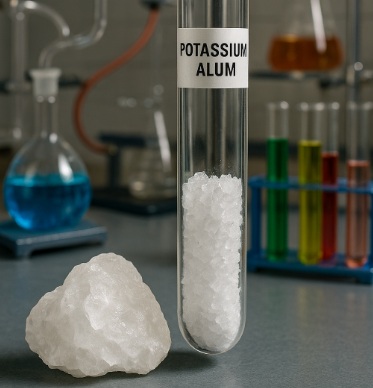
Potassium alum
Rating : 5
| Evaluation | N. Experts | Evaluation | N. Experts |
|---|---|---|---|
| 1 | 6 | ||
| 2 | 7 | ||
| 3 | 8 | ||
| 4 | 9 | ||
| 5 | 10 |
Cons:
Possible risk. Click ingredient (1)0 pts from admin
| Sign up to vote this object, vote his reviews and to contribute to Tiiips.Evaluate | Where is this found? |
| "Descrizione" about Potassium alum by admin (19545 pt) | 2025-Nov-19 12:28 |
| Read the full Tiiip | (Send your comment) |
(Food-grade Potassium Alum / Potassium Aluminium Sulfate dodecahydrate, KAl(SO₄)₂·12H₂O)
Alum is a crystalline inorganic salt known chemically as potassium aluminium sulfate dodecahydrate.
In the food industry it is used for its firming, pH-adjusting, and stabilizing properties.
It appears as white, odorless, transparent crystals with an astringent and slightly acidic taste.
Commonly used in pickling, baking powders, and specialty food applications that require controlled acidity or firming action.

(Alum is a mineral salt; it provides no calories or macronutrients.)
Energy: 0 kcal
Proteins: 0 g
Carbohydrates: 0 g
Sugars: 0 g
Lipids: 0 g
Fiber: 0 g
Sodium: 0 g (not a sodium salt)
Minerals: contains potassium, aluminium, sulfate
Potassium aluminium sulfate dodecahydrate – the functional compound.
Ions released in solution: potassium (K⁺), aluminium (Al³⁺), sulfate (SO₄²⁻).
Water of crystallization: 12 molecules of water bound in the crystal structure.
Raw materials: potassium sulfate and aluminium sulfate.
Dissolution: both salts are dissolved in hot water to obtain a supersaturated solution.
Crystallization: controlled cooling allows alum crystals to form.
Purification: recrystallization may be applied to improve purity for food-grade use.
Drying & sizing: excess water is removed, and crystals are ground to the desired particle size.
Quality control: purity, solubility, heavy metals, pH, and microbiological safety according to GMP/HACCP and food-additive standards.
Appearance: white, transparent crystals or fine powder.
Odor: odorless.
Taste: astringent, slightly acidic.
Solubility: soluble in hot water; moderately soluble in cold water.
pH (in solution): mildly acidic.
Melting point: decomposes before melting.
Stability: stable when dry; hygroscopic in humid environments.
Astringency: provides tightening/firming sensation in pickled products.
Acidity control: releases aluminum ions that mildly acidify the solution.
Firming action: strengthens pectin structure in fruits and vegetables.
Leavening role: historically used in baking powders as an acid component.
Color stabilization: helps stabilize natural pigments in some pickled foods.
Pickling: firming agent for cucumbers, gherkins, fruit pickles.
Fruit and vegetable processing: improves firmness during heat processing.
Baking powders: acidulant in double-acting leavening systems (less common today).
Food color preparations: stabilizer for certain natural colors.
Specialty uses: clarifying agent in some traditional beverages.
Alum is not nutritionally relevant, as it provides no macronutrients or calories.
Historically used safely at low concentrations in pickling and baking.
Excessive intake is not recommended due to the aluminium content.
Aluminium absorption from alum is low but may be of concern in vulnerable populations; dosage should follow food-regulation limits.
Not intended for direct consumption in significant quantities; always used sparingly as a processing aid.
Typical food-use levels:
Pickling: 0.1–0.3% in brine solution.
Baking powders: regulated minimal levels depending on formula.
Not consumed as a stand-alone ingredient.
Alum is not an allergen.
Does not contain gluten, lactose, soy, nuts, or other common allergens.
Rare cases of hypersensitivity to aluminium salts are possible in sensitive individuals.
Check for purity to avoid cross-contaminants from industrial production.
Shelf-life: typically 36–60 months if stored correctly.
Storage conditions:
keep in tightly sealed containers
protect from humidity (hygroscopic product)
store in a cool, dry environment
Exposure to moisture can lead to clumping or dissolution.
Food-grade alum is regulated as a food additive, often listed as:
E522 – Aluminium potassium sulfate
Must comply with limits for aluminium intake established by food safety authorities.
Production must follow GMP/HACCP standards.
Use levels are restricted depending on the food category (e.g., pickles, leavening agents, color stabilizers).
Safety controls include:
heavy metals (especially aluminium, lead, arsenic)
purity and solubility tests
absence of insoluble residues
Can be declared as:
“potassium alum”
“potassium aluminium sulfate”
“alum (E522)”
When used as a processing aid, labeling may depend on local regulations.
If used in pickling or baking, it must appear in the ingredients list when contributing to the final product.
Soft pickles despite alum use:
excessive processing temperature or insufficient concentration
recommendation: ensure correct brine acidity, add calcium salts if needed
Cloudy brine:
impurities or reaction with minerals in water
use purified water and food-grade alum
Undesired metallic or astringent taste:
overdosing; reduce alum concentration
Clumping during storage:
moisture exposure; improve packaging or incorporate drying packets
Production involves mineral extraction and chemical processing; sustainability depends on responsible sourcing of raw materials.
Effluents from crystallization processes should be monitored for BOD/COD and treated to reduce sulfate load.
Energy-efficient crystallization and water-recirculation systems can reduce environmental impact.
Packaging typically recyclable; product is stable and generates little waste.
(When used as “Potassium Alum” or “Alum” in cosmetics)
Deodorant active (inhibits bacterial growth).
Antiperspirant functionality (mild).
Skin-conditioning and toning properties.
Used in deodorant stones, aftershaves, and soothing gels.
CAS: 10043-67-1 7784-24-9 EC number 233-141-3
Alum is a versatile inorganic ingredient used in food processing for its firming, acidifying, and stabilizing capabilities. Although now less common than other modern additives, it remains important in traditional pickling, fruit preservation, and certain baking applications. When used within regulated limits, alum is safe and effective, offering texture enhancement and color stability. Correct handling, dosage, and high purity are essential to ensure product quality and consumer safety.
GMP/HACCP – Good Manufacturing Practices / Hazard Analysis and Critical Control Points: systems ensuring food safety, hygiene, and traceability.
BOD/COD – Biological oxygen demand / chemical oxygen demand: indicators for evaluating wastewater impact.
E522 – Additive code for potassium aluminium sulfate used as a firming agent or acidity regulator.
Studies
EFSA's Scientific Panel on Food Additives provided a scientific opinion reviewing the safety of aluminium sulphates (E520-523) and sodium aluminium phosphate, acid (E541) as food additives and concluded that there is no concern regarding genotoxicity and carcinogenicity. The Panel concluded that aluminium sulphates (E520-523) and sodium aluminium phosphate, acid (E541) are of no safety concern in current authorised uses and use levels (2).
However, the risk of cumulative intake of aluminium, which may pose a danger to human health, cannot be excluded as this ingredient can be found in widely consumed food products such as bread, various bakery products (1).
![]() | ![]() |
![]() | ![]() |
References_____________________________________________________________________
(1) Wong, W.W., Chung, S.W., Kwong, K.P., Yin Ho, Y. and Xiao, Y., 2010. Dietary exposure to aluminium of the Hong Kong population. Food Additives and Contaminants, 27(4), pp.457-463.
Abstract. A total of 256 individual food samples were collected in Hong Kong for aluminium testing. Most of food samples were analysed in ready-to-eat form. High aluminium levels were found in steamed bread/bun/cake (mean: 100-320 mg kg(-1)), some bakery products such as muffin, pancake/waffle, coconut tart and cake (mean: 250, 160, 120 and 91 mg kg(-1), respectively), and jellyfish (ready-to-eat form) (mean: 1200 mg kg(-1)). The results demonstrated that aluminium-containing food additives have been widely used in these food products. The average dietary exposure to aluminium for a 60 kg adult was estimated to be 0.60 mg kg(-1) bw week(-1), which amounted to 60% of the new PTWI established by JECFA. The main dietary source was "steamed bread/bun/cake", which contributed to 60% of the total exposure, followed by "bakery products" and "jellyfish", which contributed to 23 and 10% of the total exposure, respectively. However, the estimation did not include the intake of aluminium from natural food sources, food contact materials or other sources (e.g. drinking water). Although the results indicated that aluminium it is unlikely to cause adverse health effect for the general population, the risk to some populations who regularly consume foods with aluminium-containing food additives cannot be ruled out.
Tietz T, Lenzner A, Kolbaum AE, Zellmer S, Riebeling C, Gürtler R, Jung C, Kappenstein O, Tentschert J, Giulbudagian M, Merkel S, Pirow R, Lindtner O, Tralau T, Schäfer B, Laux P, Greiner M, Lampen A, Luch A, Wittkowski R, Hensel A. Aggregated aluminium exposure: risk assessment for the general population. Arch Toxicol. 2019 Dec;93(12):3503-3521. doi: 10.1007/s00204-019-02599-z.
Abstract. Aluminium is one of the most abundant elements in earth's crust and its manifold uses result in an exposure of the population from many sources. Developmental toxicity, effects on the urinary tract and neurotoxicity are known effects of aluminium and its compounds. Here, we assessed the health risks resulting from total consumer exposure towards aluminium and various aluminium compounds, including contributions from foodstuffs, food additives, food contact materials (FCM), and cosmetic products. For the estimation of aluminium contents in foodstuff, data from the German "Pilot-Total-Diet-Study" were used, which was conducted as part of the European TDS-Exposure project. These were combined with consumption data from the German National Consumption Survey II to yield aluminium exposure via food for adults. It was found that the average weekly aluminium exposure resulting from food intake amounts to approx. 50% of the tolerable weekly intake (TWI) of 1 mg/kg body weight (bw)/week, derived by the European Food Safety Authority (EFSA). For children, data from the French "Infant Total Diet Study" and the "Second French Total Diet Study" were used to estimate aluminium exposure via food. As a result, the TWI can be exhausted or slightly exceeded-particularly for infants who are not exclusively breastfed and young children relying on specially adapted diets (e.g. soy-based, lactose free, hypoallergenic). When taking into account the overall aluminium exposure from foods, cosmetic products (cosmetics), pharmaceuticals and FCM from uncoated aluminium, a significant exceedance of the EFSA-derived TWI and even the PTWI of 2 mg/kg bw/week, derived by the Joint FAO/WHO Expert Committee on Food Additives, may occur. Specifically, high exposure levels were found for adolescents aged 11-14 years. Although exposure data were collected with special regard to the German population, it is also representative for European and comparable to international consumers. From a toxicological point of view, regular exceedance of the lifetime tolerable aluminium intake (TWI/PTWI) is undesirable, since this results in an increased risk for health impairments. Consequently, recommendations on how to reduce overall aluminium exposure are given.
Li G, Zhao X, Wu S, Hua H, Wang Q, Zhang Z. Dietary exposure to aluminium in the popular Chinese fried bread youtiao. Food Addit Contam Part A Chem Anal Control Expo Risk Assess. 2017 Jun;34(6):972-979. doi: 10.1080/19440049.2017.1306757.
Abstract. Youtiao is a typical, traditional and widely consumed fried food in China. Fermentation of youtiao involves the use of aluminium potassium sulphate (alum). There are health concerns related to the levels of aluminium in food; therefore, we aimed to determine the aluminium concentrations of youtiao from various locations, and to estimate the dietary exposure by different age groups in southern and northern China. The aluminium content of youtiao samples varied considerably (range = 4.46-852.69 mg kg-1). Both the mean and median aluminium contents of youtiao exceeded 100 mg kg-1, which is the China National Standard (GB) 2760-2014 National Food Safety for Standards for food additives. However, the median and 97.5th percentile of weekly dietary exposure to aluminium from youtiao, estimated using Monte Carlo simulation, did not exceed the provisional tolerable weekly intake (PTWI) set by the joint FAO/WHO Expert Committee on Food Additives (JECFA) for children, adolescents, adults and seniors. The weekly dietary exposure to aluminium would exceed the PTWI if children, adolescents, adults and seniors consumed 134.47, 260.98, 327.10 or 320.41 g of youtiao per week, respectively.
(2) EFSA Panel on Food Additives and Nutrient Sources added to Food (ANS); Younes M, Aggett P, Aguilar F, Crebelli R, Dusemund B, Filipič M, Frutos MJ, Galtier P, Gott D, Gundert-Remy U, Kuhnle GG, Lambré C, Leblanc JC, Lillegaard IT, Moldeus P, Mortensen A, Oskarsson A, Stankovic I, Waalkens-Berendsen I, Wright M, Di Domenico A, van Loveren H, Giarola A, Horvath Z, Lodi F, Tard A, Woutersen RA. Re-evaluation of aluminium sulphates (E 520-523) and sodium aluminium phosphate (E 541) as food additives. EFSA J. 2018 Jul 27;16(7):e05372. doi: 10.2903/j.efsa.2018.5372.
| Sign up to vote this object, vote his reviews and to contribute to Tiiips.EvaluateClose | (0 comments) |
Read other Tiiips about this object in __Italiano (1)
Component type:   Main substances:   Last update:   2022-12-18 12:00:00 | Chemical Risk:   |

